Electrifying Rivalry Reloaded: Tactical Breakdown & Key Battles in Man Utd vs Liverpool
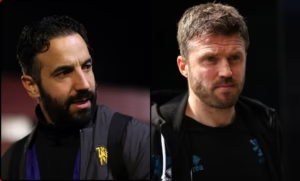
In this Man Utd vs Liverpool tactical breakdown, two footballing philosophies collide — Rúben Amorim’s disciplined structure versus Arne Slot’s fluid control. Every movement, press, and transition tells a story of evolution in England’s fiercest rivalry.
From the first whistle, a Man Utd vs Liverpool tactical breakdown is always a spectacle: two clubs with rich history, contrasting strengths, and managers who are trying to imprint identity. In this chapter of the rivalry, Manchester United under Rúben Amorim come to the contest with a renewed approach rooted in a high-press, wing-back width, and vertical transitions, while Liverpool under Arne Slot bring continuity of possession, subtle positional shifts, and a focus on half-space overloads. It’s more than a Northwest derby; it’s a calibration of style, temperament and tactical nuance that will decide who controls the game.
Amorim’s Manchester United: Identity, Formation, and Philosophy.
Rúben Amorim arrived at United in November 2024 hoping to correct course after periods of indecision. His tactical DNA at Sporting CP and early signals at Manchester United show a preference for a 3-4-3 or 3-4-2-1 base system. The back three provide defensive solidity but also allow one of the centre-backs (often the central one) to step into midfield during build-up. Wing-backs push high, giving width and stretching opposition defensive lines. Sky Sports+3Attacking Football+3Total Football Analysis+3
In possession, Amorim’s United aim to use short passing, patient build up from the back, and controlled movement to invite the opponent pressing. As the opposition commits, United look to exploit space — sometimes directly, sometimes via overlap or diagonal switching of play. Many attacking phases are constructed via the wing-backs, who are essential both for width and for overloads. Bruno Fernandes, Kobbie Mainoo, or Manuel Ugarte form the deeper midfield layer; creative players and inside forwards or wide attackers drift or interchange to pull defenders out of their zones.
Without the ball, United under Amorim press relatively high in certain phases, especially to force turnovers just outside their own box or along the halfway line. But the pressing is selective: triggers include poor touches, backward passes, or predictable build-up from the opponent. The team is organized to drop into shapes (5-2-3 or 5-4-1) when necessary, protect the central areas, force play wide, and deny penetration through the middle. MUWS – Manchester United News+2Attacking Football+2
Liverpool under Arne Slot: Continuity, Adaptation, and Key Strengths
On the other side, Liverpool under Arne Slot have maintained much of the possession-based groundwork laid previously, but with nuanced changes. Slot’s team still seeks dominance of the ball, but is less frantic in pressing than under some past Liverpool managers. The high press exists, but Slot is more measured, using pressing triggers and situational pressing rather than constant intensity. Liverpool News 247+2Total Football Analysis+2
A major strength for Liverpool has been their midfield. Ryan Gravenberch has risen under Slot, especially in his ability to intercept and recover quickly. The double-pivot has become more reliable in shielding the back-line and allowing more creative midfielders to link with attack. As Liverpool simplified some of their attacking structure (for example, fitting into 4-2-3-1 more frequently), they have balanced risk and reward more carefully. Liverpool News 247+2Total Football Analysis+2
Slot’s wide players and full-backs are a tactical weapon. While full-backs are less insistently overlapping as in past Liverpool eras, there is still rotational movement: wingers may invert, inside forwards shift, central midfielders drift. The use of half-spaces is central to Liverpool’s attack — creating pockets between lines where the ball can be played into attackers or disciplined runners can exploit for shots. Total Football Analysis+1
Key Tactical Battles in this Man Utd vs Liverpool Tactical Breakdown
When these two teams meet, several internal battles will decide how the game flows.
First, the midfield battle: Amorim’s deeper midfielders versus Liverpool’s creatives. If United’s pivot (one or two defensive mids) can prevent passes between the lines, anticipate movements, cut off diagonal passes, and force Liverpool to work wide, they frustrate Liverpool’s attack. If on the other hand, Liverpool manage to draw those midfielders out of position — via switching play, dragging them into wide zones, or quick one-twos — they open channels for inside forwards or overlapping full-backs to exploit.
Second, the flank contests. United’s wing-backs will need to balance attack and cover; their decision-making when to surge forward vs when to tuck back will be key. Liverpool’s wide attacking players will try to create overloads, exploit mismatches, and make combinations with full-backs. Whoever wins the 1v1s or controls secondary balls on the wings will shape the width and thus how compact or stretched the defensive block becomes.
Third, transitions. Both teams are dangerous in turnovers. United want to counter quickly, ideally with vertical passes or diagonal switches when Liverpool commit bodies forward. Liverpool, similarly, will attempt counter-press to recover possession and break before United can reset shape. How well each side deals with losing the ball, how quickly they regroup, and their ability to exploit space during these transitions could define the match more than steady possession phases.
Formation Dynamics & Tactical Scenarios
In a typical Man Utd vs Liverpool tactical breakdown scenario, you might see United start with a 3-4-3, wing-backs high, midfield with a double pivot that provides base stability. During attacking spells, the formation shifts; the central centre-back may join the midfield to create a temporary 3-2-5 shape, with the wing-backs stretched high, inside forwards or wide attackers tucking or drifting inside, in search of half-spaces. The attacking phase could be punishing if United force Liverpool’s full-backs backward and isolate them, or overload one side to open up the weak side via switch of play.
Liverpool, facing that, would aim to retain their structure: use a 4-2-3-1 base to maintain balance, full-backs supportive but not overcommitting unless the opportunity arises, midfielders (deep pivot + No.8) moving to support attack, inside forwards drifting, and forward runs timed to exploit the spaces left by United’s advancing wing-backs.
In defense, United may shift into a five-back (wing-backs drop) shape when Liverpool have sustained possession inside their third, or when full-backs are exposed. Pressure would be applied selectively by forwards or midfielders, particularly in wide areas or when Liverpool attempt to play through the back. Liverpool likewise will change between pressing high (when United are in build from back under pressure) and sitting deeper (when United look more direct or dangerous) to protect space between defensive and midfield lines.
Current Challenges, Form & Marginal Weaknesses
United under Amorim have shown ambition, philosophy, and flashes of tactical coherence, but they are not without problems. The biggest issues include consistency, defensive transitions when caught high up, and sometimes lacking potency in final third if the width or support from wing-backs is not sufficient. There have been critiques about being too rigid in formation, especially when the opposition forces change. Societies of pundits question whether United have enough speed and movement behind the striker(s), and whether the midfield has enough depth or mobility to cover both defensive and offensive transitions. Sources point out that while the possession is improving, conversions into high-chance scoring opportunities remain less than desired. The Guardian+1
Liverpool have been more stable lately, but their model under Slot has its own edges. Pressing is less frequent and less aggressive than under past regimes, meaning that sometimes United or other teams have found room to build, especially if Liverpool are not sharp in their triggers. Also, full-back rotations and positional interchanges sometimes leave gaps that can be exposed, particularly behind advanced full-backs. Additionally, there have been recent concerns about defending set-pieces, and about integrating new players (in attacking or midfield zones) still adjusting to Slot’s patterns. Talksport+1
How this match might play out
Given all these tactical shapes, battles, and current form, one might expect a tight and competitive clash. Manchester United will likely try to impose their rhythm early: build from the back, try to press when possible, use wing-backs to stretch Liverpool, aim to exploit half-spaces, and look for quick transitions once possession is won. Liverpool will aim to absorb, keep possession, build through midfield triangles, and exploit United when the wing-backs are caught high or when United commit numbers forward.
The first 20-30 minutes may reveal who controls the midfield. If Gravenberch, Mac Allister and the Liverpool pivot dominate, United will be under pressure; if United’s double-pivot (Ugarte, Mainoo or similar) manage to disrupt those midfield passing lanes, United could offset Liverpool’s fluid attacking structure.
Set pieces and turnovers may decide this one. In a match where both teams are trying to be composed, the small errors — throw-ins, second ball losses, momentary lapses in marking — will potentially be decisive. The wide duels, particularly on the wings where full-backs overlap or inside forwards drift, could swing control of width, which in turn affects how compact or stretched the opposing defensive lines become.
Final Reflections
A Man Utd vs Liverpool tactical breakdown is always more than theory — it’s about execution, timing, discipline, and where players withstand pressure. Amorim brings clarity, a defined system, and the chance for United to evolve. Slot brings experience, subtlety, and positional intelligence at Liverpool. Whoever adapts better, realises their strength and covers their weak points, will emerge ahead.
About The Author