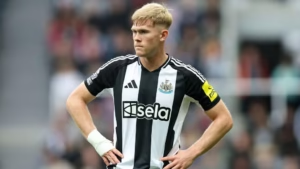
Frustrations on the Fringes: Kobbie Mainoo and Joshua Zirkzee’s Struggles Under Rúben Amorim at Manchester United
Mainoo and Zirkzee are rotting on United’s bench under Amorim. History shows talented kids who wait too long simply leave.
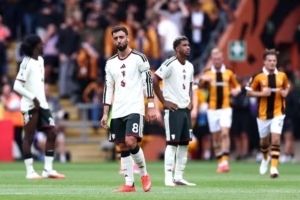
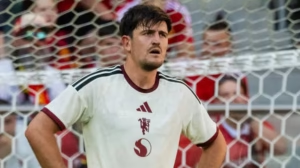
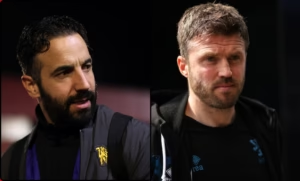
Manchester United’s transition under Rúben Amorim has been marked by tactical reinvention and pragmatic squad-building, but it has also exposed fault lines in the club’s youth development pipeline. As of November 2025, two of the club’s most promising young talents—midfielder Kobbie Mainoo and forward Joshua Zirkzee—are grappling with profound frustrations over their diminished roles. Mainoo, the 20-year-old English prodigy who dazzled during the 2023/24 season, and Zirkzee, the 24-year-old Dutch international signed for £36.5 million from Bologna last summer, have been relegated to the periphery of Amorim’s plans. Their limited minutes—totaling just 138 and 82 in the Premier League respectively—have sparked whispers of January exits, with the 2026 World Cup looming as a stark deadline for career-defining decisions. This analysis delves into the tactical underpinnings of their sidelining, dissects their playing time disparities across competitions, evaluates the broader implications for United’s squad management, draws historical parallels to past academy casualties, and assesses the potential fallout from departures. It culminates in a strategic blueprint for reconciling youth nurturing with the unrelenting demands of elite performance.
The Tactical Straitjacket: Why Amorim’s System Sidelines Mainoo and Zirkzee
Amorim’s arrival at Old Trafford in late 2024 heralded a shift to a high-intensity 3-4-2-1 formation, inspired by his triumphant Sporting CP tenure. This setup demands relentless pressing, fluid rotations between wing-backs and attacking midfielders, and a robust midfield pivot to shield a back three. It’s a system predicated on physical dominance and tactical discipline—qualities that have stabilized United’s defense but at the expense of creative flair from younger profiles.
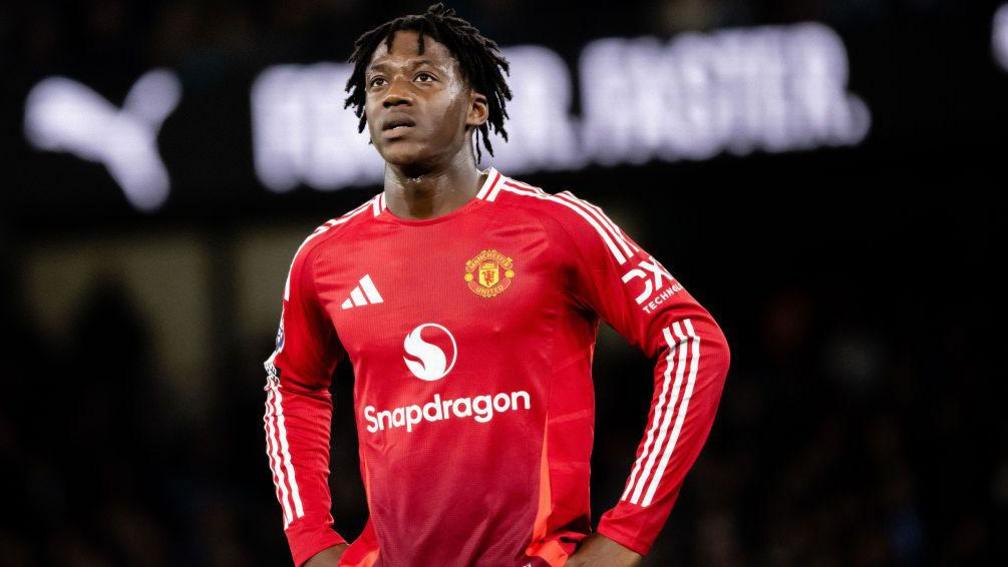
For Mainoo, the issue is positional mismatch. The Stockport-born midfielder thrives as a box-to-box No. 8, blending progressive passing (88th percentile in the Premier League last season per FBref) with intelligent late arrivals into the box. Yet Amorim favors a deeper, more destructive pivot featuring Manuel Ugarte and Casemiro, who provide the “stability” Amorim craves amid United’s midfield frailties. Ugarte, signed from PSG for £50 million, embodies Amorim’s ideal: a tenacious ball-winner who averages 3.2 tackles per 90 minutes but lacks Mainoo’s 1.8 key passes. Bruno Fernandes, the undroppable captain, occupies the advanced No. 10 slot, leaving Mainoo competing for scraps in a system that prioritizes experience over experimentation. Amorim has admitted the lack of European fixtures hampers rotation: “With one game a week, it’s really hard” to integrate youngsters like Mainoo without risking results. Critics, including journalist Alex Crook, label this “criminal underuse,” arguing Mainoo’s composure—evident in his Euro 2024 final start for England—makes him a stylistic fit for Amorim’s “pausa” (pausing play to reset) philosophy, yet he’s been overlooked in favor of veterans.
Zirkzee’s predicament is equally tactical. The towering forward, known for his link-up play and hold-up ability (he ranked in the 92nd percentile for progressive carries at Bologna), was envisioned as a versatile No. 9/10 under Erik Ten Hag. However, Amorim’s rigid front line—centered on Benjamin Šeško’s aerial prowess and Matheus Cunha’s pressing intensity—demands a “clinical No. 9” with raw physicality. Amorim has publicly critiqued Zirkzee’s “lack of strength” and selfishness in the box, noting only 11 shots on target last season and urging him to emulate Cunha’s between-the-lines menace. With wing-backs like Bryan Mbeumo and Amad Diallo providing width, Zirkzee’s drop-deep tendencies clash with Amorim’s direct long-ball build-up, which relies on a focal point to pin defenses. The result? Zirkzee has been typecast as a bench option for “situations beyond control,” per reports, his flair stifled in a setup that values proven Premier League grinders over unpolished potential.
These choices reflect Amorim’s short-termism: United’s 10th-place start to 2025/26 (five wins, three draws, three losses) has amplified pressure for results, sidelining youth in favor of stability. Yet, as X users lament, this risks alienating homegrown stars like Mainoo, echoing fan cries of “bench Fernandes… play Kobbie.”
Dissecting the Minutes: A Stark Comparative Table
To quantify the disparity, consider the players’ involvement across competitions up to November 23, 2025. United’s schedule—devoid of Europe after last season’s Europa League loss—has meant fewer rotation opportunities, exacerbating the issue. The table below compares Mainoo and Zirkzee’s minutes to key competitors, highlighting Amorim’s preferences.
| Player | Premier League (Apps/Mins) | FA Cup (Apps/Mins) | EFL Cup (Apps/Mins) | Total Mins (% of Available) | Notes |
|---|---|---|---|---|---|
| Kobbie Mainoo | 7 subs / 138 mins | 0 / 0 | 1 start / 90 mins | 228 (14%) | Only PL start denied; blocked summer loan. |
| Joshua Zirkzee | 4 subs / 82 mins | 0 / 0 | 0 / 0 | 82 (5%) | Unused sub 7x; no starts all comps. |
| Bruno Fernandes (Mainoo rival) | 11 starts / 990 mins | 1 start / 90 | 1 start / 90 | 1,170 (95%) | Undroppable No. 10. |
| Casemiro (Mainoo rival) | 9 starts / 765 mins | 1 sub / 45 | 0 / 0 | 810 (75%) | Pivot staple despite age (33). |
| Benjamin Šeško (Zirkzee rival) | 10 starts / 850 mins | 1 start / 90 | 1 start / 90 | 1,030 (90%) | Injury opens door for Zirkzee. |
| Matheus Cunha (Zirkzee rival) | 8 starts / 680 mins | 0 / 0 | 1 sub / 30 | 710 (65%) | Pressing fit for Amorim’s system. |
Data sourced from Premier League and Transfermarkt stats up to Matchweek 12. Mainoo’s 14% utilization pales against Fernandes’ near-total involvement, while Zirkzee’s 5% underscores his redundancy behind Šeško. In the EFL Cup—United’s sole cup run before a shock Grimsby exit—Mainoo started once (90 minutes), but Zirkzee was absent entirely. This uneven distribution isn’t mere rotation oversight; it’s systemic, with veterans logging 70-95% of minutes in a congested fixture list that still feels sparse without continental commitments.
Squad Management Under Scrutiny: Stifling Youth Development?
United’s post-Ferguson era has been a cautionary tale of squad bloat and integration failures. INEOS’s oversight since 2024 has injected £250 million into transfers, yet the academy—once a Ferguson hallmark—feels adrift. Amorim’s “club comes first” mantra, reiterated ahead of the Everton clash, prioritizes results over development, blocking Mainoo’s summer loan plea despite his 73 Premier League minutes by September. Zirkzee, too, has been “frustrated and confused” by role ambiguity, his professionalism praised but opportunities withheld.
This approach harms young talents profoundly. Mainoo’s England exile—omitted from Thomas Tuchel’s November squad—stems directly from his bench role, jeopardizing his World Cup dreams. Zirkzee’s Netherlands snub under Ronald Koeman echoes this, with just six caps and one goal since his 2024 debut. Psychologically, the toll is evident: Mainoo’s “waiting and seeing” contract stance signals doubt, while Zirkzee’s “miserable” demeanor risks burnout. Broader squad dynamics suffer too; X discourse rails against Amorim’s “hypocrisy” in praising academy ethics while underusing Mainoo. United’s 30-man squad—bloated post-summer signings—exacerbates this, with talents like Amad Diallo thriving briefly before AFCON duties highlight depth issues. Ultimately, this management style erodes the club’s DNA: Ferguson integrated 25 academy players; Amorim risks none.
Echoes of the Past: Historical Parallels in Poor Integration
Manchester United’s history is littered with cautionary tales of squandered youth. The Class of ’92 succeeded through patient integration, but post-Ferguson, frustration-fueled exits became rife. Wilfried Zaha, a 2013 wonderkid, featured sporadically under David Moyes before loans and a £15 million Palace return; he later admitted the “pressure” stunted him. Adnan Januzaj, hailed as the “new Ronaldo” in 2013, amassed 63 appearances but zero goals in his breakout season, only to flounder amid tactical shifts and depart for Sociedad in 2017—now a journeyman at 30.
Ravel Morrison’s arc is more tragic: a 2010 prodigy with “time and space” Ferguson envied, he tallied 10 youth goals in a season but battled discipline issues and limited minutes (three senior apps). Loans to West Ham yielded promise, but off-field woes led to a 2023 release; at 32, he’s unattached. Angelo Henriquez, the “Chilean Messi” signed in 2012, scored prolifically in reserves but netted once in 10 senior outings before a Leverkusen exit in 2015—now at Universidad de Chile. Even Javier “Chicharito” Hernandez, arriving as a 2010 prospect, scored 26 goals in 2010/11 but was loaned amid Jose Mourinho’s preferences, departing permanently in 2015; his career peaked retrospectively at United.
These parallels to Mainoo (Zaha-like positional battles) and Zirkzee (Henriquez’s bench exile) underscore a pattern: rushed integration or outright neglect breeds regret. As X user @XavioMtl notes, “History repeats itself” with Mainoo’s sidelining. United recouped fees (Zaha £15m, Januzaj free) but lost legacies, a £100 million+ opportunity cost in today’s market.
Long-Term Consequences: The Cost of Potential Exits
If Mainoo or Zirkzee force moves—Napoli eyes Mainoo in a McTominay swap ,if possible, Roma covets Zirkzee—the repercussions could scar United for a generation. Financially, Mainoo’s homegrown status offers pure profit (valued at £44 million), but offloading a £0 acquisition for £40 million pales against his projected £100 million peak by 2028. Zirkzee’s £36.5 million fee could halve to £18 million amid his slump, per reports, inflating Amorim’s summer spend.
Reputationally, exits would tarnish United’s youth allure. Mainoo’s departure—after Euro 2024 heroics—signals to prospects like Harry Amass that Old Trafford benches are career graveyards, deterring talents amid FFP constraints. Zirkzee’s Serie A return revives his World Cup shot but exposes Amorim’s inflexibility, inviting scrutiny on his £10 million-a-year salary. On-pitch, midfield creativity dips without Mainoo’s vision, while attack lacks Zirkzee’s link-up—exacerbated by Šeško’s injury and AFCON absences. Long-term, this erodes squad cohesion; as Gullit critiqued Zirkzee’s “wrong decision” joining United, it perpetuates a cycle of high-profile flops. World Cup fallout looms: Mainoo’s absence from Tuchel’s plans mirrors Zaha’s international wilderness, stunting national team pipelines.
Strategic Recommendation: A Balanced Blueprint for Renewal
To avert catastrophe, United must pivot toward a hybrid model: tactical flexibility fused with structured youth pathways. First, Amorim should adapt his 3-4-2-1 for midweek “academy nights,” mandating 30% youth minutes in cups—echoing Ferguson’s EFL rotations that launched the Class of ’92. Loan Mainoo selectively (e.g., to Leeds for Championship exposure) only post-replacement signing, like João Neves (£60 million target) for midfield depth. For Zirkzee, reposition him as a Cunha hybrid in the No. 10, leveraging his 1.2 dribbles per 90 to complement Šeško—Amorim’s “selfishness” critique demands coaching, not benching.
INEOS should enforce a “Ferguson Clause”: 20% of starts for under-23s, monitored quarterly, with performance tied to transfer budgets. Invest in analytics for positional fits—e.g., Mainoo’s heatmaps scream No. 8—and foster mental resilience via sports psychologists, addressing media hype Amorim flags. Finally, target European qualification via pragmatic January buys (e.g., Gallagher loan for Mainoo cover), unlocking rotation. This balances pressure with potential: United’s identity thrives on youth alchemy, not veteran crutches. Implement now, or risk Mainoo and Zirkzee as footnotes in a fading legacy.
About The Author