Manchester United vs Crystal Palace 2-1: In-Depth Match Analysis, Tactical Breakdown, and Key Insights from Premier League Clash
Set-piece salvation saved United again, but the first-half horror show proves consistency remains their biggest enemy.
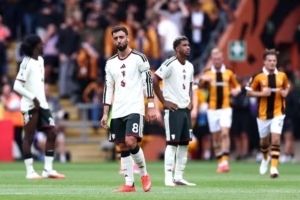
In the high-octane world of the Premier League, where every fixture can reshape the standings, Manchester United’s 2-1 comeback victory over Crystal Palace on November 30, 2025, at Selhurst Park stands as a testament to resilience amid ongoing challenges. Trailing after Jean-Philippe Mateta’s first-half penalty, United mounted a second-half revival with goals from Joshua Zirkzee and Mason Mount, both masterminded from set pieces by Bruno Fernandes. This result propelled United to sixth in the Premier League table, ending a five-year winless streak at Selhurst Park and snapping Palace’s nine-month unbeaten home run in the league. As a united fan, I’ll deliver a brutally honest, expert-level dissection of this Manchester United vs Crystal Palace match, highlighting tactical decisions, pivotal moments, standout and subpar performances, and the broader implications for United’s season. Was this a sign of genuine progress under Ruben Amorim, or just another fleeting spark in a campaign plagued by inconsistency?
Tactical Setup: Amorim’s 3-4-3 vs Glasner’s Aggressive Press
Manchester united Ruben Amorim stuck faithfully to his preferred 3-4-3 formation, deploying Senne Lammens in goal behind a back three of Leny Yoro, Matthijs De Ligt, and Luke Shaw. The midfield quartet featured Amad Diallo and Diogo Dalot as wing-backs, with Casemiro and Bruno Fernandes providing central balance. Up front, Bryan Mbeumo, Mason Mount, and Joshua Zirkzee formed a fluid attacking trio aimed at exploiting transitions. This setup sought defensive solidity while enabling quick counters, but it faltered against Palace’s high-pressing 3-4-3 under Oliver Glasner.
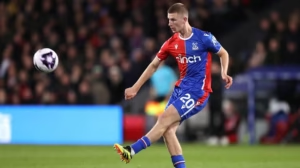
Palace lined up with Dean Henderson in goal, a defensive unit of Chris Richards, Maxence Lacroix, and captain Marc Guéhi, midfielders Daniel Muñoz, Adam Wharton, Daichi Kamada, and Tyrick Mitchell, and forwards Ismaila Sarr, Yeremy Pino, and Mateta. Glasner’s tactics emphasized aggressive pressing and rapid flank attacks, targeting United’s build-up play. In the first half, this approach paid dividends, with Palace dominating duels (56% won) and forcing errors. United’s pressing was lackluster, with a PPDA (passes per defensive action) of 13.2—well above their season average of 10.8—allowing Wharton and Kamada to dictate tempo.
Palace’s strategy exposed United’s vulnerabilities, particularly on the left where Shaw was repeatedly tested. The hosts generated 1.12 xG in the opening period compared to United’s 0.18, underscoring a tactical mismatch that left Amorim’s side passive and disjointed.
First-Half Struggles: Defensive Lapses and Missed Opportunities
The opening 45 minutes encapsulated Manchester United’s seasonal inconsistencies, with a bright start giving way to defensive frailty. Just 43 seconds in, Casemiro nearly scored from Dalot’s long throw but scuffed wide—a missed chance that set the tone for United’s inefficiency. Palace capitalized, with Wharton’s half-volley testing Lammens and Mateta squandering a golden opportunity after Yoro’s errant pass.
The defining moment came in the 36th minute: Wharton threaded a precise pass to Mateta, who was fouled by Yoro in the box. Mateta’s initial penalty was retaken due to an accidental double touch—per IFAB’s 2025 rule allowing retakes for such infringements—and he slotted the second into the bottom left past Lammens. This goal, Mateta’s seventh successful penalty of the season, highlighted United’s transitional weaknesses, as they conceded first for the eighth time in 13 games.
United mustered little threat, with Fernandes isolated (68% pass accuracy) and Zirkzee winning just 2 of 7 duels. Palace’s 58% first-half possession and 9-3 shot advantage painted a picture of dominance, forcing Amorim into halftime introspection. Post-match, Amorim noted the need for “higher intensity and better second-ball recovery,” signaling subtle tweaks without overhauling the system.
Key Turning Points: Second-Half Revival and Set-Piece Mastery
Halftime proved transformative, with Amorim’s adjustments ramping up United’s pressing (PPDA dropping to 8.4) and injecting urgency. No immediate subs, but the introduction of Noussair Mazraoui for Yoro in the 54th minute added composure on the right, allowing Dalot to push forward.
The equalizer arrived swiftly: Fernandes’ bouncing free-kick was chested down by Zirkzee, who swiveled past Kamada and rifled a low shot from a tight angle past Henderson—ending a 364-day Premier League goal drought (last vs. Everton on December 1, 2024). This moment shifted momentum, with United’s xG surging to 1.38 post-interval.
Nine minutes later, another Fernandes set piece—a clever tap—found Mount, who curled a 20-yard strike low into the corner through a disorganized Palace wall. These goals flipped the script, limiting Palace to 0.28 xG after the break amid fatigue from their midweek Conference League loss to Strasbourg—their fourth defeat following European fixtures this season.

Late Palace subs (Hughes for Wharton, Uche for Pino in 78′; Lerma for Kamada, Devenny for Mitchell in 85′) aimed to rally, but United’s changes—Lisandro Martinez for Shaw (82′), Patrick Dorgu for Amad and Kobbie Mainoo for Mbeumo (90+1′)—bolstered resilience. Key blocks from Shaw (denying Nketiah) and De Ligt preserved the lead, marking a tactical win for Amorim’s adaptability.
Individual Performances: Standouts, Strugglers, and Game-Changers
Player evaluations reveal a tale of two halves, with flashes of brilliance masking underlying issues.
Manchester United Highlights:
- Bruno Fernandes (9/10): The captain’s set-piece wizardry assisted both goals, surpassing Paul Scholes with 57 Premier League assists for United. His vision was pivotal.
- Joshua Zirkzee (8/10): Redeemed a quiet season with a clinical finish and near-miss; won 7 of 11 duels post-halftime, justifying his £36.5m tag.
- Mason Mount (8/10): Scored the winner in his first full start since October, with 83% pass accuracy adding midfield spark.
- Luke Shaw (7/10): Heroic last-ditch tackle on Nketiah; solid despite fatigue.
United Low Points:
- Leny Yoro (4/10): Conceded the penalty with a clumsy challenge; lost 55% of aerial duels before substitution— a tough week for the young defender.
- Casemiro (5/10): Labored, losing possession 11 times; his age showed against Palace’s tempo.
- Senne Lammens (6/10): Routine saves but lacked command on the penalty.
Crystal Palace Standouts:
- Jean-Philippe Mateta (7/10): Clinical from the spot; bullied United’s backline, winning 8 duels.
- Adam Wharton (8/10): 91% pass accuracy, assisted the penalty build-up; stung Lammens’ palms.
- Yeremy Pino (7/10): Threatened with a volley blocked by Yoro; lively before sub.
Palace Strugglers:
- Dean Henderson (5/10): Poor positioning on Zirkzee’s angle; wall collapse for Mount’s goal.
- Eddie Nketiah (6/10, sub): Energetic but denied by Shaw; booked for a late challenge.
Manchester United’s Ongoing Struggle with Consistency: Progress or False Dawn?
This victory, while gritty, doesn’t mask United’s Jekyll-and-Hyde form. They’ve trailed at halftime in six of 13 games, relying on set pieces for 52% of their 22 goals—evident here with 0.42 xG from open play. Amorim has instilled comeback spirit (third win from a deficit in 2025), but first-half apathy persists, echoing November stumbles: draws with Nottingham Forest (2-2) and Tottenham (1-1), a home loss to Everton (0-1).
With 21 points (6W-3D-4L, GD +1), United average 1.62 PPG, projecting 61 points—likely mid-table. Defensive leaks (19 conceded, 13th in league) and 11th-ranked pressing (PPDA 10.8) highlight structural flaws. Injuries (e.g., Sesko) and AFCON absences (Diallo, Mbeumo, Mazraoui) strain depth. Zirkzee and Mount’s moments were bright, but without Fernandes, United looked ordinary. Glasner lamented Palace’s “fatigue from the schedule,” but United’s win owed more to set-piece savvy than dominance.
Brutally, this isn’t sustainable improvement—it’s reactive heroism. True progress demands 90-minute cohesion, not halftime fixes. Amorim’s “small details” worked, but against top sides like Arsenal (0-1 loss) or City (0-3), vulnerabilities are punished.
The Premier League Table: Increasing Competitiveness and United’s European Push
The 2025-26 Premier League is a cauldron of parity, with just nine points separating first from seventh as of December 1, 2025. Arsenal lead with 30 points (9W-3D-1L, GD +18), followed by Manchester City (25 pts, 8W-1D-4L, +15), Chelsea (24 pts, 7W-3D-3L, +12), Aston Villa (24 pts, 7W-3D-3L, +5), Brighton & Hove Albion (22 pts, 6W-4D-3L, +5), Sunderland (22 pts, 6W-4D-3L, +4), Manchester United (21 pts, 6W-3D-4L, +1), Liverpool (21 pts, 7W-0D-6L, 0), Crystal Palace (20 pts, 5W-5D-3L, +6), and Brentford (19 pts, 6W-1D-6L, +1).
This tightness—with nine points separating first from seventh—amplifies the impact of dropped points in a highly competitive season. United’s +1 GD highlights their inefficiency, with promoted sides like Sunderland thriving in sixth and mid-table outfits like Brighton surging into contention. For European qualification, top four is within reach (just three points off Aston Villa in fourth), while fifth to seventh could secure Europa or Conference League berths. Liverpool (level on points but below on GD) and Palace (one point behind) pose immediate threats, making consistency imperative
Upcoming fixtures (West Ham home, Wolves away) offer momentum, but United’s post-win slumps (three this season) suggest risk. In this compressed landscape, pedigree alone won’t suffice—tactical evolution is key to avoiding mid-table limbo.
A Gritty Win, But Questions Linger for Manchester United
Manchester United’s 2-1 triumph over Crystal Palace was a set-piece masterclass fueled by Fernandes’ guile and second-half intensity, not a comprehensive display. Zirkzee and Mount provided the sparkle, but systemic cracks—defensive naivety, inconsistent pressing, and overreliance on dead balls—endure. As the festive period looms, Amorim must forge reliability to capitalize on the tight Premier League table and secure European football. For fans searching for “Manchester United latest match analysis” or “Premier League comeback wins,” this game offers hope, but the brutal truth remains: champions dominate from kickoff, not just in comebacks.
About The Author