Manchester United Linked With Rúben Neves — Is This the Midfield Upgrade They Actually Need?
Manchester United’s link with Rúben Neves feels logical — but logic hasn’t always led them forward. Is this a smart stabiliser or another familiar mistake?
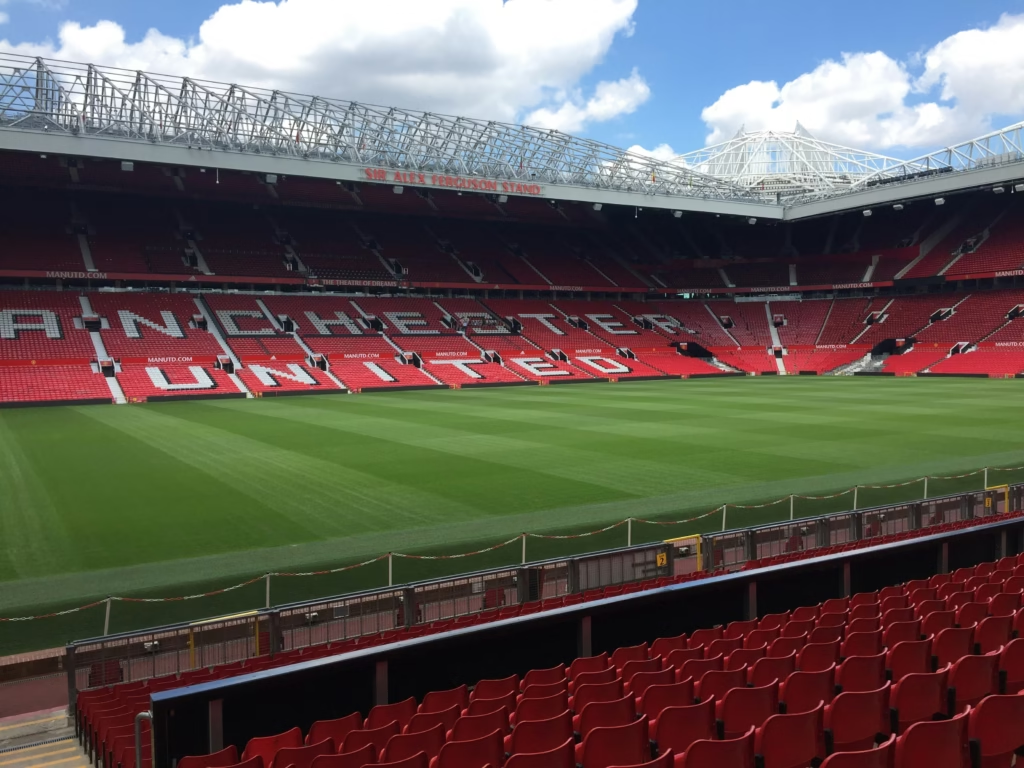
The January transfer window has a habit of dragging Manchester United into its orbit, and this winter is proving no different. As December 2025 edges closer to its end, one name has begun circulating with increasing insistence: Rúben Neves.
Reports suggest United are exploring the possibility of bringing the Portuguese midfielder back to the Premier League, with Al-Hilal open to selling and Neves himself keen on a return to European football. The headline figure — around £20 million — immediately raises eyebrows. For a player with his experience, pedigree, and Premier League history, that number feels unusually modest.
Naturally, debate has followed. Some see Neves as a smart, low-risk solution to United’s midfield issues. Others view the link as yet another example of the club drifting toward short-term fixes instead of committing fully to a long-term rebuild.
With United sitting sixth in the Premier League after 16 games, still searching for consistency under Rúben Amorim, the question isn’t simply whether Neves is a good player. It’s whether he is the right player, at the right time, for a club still trying to define its identity.
To answer that properly, we need to step back and look at the wider picture — the player, the system, the squad, and the direction United claim to be heading.
Rúben Neves: Experience, Control, and a Familiar Premier League Face
Rúben Neves is not an unknown quantity. Few midfielders arriving in England over the past decade adapted as seamlessly as he did when he joined Wolves in 2017. Scoring on his debut from 30 yards, Neves quickly became synonymous with long-range goals, composure on the ball, and tactical intelligence well beyond his years.
Across six seasons at Wolves, Neves made 177 Premier League appearances, captained the side, and developed into one of the league’s most reliable deep-lying midfielders. He wasn’t flashy in the modern sense, but he offered something increasingly rare: control. He slowed games down, dictated tempo, and brought structure to teams that needed it.
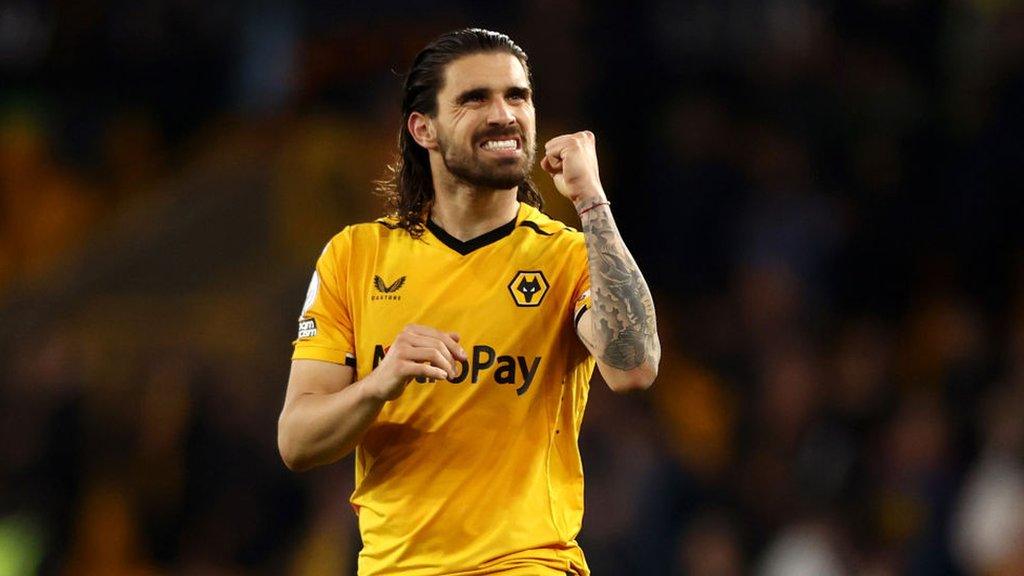
His move to Al-Hilal in 2023, while surprising from a sporting perspective, made financial sense. Like many players in their late twenties, Neves took advantage of Saudi Arabia’s spending power. However, the shift inevitably removed him from the weekly intensity of elite European football.
Statistically, Neves has remained productive in Saudi Arabia. During the 2025/26 season, he has featured regularly, contributing goals — including penalties — and maintaining a high volume of touches and passes. His technical ability has not disappeared. His vision, passing range, and set-piece quality are all intact.
What has changed is the environment. The Saudi Pro League does not replicate the pace, pressing intensity, or physical demands of the Premier League. That reality fuels understandable concerns about whether Neves can instantly return to peak performance in England at nearly 29 years old.
Yet context matters. Neves has played over 200 top-flight matches in England, understands the league’s rhythm, and would not require the adaptation period associated with younger foreign signings. That alone carries value for a club that often looks disjointed when integrating new players mid-season.
Manchester United’s Midfield: Where Control Goes to Disappear
Manchester United’s midfield problems are no longer subtle. They are structural, recurring, and visible regardless of formation.
Casemiro, once the stabilising force United desperately needed, has declined sharply. His positional awareness remains, but his legs are no longer reliable over 90 minutes. Errors in possession and late challenges have become frequent, particularly against high-energy sides.
Manuel Ugarte, signed to inject aggression and ball-winning ability, has struggled for rhythm. His strengths are clear, but his integration into Amorim’s system has been uneven, often leaving gaps rather than closing them.
Kobbie Mainoo remains one of United’s brightest prospects, but expecting a teenager to anchor midfield responsibility in a chaotic team environment is unfair. His talent is unquestionable; his protection is not.
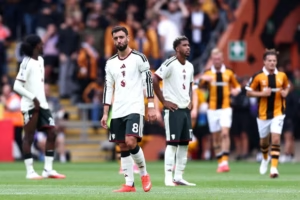
As a result, United frequently lose control of matches — not always through poor defending, but through an inability to manage tempo. They either play too quickly when patience is required or too slowly when transitions are needed.
This is where Neves enters the conversation.
Amorim’s System and the Neves Question
Rúben Amorim’s tactical blueprint is clear in theory, even if execution has fluctuated at United. His preferred 3-4-2-1 relies heavily on midfield intelligence. The system demands players who understand space, positioning, and timing — not just athletic output.
At Sporting, Amorim’s midfielders acted as the team’s metronome. They recycled possession efficiently, switched play to wing-backs, and ensured defensive stability during transitions.
In that sense, Neves appears tailor-made.
As a deep midfielder, Neves excels at:
- Progressing the ball without unnecessary risk
- Switching play to wide areas quickly
- Providing positional discipline in front of the defence
- Offering leadership and calm under pressure
In matches where United struggle to impose themselves, Neves could offer control that currently feels absent. His presence would allow players like Bruno Fernandes to operate higher up the pitch without constantly dropping deep to collect the ball.
However, there are limitations Amorim would have to manage.
Neves is not a high-intensity presser in the modern mould. He reads the game well but does not cover ground aggressively. Against elite sides with explosive midfield runners, this could become an issue unless paired with a more mobile partner.
In a 4-3-3, which Amorim has experimented with due to injuries and fixture congestion, Neves could operate as the single pivot — but only with disciplined interiors alongside him. Without that balance, United risk being overrun.
So while Neves fits the idea of Amorim’s system, his success would depend heavily on squad structure around him.
The Price Tag: Bargain or Red Flag?
A £20 million fee for Rúben Neves immediately invites skepticism. Football rarely offers genuine bargains without caveats.
From United’s perspective, the deal makes sense financially. It represents:
- Minimal risk compared to £70m+ midfield gambles
- Immediate Premier League experience
- No long adaptation period
- A short-term stabiliser for a fragile squad
From Al-Hilal’s perspective, moving on a high-earning player nearing 30 aligns with long-term squad planning.
The real concern is not the transfer fee — it is the intention behind the signing.
If Neves is viewed as a bridge signing — someone to steady midfield while younger profiles develop — the logic holds. If he is seen as a foundational piece for the next four or five years, history suggests caution.
Manchester United have repeatedly turned to experienced midfielders in moments of crisis. Sometimes it works briefly. Often, it delays deeper structural fixes.
Youth vs Experience: The Ongoing Dilemma
One of the defining questions of United’s rebuild is whether the club truly trusts its long-term vision.
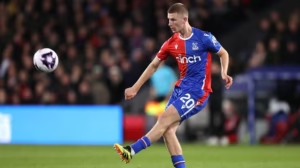
Younger midfielders on the market — Adam Wharton, João Gomes, Carlos Baleba — offer athleticism, resale value, and development upside. They also require patience, coaching, and tolerance for inconsistency.
Neves offers the opposite: reliability now, limited upside later.
There is no universally correct answer. Elite teams balance youth and experience. The issue at United is sequencing. Bringing in Neves without first establishing a clear midfield hierarchy risks repeating cycles of short-term thinking.
Mainoo, in particular, requires clarity. He needs minutes, structure, and mentorship — not competition that pushes him to the margins.
If Neves arrives as a guide rather than a blocker, the move can work. If he becomes another automatic starter, development suffers.
Are There Bigger Priorities Than Midfield?
Arguably, yes.
United’s left-back situation remains precarious due to recurring injuries. Their goal output continues to lag behind rivals. Defensive concentration, especially at set pieces, still costs points.
Focusing heavily on midfield while neglecting these areas would be a mistake.
January windows rarely allow for perfect planning, but prioritisation matters. One stabilising midfielder does not fix systemic issues across the pitch.
Final Verdict: Smart Stopgap or Familiar Trap?
Rúben Neves to Manchester United makes sense — but only under specific conditions.
As a short-term stabiliser, mentor, and tactical organiser, he could raise the floor of United’s performances immediately. His experience, composure, and leadership would be valuable in a squad still searching for identity.
As a long-term solution, he is not enough.
United’s problems are deeper than one signing, and history warns against mistaking familiarity for progress. The club must be clear-eyed: Neves can support a rebuild, but he cannot be the rebuild.
If this move is part of a wider, coherent plan under Amorim and INEOS, it could prove quietly effective. If it becomes another reactive signing driven by short-term anxiety, it will simply add to a long list of nearly-right decisions.
January will tell us a lot — not just about Rúben Neves, but about whether Manchester United have finally learned from their own patterns.
About The Author