Manchester United’s £2 Billion New Stadium: Revolutionizing Old Trafford and Beyond
Manchester United is set to transform football with a stunning £2 billion, 100,000-capacity stadium next to historic Old Trafford. Backed by Sir Jim Ratcliffe and designed by Foster + Partners, this iconic project promises world-class facilities, massive regeneration, and a new era for the club. Read the full details inside.
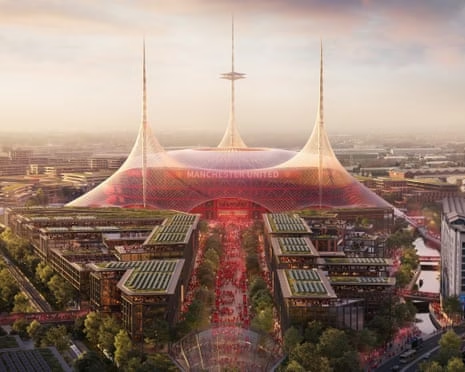
In the heart of Manchester, a monumental shift is underway. Manchester United, has unveiled plans for a groundbreaking £2 billion stadium project. This ambitious endeavor promises a 100,000-seat arena that could redefine English football, blending cutting-edge design with massive urban regeneration. Announced amid calls for modernization, the project signals a new chapter for the Red Devils, addressing long-standing issues at Old Trafford while positioning the club as a global powerhouse. But what does this mean for fans, the local community, and the sport? Let’s dive in.
The Historic Announcement: A Bold Vision Unveiled
On March 11, 2025, Manchester United made headlines with the official reveal of their stadium plans. Co-owner Sir Jim Ratcliffe, who acquired a minority stake in 2024, described it as the “world’s greatest football stadium” at the center of a regenerated Old Trafford area. The project isn’t just about bricks and mortar—it’s a statement of intent to restore the club’s prestige.
The new stadium will be built adjacent to the existing Old Trafford, preserving the site’s historic essence while introducing state-of-the-art facilities. Club CEO Omar Berrada emphasized that this move follows extensive consultations, including feedback from thousands of fans who favored a fresh start over piecemeal upgrades. With Old Trafford’s last major renovation in 2006, the time for change has arrived.
This announcement came after a task force, led by figures like Lord Sebastian Coe and Greater Manchester Mayor Andy Burnham, explored options. The decision? A new build, not redevelopment, to create something truly iconic.
Why Ditch Redevelopment? The Case for a Fresh Start
Old Trafford, opened in 1910, has hosted countless triumphs, from Busby Babes eras to Sir Alex Ferguson’s dominance. Yet, persistent problems like leaking roofs—infamously during heavy rains in 2024—have plagued the venue. Redeveloping the 74,000-capacity stadium was considered, with estimates around £1.5 billion, but experts deemed it insufficient for modern demands.
A new stadium allows for innovations impossible in a retrofit. For instance, shrinking Old Trafford for the women’s or academy teams post-move wasn’t cost-effective. Ratcliffe’s vision draws from global benchmarks like SoFi Stadium in Los Angeles, prioritizing fan experience and sustainability.
Fan surveys played a pivotal role. In 2024, 52% supported a new arena, reflecting a desire for progress while honoring history. As Berrada noted, “Our long-term objective is to have the world’s best football team playing in the world’s best stadium.”
Architectural Wonders: Design Features That Wow
Led by renowned architects Foster + Partners, under Lord Norman Foster, the design is nothing short of spectacular. The stadium boasts a 100,000-seat capacity, making it the UK’s largest and Europe’s second-biggest after Barcelona’s Camp Nou.
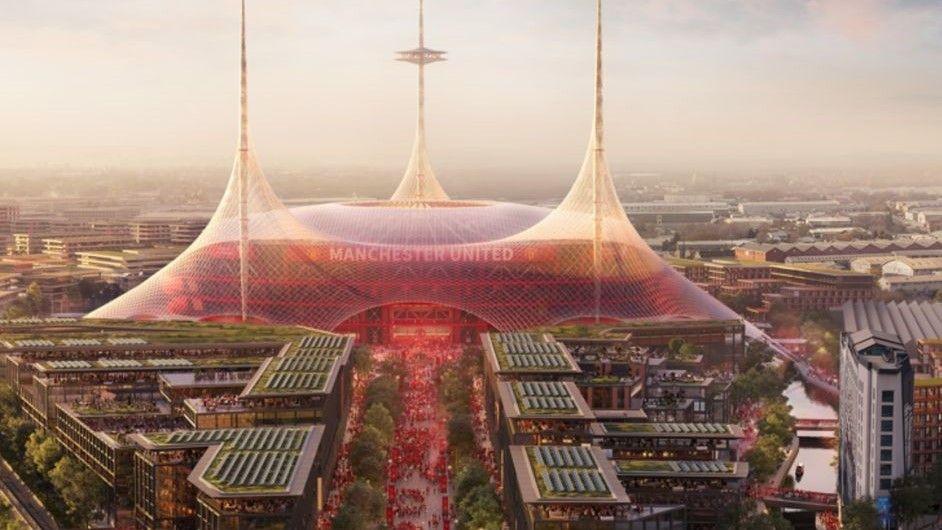
Key elements include a massive “umbrella” canopy covering a public plaza twice the size of Trafalgar Square. Three 200-meter-high masts, dubbed the “trident,” pay homage to the club’s crest and will be visible from 25 miles away. The pitch sits 15.9 meters below ground, enhancing acoustics and bringing fans closer to the action.
Sustainability is core: Rainwater harvesting via the umbrella, modular construction with parts shipped via the Manchester Ship Canal to reduce emissions. Conceptual renders show a sleek, futuristic structure that blends with the industrial heritage of the area. Ratcliffe envisions it as a tourist magnet, akin to the Eiffel Tower.
Economic Powerhouse: Jobs, Homes, and Billions in Boost
This isn’t just a stadium—it’s the linchpin of a vast regeneration scheme. Projections estimate £7.3 billion annual addition to the UK economy, 92,000 new jobs, over 17,000 homes, and 1.8 million extra visitors yearly.
The Old Trafford area, spanning 370 acres, will transform into a vibrant district with mixed-use developments. Lord Coe, chair of the newly launched Manchester Development Corporation (MDC), calls it a “defining moment” comparable to the 2012 London Olympics. The MDC, approved by the government in early 2026, will oversee the masterplan, including 15,000 homes and 48,000 local jobs.
Mayor Andy Burnham highlights its scale as the UK’s biggest sports-led regeneration since 2012. For Manchester, this means revitalizing a historic but underinvested neighborhood, fostering long-term growth.
Funding the Future: Navigating the £2 Billion Challenge
Financing such a colossal project is no small feat. The £2 billion tag includes stadium construction and surrounding infrastructure. United’s existing £1 billion debt adds complexity, with potential new borrowing of £1-1.5 billion from lenders.
Ratcliffe and INEOS are expected to inject equity, while a public-private partnership could leverage government support without direct taxpayer funds. Berrada expresses confidence, noting the project’s appeal to investors. Multi-functional use, like concerts and events, could mirror Tottenham’s model, generating revenue to offset costs.
Risks include rising debt, but experts like Kieran Maguire see it as viable if executed well. No public money is pledged, emphasizing private investment.
Timeline: From Plans to Pitch
Construction could commence as early as 2026, utilizing pre-fabrication for efficiency. The five-year build targets an opening for the 2030-31 season. United will continue playing at Old Trafford during this period, with the old site likely demolished afterward.
Recent milestones include the MDC’s launch in January 2026, paving the way for detailed masterplans. Further consultations will refine designs, ensuring stakeholder input. Potential as a 2035 FIFA Women’s World Cup venue adds urgency.
Fan Pulse: Excitement, Skepticism, and Everything In Between
Reactions from the United faithful are passionate and varied. Many embrace the vision, with fans praising the move to modern facilities: “How can you not be moved by this?” Others highlight the design’s uniqueness, countering “circus tent” jabs by noting it breaks from generic bowls.
Skeptics, however, voice concerns. Some campaigns point to debt and question priorities, with fans lamenting the loss of Old Trafford’s soul. Pundit Paul Merson called it “pathetic,” urging focus on the team. Yet, other supporters defend the ambition, dismissing rival jealousy.
Ongoing consultations aim to address these, ensuring the project resonates with the fanbase.
Global Comparisons: How It Stacks Up
Dubbed the “Wembley of the North,” the stadium aims to eclipse London’s 90,000-seat icon. Internationally, it rivals SoFi’s tech-forward approach and Real Madrid’s Bernabeu revamp. Tottenham’s £1 billion stadium sets a revenue benchmark, which United hopes to surpass with hospitality seating at 15.5%.
In Europe, only Camp Nou’s planned 105,000 seats top it. This positions United to host major events, boosting global appeal.
The Broader Regeneration: Transforming Manchester
Beyond football, the project catalyzes urban renewal. The MDC will develop a “miniature city” with entertainment, housing, and green spaces. Chief Operating Officer Collette Roche envisions a district with the “best matchday atmosphere in world football.”
Government backing aligns with growth agendas, though Chancellor Rachel Reeves stressed no direct funding. This public-private synergy could model future UK projects.
A Legacy in the Making
Manchester United’s £2 billion stadium project isn’t merely an upgrade—it’s a transformation. From architectural innovation to economic revival, it promises to elevate the club and city. As Ratcliffe puts it, “Today marks the start of an incredibly exciting journey.” Challenges remain, but the potential for a “Wembley of the North” is undeniable. For fans, it’s a new home; for Manchester, a brighter future. The Red Devils are building more than a stadium—they’re forging a legacy.
About The Author