Shocking Kenya Sh10bn Non-Existent Firm Scandal Exposed
In-Depth: The Kenya Sh10bn Non-Existent Firm Saga, How It Happened and Its Impact on Taxpayers and Governance.

The Kenya Sh10bn non-existent firm saga is not just another legal dispute; it is a revealing case study of how complex international contracts, weak due diligence, and delayed legal awareness can combine to expose a country to massive financial loss. At its core, the controversy revolves around a dissolved foreign contractor that is still positioned to receive billions of shillings from Kenyan taxpayers.
What makes this case particularly alarming is not just the amount involved but the legal confusion surrounding who exactly should be paid and whether the entity claiming compensation even legally exists.
Kenya’s Sh10bn Non-Existent Firm: What Happened?
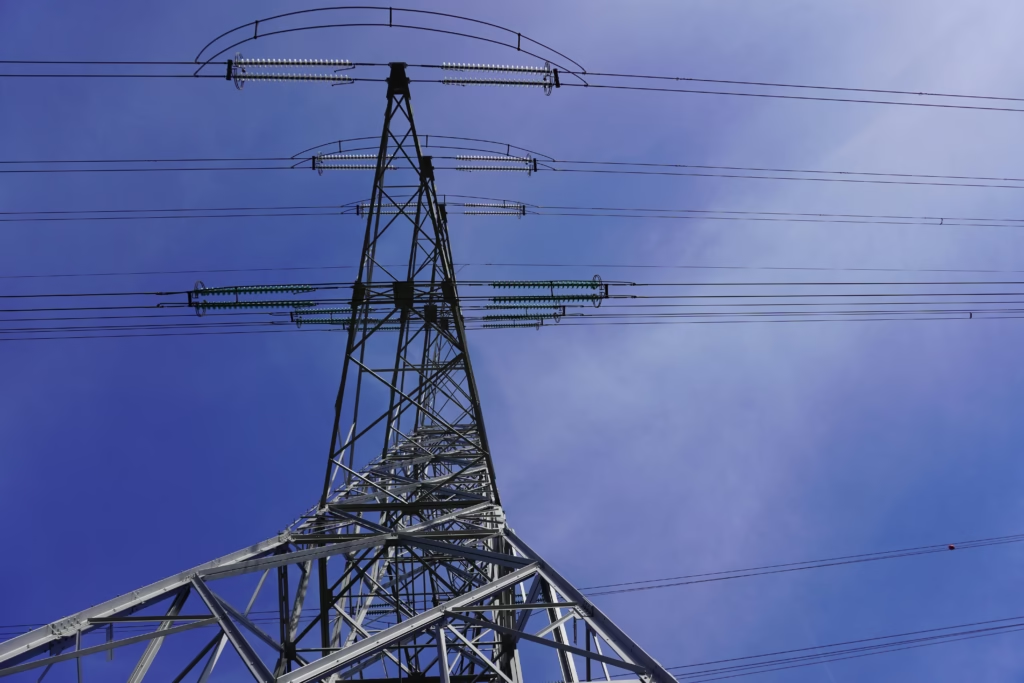
The dispute traces back to a contract awarded by Kenya Electricity Transmission Company (Ketraco) to a Spanish engineering firm, Instalaciones Inabensa. The project involved constructing high-voltage transmission lines and substations critical for regional electricity trade.
However, the contract collapsed in 2016 following disagreements between the two parties. The fallout triggered a legal battle that eventually reached the Supreme Court of Kenya, which in 2022 ruled that Ketraco had breached the contract and ordered compensation of approximately €37.6 million, equivalent to about Sh10 billion.
At face value, this seemed like a straightforward arbitration outcome. But what Kenyan authorities did not fully account for at the time was the financial state of Inabensa.
Instalaciones Inabensa Case: The Missing Link
The most critical twist in the Instalaciones Inabensa case is that the company was effectively collapsing even as the court ruling was being delivered.
Reports indicate that Inabensa was declared bankrupt and later dissolved shortly after the Supreme Court judgment. This means that by the time Kenya was preparing to settle the compensation, the original contractor had ceased to exist in its operational form.
In insolvency situations, the rights to claim payments often shift to administrators or creditors. In this case, the Spanish firm’s affairs were taken over by insolvency managers, including Ernst & Young, acting as administrators.
This is where the confusion deepens. If a company no longer exists, who is legally entitled to receive compensation? The answer is not always straightforward, especially across jurisdictions.
Ketraco Compensation Dispute and Multiple Claimants
The Ketraco compensation dispute escalated further when multiple entities emerged, each claiming rights to the same Sh10 billion payout.
A separate Spanish firm, C.A. Infraestructuras T & I SLU, entered the picture after acquiring rights from Inabensa in July 2023. At the same time, insolvency administrators representing creditors also asserted claims over the same funds.
This created a dangerous legal scenario where Kenya could be exposed to triple liability. Government legal advisors warned that the country might end up paying as much as Sh30 billion if all claims were upheld.
To complicate matters further, some claimants took aggressive legal steps, including attempts to wind up Ketraco and freezing billions of shillings in its bank accounts across multiple Kenyan banks.
This is no longer just a contract dispute; it is a multi-layered legal crisis involving insolvency law, international arbitration, and asset recovery.
How the Kenya Sh10bn Nonexistent Firm Crisis Emerged
Understanding how Kenya arrived at this situation requires looking beyond the court ruling to structural weaknesses in contract management and legal oversight.
First, the original contract termination in 2016 set the stage for arbitration. Terminating large infrastructure contracts often triggers compensation clauses, especially when foreign firms are involved.
Second, the legal process took years to conclude. During this period, Inabensa’s financial health deteriorated significantly, culminating in bankruptcy and dissolution. Yet, the legal proceedings continued without fully integrating these developments into the Kenyan defense strategy.
Third, there appears to have been limited real-time due diligence on the contractor’s financial status. By the time the Supreme Court issued its ruling, the company’s collapse was already underway, but this critical fact did not significantly alter the legal outcome.
Finally, the transfer of claims to third parties created a layered ownership structure that is now difficult to untangle. Each entity, original contractor, successor firm, and insolvency administrator, has a plausible legal argument.
Government Contract Disputes in Kenya: A Systemic Issue
The government contract disputes in Kenya’s landscape have increasingly revealed patterns of risk. Large infrastructure projects, often financed or executed through international partnerships, carry complex legal frameworks that can backfire when disputes arise.
This case reflects three systemic challenges.
The first is a weak contract enforcement strategy. Terminating contracts without airtight legal backing exposes the government to expensive arbitration outcomes.
The second is a delayed legal response. Long court processes allow situations to evolve, such as corporate insolvency, without timely adaptation.
The third is fragmented institutional coordination. Agencies, legal teams, and external advisors may not always share real-time intelligence, especially on international corporate developments.
These structural weaknesses are not unique to this case, but here they converge in a particularly costly way.
Kenya Public Finance Risk: Who Pays the Price?
The Kenya public finance risk implications are profound. At a time when the government is already under fiscal pressure, a Ksh10 billion payout, or worse, Ksh30 billion, would have serious consequences.
Public funds used to settle such disputes come directly from taxpayers. This means fewer resources for essential services like healthcare, education, and infrastructure.
Moreover, such liabilities can increase borrowing needs, pushing the country deeper into debt. Kenya’s fiscal space is already constrained, and unexpected legal payouts only worsen the situation.
There is also the issue of opportunity cost. The original project itself, valued at around Sh4.5 billion, was meant to enhance electricity trade and regional integration. Instead, the country now faces a liability more than double the project’s value.
Legal and Economic Implications of the Non-Existent Firm Claim
The legal implications of the Kenya Sh10bn non-existent firm case extend beyond this single dispute.
One key issue is precedent. If Kenya is forced to pay multiple claimants for the same contract, it could set a dangerous legal benchmark that other contractors might exploit.
Another implication is investor perception. International investors closely watch how governments handle disputes. A perception of weak contract management or vulnerability to legal loopholes can increase the cost of doing business.
There is also the risk of asset seizures. In extreme cases, foreign claimants can seek to attach Kenyan assets abroad to enforce payment, escalating the dispute into a diplomatic issue.
Economically, such cases undermine confidence in public project management. They raise questions about transparency, accountability, and risk mitigation in government contracts.
What This Means for Citizens and the Future
For ordinary Kenyans, this case may seem distant, but its effects are very real. Every shilling paid in compensation is a shilling that could have been invested in development.
The scandal also highlights the importance of institutional accountability. Citizens expect that public contracts are managed prudently and that legal risks are minimized.
Moving forward, the government may need to strengthen several areas.
Improved due diligence on contractors, especially foreign firms, is essential. Real-time monitoring of financial health could prevent similar situations.
Legal strategy must also evolve. Faster response times and better integration of international legal developments can reduce exposure.
Finally, transparency in public contracts can build trust and deter mismanagement.
A Defining Moment for Governance and Accountability
The Kenya Sh10bn non-existent firm saga is more than a legal anomaly; it is a defining moment for governance in Kenya.
It exposes how quickly a routine infrastructure dispute can escalate into a national financial risk when legal, financial, and institutional gaps align.
At its core, the issue is not just about paying a dissolved company. It is about whether systems are robust enough to protect public funds in an increasingly complex global economy.
If handled decisively, this case could become a turning point, prompting reforms that strengthen contract management and safeguard taxpayers. If mishandled, it risks becoming another costly lesson in governance failure.
The stakes are high, and the outcome will likely shape how Kenya approaches international contracts for years to come.
About The Author