Devastating Setback: Manchester United’s Benjamin Šeško Suffers Knee Injury in Tottenham Draw – Amorim’s Reaction and Tactical Implications
In a thrilling 2-2 draw at Tottenham on November 8, 2025, Manchester United’s Benjamin Šeško suffered a knee injury, forcing the team to finish with 10 players. The 22-year-old, signed from RB Leipzig for €76.5 million, twisted his knee, but early updates are positive, with no serious damage suspected and scan results from November 9 indicating a short absence.
In a thrilling Premier League showdown at Tottenham Hotspur Stadium on November 8, 2025, Manchester United fought back to secure a dramatic 2-2 draw against Tottenham Hotspur. However, the result was marred by a concerning knee injury to key striker Benjamin Šeško, who was forced off the field, leaving the Red Devils to play the final 15 minutes with just 10 men. The 22-year-old Slovenian, acquired from RB Leipzig for approximately €76.5 million plus add-ons in a blockbuster summer transfer, has been a focal point in United’s attack this season. As Ruben Amorim’s side pushes through a transitional period, Šeško’s potential sidelining raises questions about the team’s offensive depth. In this detailed piece, we explore the injury details, Amorim’s insights, the impact on United’s forward line, possible tactical adjustments, expert commentary, and a balanced comparison of Šeško’s contributions to date versus Rasmus Højlund’s output in his final season at Old Trafford. Our thoughts go out to Šeško during this challenging time, as injuries can be both physically and mentally taxing for young talents adapting to new environments.
The Incident: How Benjamin Šeško’s Injury Unfolded in the Tottenham Match
The encounter was a high-stakes affair, with both teams vying for crucial points in the 2025/2026 Premier League campaign. Manchester United struck first in the 32nd minute when Bryan Mbeumo headed home a precise cross from Amad, giving the visitors a deserved lead. Tottenham, under manager Thomas Frank, mounted a comeback in the latter stages. Mathys Tel equalized in the 84th minute with a sharp turn and shot that deflected off Matthijs De Ligt. The hosts then took the lead in the 90th minute through Richarlison’s glancing header off a powerful shot from substitute Wilson Odobert. Drama peaked in the 96th minute as De Ligt redeemed himself by heading in a corner from Bruno Fernandes to salvage a point for United.
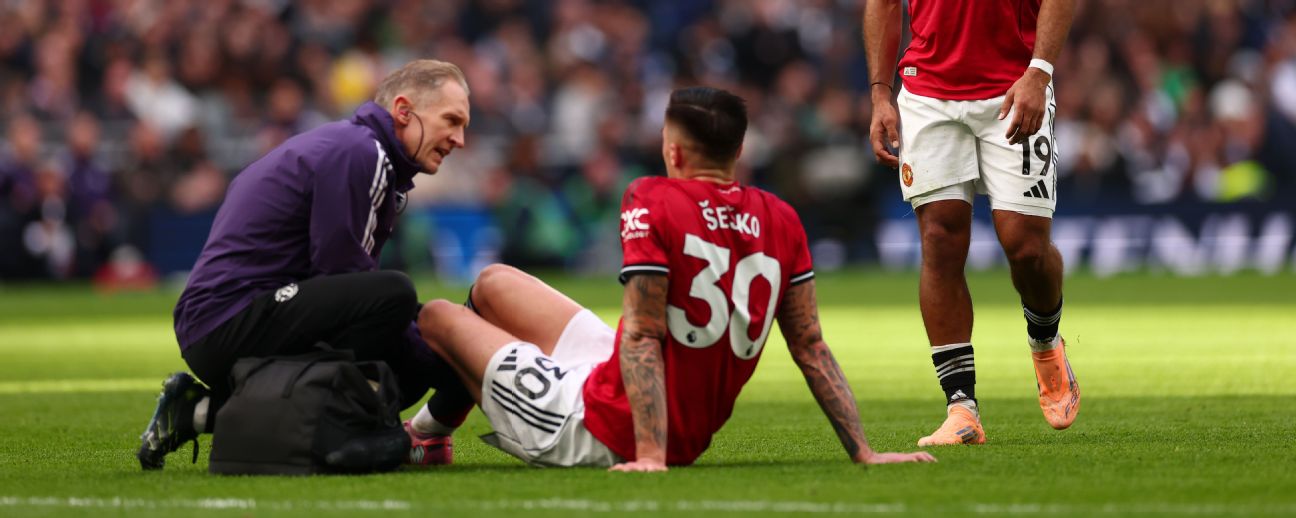
Amid this intensity, Šeško’s injury occurred around the 75th minute when he twisted his knee awkwardly during a challenge for the ball. The 6’5″ forward, renowned for his aerial dominance and physicality, immediately clutched his knee and signaled to the bench, unable to continue. With all substitutions already made, United were reduced to 10 players for the remainder of the match, adding to the defensive strain in stoppage time. Post-match assessments revealed that Šeško felt significant pain but initial evaluations were encouraging, suggesting no severe ligament damage. He was set for a scan on November 9, 2025, to confirm the extent, with hopes of a short recovery period.
It’s disheartening to witness such a promising player encounter this setback, especially as Šeško has been showing signs of settling into the Premier League’s demanding pace. His injury history has generally been favorable, with only minor absences in previous seasons at RB Leipzig, such as brief spells for muscle strains or foot issues, typically lasting one to two weeks. Fans and the club alike will be eagerly awaiting the scan results, empathizing with the young star’s frustration during what should be an exciting chapter in his career.
Ruben Amorim’s Reaction: Quotes and Context on Šeško’s Setback
Ruben Amorim, Manchester United’s manager, addressed the injury with a blend of caution and positivity in his post-match comments. “He felt something in his knee and didn’t feel comfortable continuing. We’ll have to wait for the scan to know more,” Amorim stated, highlighting the need for patience while underscoring Šeško’s importance to the team. He added, “We need Ben [Šeško] to be a better team. We have to check. He has something in his knee. Let’s see.” These remarks reflect Amorim’s supportive approach, prioritizing player well-being amid the pressures of elite competition.
In broader context, Amorim has been forthright about Šeško’s adaptation since his arrival. Labeling him a “control freak” in training, the manager noted, “I’m relaxed, but he is not relaxed. I understand how things are in football. He is going to struggle, that is a fact.” Amorim has acknowledged the challenges of the €76 million move, saying, “He has even more potential than what I was expecting,” while admitting Šeško has “struggled a little bit” to fully integrate. Despite modest output—two goals and one assist in 11 Premier League appearances (six starts, five substitutes, 586 minutes played)—Šeško’s work ethic has impressed. Amorim’s empathetic tone, emphasizing resilience, could play a vital role in Šeško’s mental recovery, especially given his upbeat demeanor post-injury.
How Šeško’s Absence Could Impact Manchester United’s Attack
Šeško’s potential unavailability poses a significant challenge to Manchester United’s attacking dynamics. As a traditional No. 9, his physical presence—winning 76% of aerial duels—provides a crucial outlet for long balls and set-piece threats. With an expected goals (xG) of 2.81 from nine shots on goal and four successful dribbles, he has demonstrated efficiency despite limited starts. His absence could disrupt United’s ability to hold up play and create space for creative players like Bruno Fernandes, potentially leading to a more disjointed offense.
United’s attack has been inconsistent this season, relying on moments of brilliance rather than sustained dominance. Without Šeško, the burden shifts to forwards like Joshua Zirkzee or Matheus Cunha, but neither fully replicates his blend of height, speed, and finishing. Empathetically, this injury arrives at a tough moment for Šeško, who has been building confidence after a stellar 2024/2025 at Leipzig, where he scored 21 goals across competitions. The team’s goal output might suffer in upcoming matches, such as against Everton, where his set-piece prowess could be missed.
Tactical Changes Ruben Amorim Might Consider in Šeško’s Absence
Amorim’s preferred 3-4-2-1 formation emphasizes defensive structure and quick transitions, with Šeško often serving as the focal point. In his absence, Amorim could pivot to a more fluid 3-4-3, utilizing a false nine like Mount or Cunha to maintain creativity while bolstering midfield control. This shift might involve deeper wing-back involvement to exploit flanks, drawing from Amorim’s successful Sporting CP tactics.
Alternatively, a 4-2-3-1 could provide added balance, with Manuel Ugarte anchoring midfield to allow aggressive pressing without exposing the backline. Amorim has stressed flexibility, noting post-match that his side lacked aggression but showed resilience. Empathetically, these adaptations prioritize squad rotation to prevent further injuries, ensuring long-term sustainability.
Expert Analysis: Assessing the Broader Implications
Pundits have dissected the injury’s fallout. Jamie Carragher commented, “Šeško brings a different dimension to United’s attack—his hold-up play is elite. Without him, Amorim must rethink his pressing game.” Gary Neville added, “It’s a setback, but United’s depth will be tested,” critiquing Šeško’s early struggles but praising his potential. Medical experts note Šeško’s strong recovery history, with absences averaging under two weeks, offering optimism. nytimes.com si.com givemesport.com
Tactically, analysts from The Athletic suggest evolving Amorim’s zonal marking to incorporate more man-oriented pressing during absences. Rio Ferdinand emphasized mental fortitude: “Injuries can dent confidence, but Šeško’s resilience is key.” Overall, experts view this as a test of United’s squad depth under Amorim.
Comparing Šeško’s Impact So Far with Rasmus Højlund’s Last Season
Šeško’s early tenure invites comparison to Rasmus Højlund’s 2024/2025 campaign at United, his final before moving to Napoli. Højlund managed four goals in 32 Premier League appearances, with an xG of approximately 1.52 and minimal assists, hampered by adaptation and injuries. His season was inconsistent, with sporadic bursts but limited overall influence.
In contrast, Šeško has two goals, one assist, and superior metrics in fewer games: 2.81 xG, nine shots on goal, and four dribbles. His goals-per-game ratio (1 in 5.5) edges Højlund’s (1 in 8), with better aerial wins and playmaking per 90 minutes. While Højlund showed promise, Šeško’s impact appears more immediate, offering a stronger focal point. Empathetically, both faced high expectations—Šeško’s injury echoes Højlund’s challenges, but his stats hint at a more promising trajectory.
Looking Ahead: Manchester United’s Path Without Šeško
With fixtures like Arsenal looming, United’s depth—bolstered by signings like Mbeumo and Cunha—will be key. Šeško’s expected short absence (potentially weeks) provides hope, supported by teammate messages on social media. This episode underscores football’s unpredictability, and we extend our best wishes for Šeško’s swift recovery. Stay updated on Manchester United news for further developments.