Manchester United’s Q1 Fiscal 2026 Earnings: A Deep Dive into Resilience and Challenges
Robust financial results reflect the resilience of Manchester United as difficult decisions create a sustainably lower cost base for long-term success.
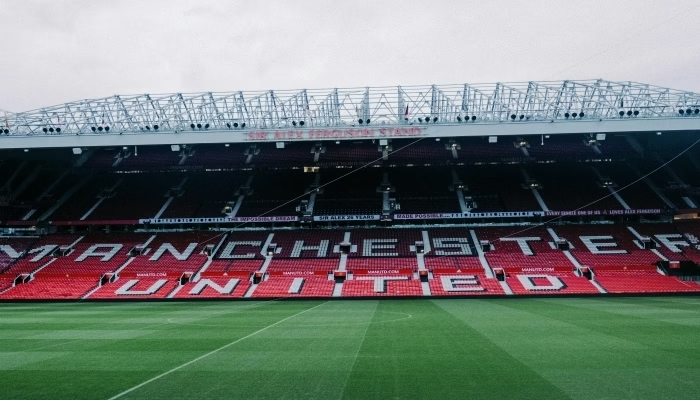
As a dedicated follower of Manchester United’s on-pitch drama and off-pitch business maneuvers, the release of their first quarter fiscal 2026 results on December 11, 2025, offers a fascinating snapshot of a club in transition. Drawing from the official press release issued by Manchester United PLC (NYSE: MANU) via Business Wire, this blog aims to dissect every aspect of the report with clarity, honesty, and analytical depth. We shall explain the numbers, what they mean in context, and their implications for the club, investors, and fans. We’ll cover positives like cost-cutting successes and negatives like revenue stagnation, examining short-term stability and long-term growth potential. All data is pulled directly from the report to ensure accuracy—no speculation here, just facts.
Let’s start with the big picture. Manchester United, one of the world’s most iconic sports brands with a 148-year history and 69 trophies, reported total revenues of £140.3 million for the quarter ended September 30, 2025—a slight 2.0% dip from £143.1 million in the prior year. Yet, adjusted EBITDA climbed 13.5% to £26.9 million, and operating profit swung to £13.0 million from a £6.9 million loss. This turnaround stems from aggressive cost reductions implemented last year, but a net loss of £6.6 million (versus a £1.3 million profit) highlights ongoing pressures from foreign exchange fluctuations and high debt. The club reiterates full-year guidance: revenues of £640-660 million and adjusted EBITDA of £180-200 million, while affirming compliance with Premier League Profit and Sustainability Rules (PSR) and UEFA Financial Fair Play (FFP).
Key Highlights from the Manchester United Report
The report opens with key points that set the tone. Revenues held steady despite no European football, thanks to a lower cost base. Manchester United men’s team sits 6th in the Premier League, while the women’s team is 3rd in the Women’s Super League (WSL) and has qualified for the UEFA Women’s Champions League (UWCL) league phase for the first time—a milestone that could boost future revenues. Partnerships with Canon Medical Systems and Concha y Toro were extended, underscoring commercial stability.
Manchester United CEO Omar Berrada’s commentary emphasizes “resilience” and “transformation.” He notes that tough decisions, like headcount reductions, have created a “streamlined, effective organisation” poised for better sporting and commercial performance. This is honest: the club has shed costs, but success hinges on results. The outlook reaffirms guidance, with no changes despite the revenue miss, signaling confidence in the season’s phasing—more games in Q2 and Q3.
The phasing table illustrates this: For the 2025/26 season (as of December 11), Q1 had 6 Premier League games, Q2 13, Q3 12, and Q4 7. Compared to last year, it’s similar, but without European fixtures, broadcasting suffers early on.
Revenue Breakdown: Strengths in Commercial, Weaknesses Elsewhere
Diving into revenues, commercial remains the powerhouse at £84.2 million (60.0% of total, up from 59.6%), down just 1.3% year-over-year. Sponsorship fell 9.3% to £47.0 million due to partner mix changes—perhaps expiring deals or renegotiations amid economic pressures. However, retail, merchandising, apparel, and product licensing surged 11.0% to £37.2 million, driven by a full quarter under the new e-commerce model (versus one month last year). This shift to direct-to-consumer sales is a smart long-term play, reducing reliance on third parties and capturing more margins.
Broadcasting revenue dropped 4.5% to £29.9 million (21.3% of total), primarily because the men’s team had no UEFA competition this quarter (last year featured Europa League). This absence is a stark reminder of how on-pitch performance directly impacts finances—missing Champions League can cost £50-100 million annually in broadcasting and matchday alone.
Matchday revenue edged down 1.1% to £26.2 million (18.7% of total), with the same three home Premier League games but no extra cup or European ties. Home matches played: 3 PL (same as last year), no UEFA or domestic cups (versus 1 each last year). Away: 3 PL and 1 domestic cup (versus 3 PL last year).
Clearly, revenues are resilient but vulnerable. Short-term positive: Commercial dominance cushions blows. Negative: No Europe creates a £5-10 million quarterly hole. Long-term, consistent top-4 finishes are essential to unlock broadcasting growth, potentially adding 20-30% to annual revenues.
Expenses, Profitability, and Non-IFRS Metrics
Operating expenses fell 7.1% to £172.4 million—a win from restructuring. Employee benefits dropped 8.2% to £73.6 million (52.5% of revenue, improved from 56.0%), reflecting redundancies that saved £6.6 million. Other operating expenses rose slightly by 1.5% to £39.8 million, while depreciation increased 11.6% to £4.8 million (new facilities like Carrington) and amortization 1.5% to £54.1 million. The unamortized player registrations balance hit £624.1 million (up from £559.3 million), indicating heavy squad investment—think summer signings like potential stars, but also risks if they underperform.
No exceptional items this quarter (versus £8.6 million last year for restructuring). Profit on intangible assets (player sales) jumped 26.4% to £45.0 million, a savvy trading strategy that offsets high wages and amortizations.
Net finance costs swung to £21.4 million (from £8.6 million income), due to unfavorable FX on unhedged USD borrowings—GBP weakened slightly against USD (1.3449 vs. 1.3412). Income tax credit: £1.8 million (vs. £0.3 million expense).
Adjusted metrics (non-IFRS) provide a cleaner view: EBITDA up due to cost controls, excluding depreciation, amortization, player profits, FX, and exceptionals. Adjusted net loss: £2.6 million (vs. £0.3 million), with adjusted loss per share -1.48 pence.
This section reveals fiscal discipline. Positive short-term: Lower costs boost profitability, aiding PSR compliance. Negative: High amortization (£54m quarterly) signals expensive squad; FX volatility adds unpredictability. Long-term positive: Streamlined ops could fund reinvestment. Negative: If player trading dries up, underlying losses could widen.
Balance Sheet: Debt Stability Amid Cash Squeeze
Non-current assets rose to £1,471.3 million, driven by intangible assets (players) at £1,052.7 million (up from £987.7 million). Property, plant, and equipment: £299.3 million (Carrington upgrade). Current assets: £256.3 million, with cash at £80.5 million (down 46% YoY from £149.6 million).
Equity: £186.3 million, with retained deficit £348.1 million. Non-current liabilities: £712.0 million, including borrowings £481.2 million (USD $650m unchanged). Current liabilities: £829.3 million, with borrowings £268.0 million (revolving facility drawn up).
The balance sheet shows leverage: Gross debt ~£749 million, net debt higher with low cash. Short-term: Cash dip from capex and player spends raises liquidity concerns. Positive: Stable debt levels. Long-term negative: High debt servicing (£22.7 million finance costs) limits flexibility; refinancing needed if rates rise. Positive: Asset base (stadium, brand) supports borrowing.
Cash Flows: Investments Outpace Operations
Net cash outflow from operations: £1.3 million (vs. £13.3 million inflow), due to timing. Investing: £116.7 million outflow, with £17.0 million capex (Carrington) and £99.7 million net player spend (down from £120.2 million, thanks to £62.9 million sales proceeds vs. £33.6 million).
Financing: £102.7 million inflow from £105 million revolver draw (vs. £200 million last year). Overall cash decrease: £5.6 million, plus FX effects.
This highlights seasonal flows—football clubs burn cash in summer windows. Short-term positive: Player sales provide buffer. Negative: Reliance on debt for investments. Long-term: Sustainable if revenues grow; otherwise, more borrowing cycles.
Key Performance Indicators and Statements
KPIs reinforce trends: Commercial 60%, employee costs/revenue improved. Consolidated P&L: Revenue £140.3k, op profit £13.0k, net loss £6.6k. Balance sheet totals £1,728 million assets/liabilities. Cash flow as above.
Supplemental notes define adjusted metrics: EBITDA excludes non-cash items for op performance view. Adjusted net loss normalizes tax at 25%, strips FX/exceptionals.
Implications for the Club, Investors, and Fans
For the Club (Sporting and Operational):
Positively, cost savings (£13.2 million op expense drop) create headroom for squad building, as seen in £624 million registrations. Women’s success could open new revenue streams (UWCL broadcasting ~£5-10 million). Carrington’s £17 million upgrade enhances training, potentially improving performance.
Negatively, no men’s Europe limits exposure and funds—estimated £30-50 million annual loss. High amortization reflects past overspending; squad needs wins to justify costs.
Short-term: Stabilized ops, PSR compliance eases pressure. Long-term: On-pitch revival critical—top-4 could add £100 million revenues, funding stadium regen (Old Trafford taskforce ongoing, potential £2 billion project).
For Investors:
MANU stock (around $15-16 post-release) shows cautious optimism. EBITDA growth signals turnaround under INEOS (Ratcliffe’s influence since 2024 stake). Guidance hold suggests no nasty surprises.
But revenue dip and net loss underscore risks; debt (£749 million) and FX swings erode profits. P/E negative due to losses.
Short-term positive: Cost efficiencies boost margins. Negative: Seasonality means Q1 weak; misses could pressure shares. Long-term: Brand (1.1 billion fans) undervalued; Europe return could double stock. Risks: Regulatory changes, economic downturns.
For Fans:
Positive: Investments in teams/facilities show ambition; women’s progress exciting for inclusivity. Lower costs without apparent quality drop (yet) means more for players.
Negative: Redundancies hurt morale; mid-table men’s form frustrates, indirectly raising ticket prices to cover gaps. No Europe diminishes prestige.
Short-term: Endure tough season, hope for cup runs. Long-term: Transformation could restore glory, but fans demand results—stadium upgrades key for experience.
The Way Forward: Balancing Act
Manchester United’s Q1 shows progress: costs down, ops profitable, guidance intact. But honesty demands noting vulnerabilities—revenue tied to performance, debt burdensome. Short-term: Focus on league climb for Europe qualification. Long-term: Leverage brand for growth; stadium decision pivotal (new build could add £100 million matchday). If Berrada’s vision holds, United could thrive; otherwise, more cycles of promise and pain.
As fans and stakeholders, vigilance is key. What are your thoughts on United’s path? Share below.
( All analysis based on Manchester United’s official Q1 FY2026 report, released December 11, 2025.)
About The Author