7 ways Africa energy investment could change East African oil security
Africa Energy Investment is entering a strategic phase as Aliko Dangote proposes a mega refinery in Tanzania. This move could reshape East African oil security, reduce dependence on volatile global supply chains, and redefine regional energy power dynamics.
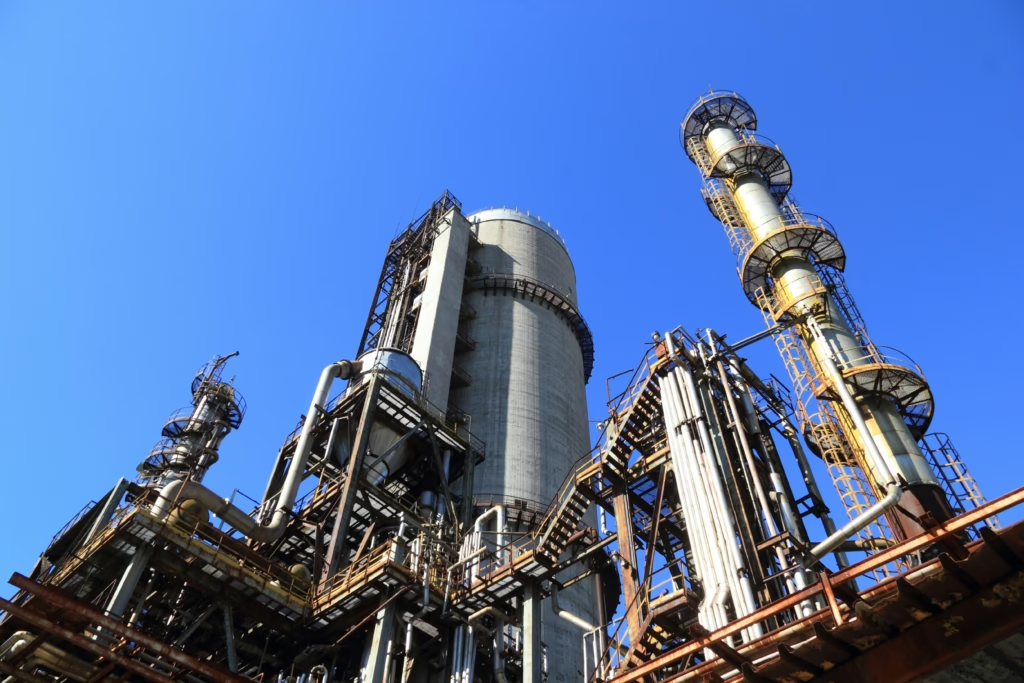
Africa’s energy story is often told in contradictions. A continent rich in crude oil resources continues to import billions of dollars’ worth of refined petroleum products every year. This imbalance has quietly shaped economies, influenced currencies, and constrained industrial growth across regions that should, in theory, be energy secure. What is now emerging, however, is not just another Africa Energy Investment announcement but a structural shift in how Africa thinks about energy, value, and power.
When Aliko Dangote signaled in Nairobi his intention to build a 650,000-barrel-per-day refinery in Tanzania, modeled after his already transformative complex in Lagos, the headline itself sounded familiar. Another mega-project. Another promise of industrialization. But beneath that surface lies a deeper, more consequential reality: this is a strategic intervention into one of Africa’s most persistent vulnerabilities, its dependence on external energy systems.
To understand why this matters, one must move beyond the announcement and examine the underlying structure of Africa Energy Investment and, more importantly, what changes when refining capacity is brought closer to consumption.
Africa Energy Investment Is Shifting from Extraction to Control
For decades, Africa has participated in the global energy system as a supplier of raw inputs and a buyer of finished products. Crude oil leaves African shores at relatively low margins, only to return as refined fuel at significantly higher costs. This is not just a trade imbalance; it is a structural dependency that exposes African economies to external pricing, currency volatility, and geopolitical disruptions.
What Dangote achieved in Nigeria was not merely building a refinery; it was creating leverage. By controlling refining capacity at scale, he effectively inserted Africa into a more powerful position within the energy value chain. Replicating that model in East Africa suggests a deliberate strategy: decentralize refining capacity across the continent and reduce reliance on distant supply hubs.
The proposed Dangote refinery in Tanzania is therefore not just about meeting demand; it is about shifting control. And control, in energy economics, translates directly into stability, pricing power, and geopolitical relevance.
East African Oil Security Has Always Been an Illusion
The phrase “East African oil security” is often used but rarely interrogated. In reality, the region has never been truly secure. Countries like Kenya have built relatively efficient import systems, but efficiency should not be mistaken for resilience.
Kenya’s fuel supply chain, for example, depends heavily on imports routed through global markets. This means that local prices are influenced less by domestic policy and more by international events, conflicts, shipping disruptions, currency swings, and even speculative trading.
What this creates is a form of “borrowed stability.” As long as global systems function smoothly, East Africa appears stable. But the moment those systems are stressed, vulnerabilities surface quickly, causing fuel shortages, price spikes, and economic ripple effects.

A refinery in Tanzania fundamentally changes this equation. It introduces proximity into the supply chain. And in energy economics, proximity is power. It reduces transit risks, shortens supply timelines, and creates the possibility of regional stockpiling and coordinated distribution.
But perhaps more importantly, it shifts the psychology of energy planning from reactive to strategic.
The Hidden Risk: The Impact of Middle East Conflict on Africa’s Oil
One of the least discussed but most critical dimensions of this development is the impact of Middle East conflict on Africa’s oil supply. Much of East Africa’s refined petroleum imports are linked, directly or indirectly, to the Middle East. This creates a silent exposure to one of the most volatile geopolitical regions in the world.
The global oil system is tightly interconnected. A disruption in the Middle East, whether through conflict, sanctions, or shipping bottlenecks, does not remain localized. It cascades through supply chains, affecting prices and availability worldwide.
For East Africa, this means vulnerability without influence. The region bears the consequences of disruptions it has no control over.
A Tanzanian refinery introduces a layer of insulation. It does not eliminate global exposure entirely; crude oil will still need to be sourced, but it significantly reduces dependence on imported refined products. This distinction is crucial. Controlling refining capacity allows a region to adapt more flexibly to disruptions, sourcing crude from alternative suppliers while maintaining local production.
In other words, it transforms East Africa from a passive recipient of global shocks into a more adaptive participant.
Economic Transformation: Beyond Fuel into Industrial Momentum
The economic implications of the Dangote refinery in Tanzania extend far beyond fuel supply. Large-scale refineries act as industrial anchors. They create ecosystems.
First, there is the direct impact: jobs, skills development, and local procurement. But the deeper effect lies in the industries that emerge around such infrastructure. Petrochemicals, plastics manufacturing, logistics, and even agriculture (through fertilizer production) can all benefit from the by-products of refining.
This is where Africa Energy Investment becomes a catalyst rather than a standalone sector. Energy, when strategically developed, becomes the foundation upon which other industries grow.
For Kenya, this presents both an opportunity and a challenge. On one hand, access to cheaper, more reliable fuel could lower production costs and enhance competitiveness. On the other hand, it may need to reposition itself within the regional value chain, perhaps focusing more on logistics, storage, and distribution rather than refining itself.
The countries that benefit most will be those that align their industrial policies with this new reality.
Regional Energy Challenges: The Risk Beneath the Opportunity
Despite its promise, the project is not immune to the regional energy challenges that have historically undermined similar ambitions.
Financing remains a critical hurdle. Projects of this scale require not just capital but patient capital, investment willing to endure long gestation periods and complex regulatory environments. Dangote’s success in Nigeria was as much about persistence as it was about funding.
Infrastructure is another constraint. A refinery is only as effective as the network that supports it. Pipelines, storage facilities, and transport systems must be developed in parallel. Without them, the benefits of refining capacity cannot be fully realized.
There is also the question of governance. Large infrastructure projects in Africa have often been slowed by bureaucratic inefficiencies, policy inconsistencies, and corruption risks. Ensuring transparency and regulatory stability will be key to attracting and sustaining investment.
Environmental Tension: Development vs. Transition
No serious analysis of Africa Energy Investment can ignore the environmental dimension. The world is moving, albeit unevenly, toward cleaner energy systems. Investing in large-scale fossil fuel infrastructure at this moment raises legitimate concerns.
Critics argue that such projects risk locking Africa into a carbon-intensive path just as global markets begin to shift. There is also the question of stranded assets. What happens if global demand for fossil fuels declines faster than expected?
Yet this perspective must be balanced against Africa’s developmental realities. Energy demand in the region is still growing. Industrialization requires reliable and affordable energy, and renewables, while promising, are not yet sufficient to meet all needs.
The real question is not whether to invest in refining, but how to integrate it into a broader, more sustainable energy strategy. This could include using refinery revenues to fund renewable projects, adopting cleaner technologies, and ensuring strict environmental standards.
A Quiet Geopolitical Shift
Perhaps the most underappreciated aspect of the Dangote refinery in Tanzania is its geopolitical significance. Energy infrastructure shapes power dynamics. Countries that control energy flows often wield disproportionate influence.
By establishing a major refining hub in East Africa, Tanzania could elevate its regional standing. It would become not just a consumer but a supplier, a shift that carries both economic and political weight.
For Kenya, the implications are nuanced. While it stands to benefit economically, it may also need to navigate a changing regional hierarchy. Strategic partnerships, rather than competition, will likely determine outcomes.
More broadly, this development signals a shift toward intra-African energy integration. Instead of relying primarily on external partners, African countries are beginning to build systems that serve each other.
Africa Energy Investment Is Entering a Strategic Era
What makes this moment different is not just the scale of the proposed refinery, but the intent behind it. This is not merely about meeting demand, it is about reshaping the structure of dependence that has defined Africa’s energy landscape for decades.
The proposed Dangote refinery in Tanzania sits at the intersection of economics, geopolitics, and development. It offers a pathway toward stronger East African oil security, reduced exposure to the impact of Middle East conflict on Africa oil, and a more resilient response to regional energy challenges.
But its success will depend on execution, coordination, and vision. If done right, it could mark the beginning of a new phase in Africa Energy Investment, one where the continent moves from the margins of the global energy system to a position of greater control and influence.
And that, ultimately, is the deeper story: not just a refinery, but a redefinition of power.
About The Author