Central Bank of Kenya Defies Weak Demand to Raise KSh 30.1 Billion in Bond Auctions
The Central Bank of Kenya has raised KSh 30.1 billion through Treasury bond auctions to meet April budget needs, but cautious investor demand and signs of undersubscription reveal growing concerns about long-term debt and fiscal sustainability.
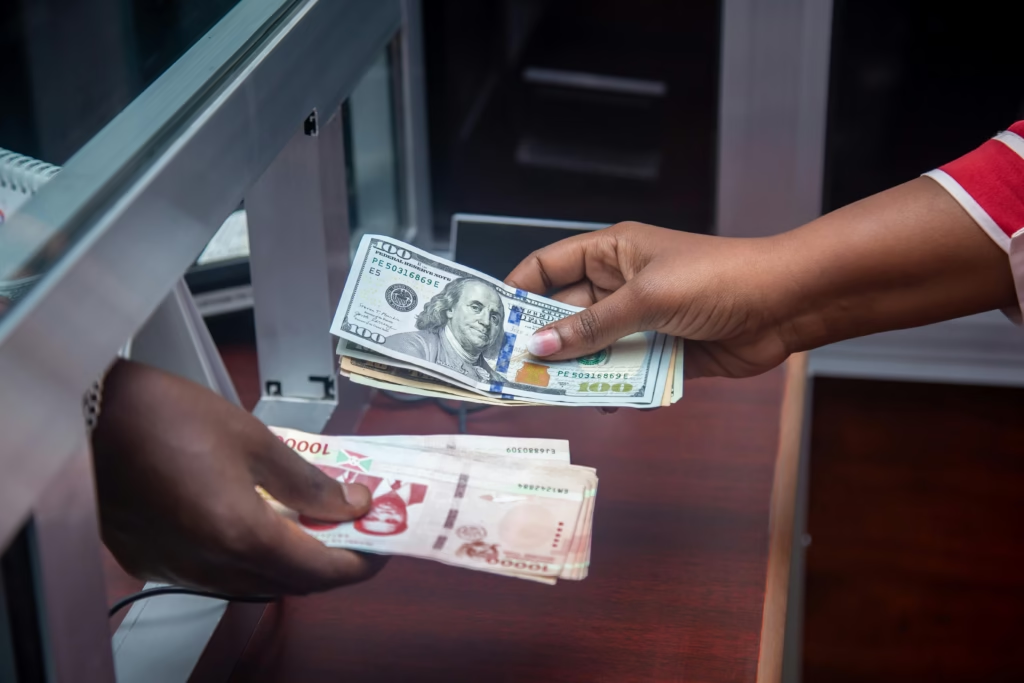
The Central Bank of Kenya raises additional KSh 30.1Bn for budgetary spend through Treasury bond auctions at a time when fiscal pressures are intensifying and investor sentiment is becoming increasingly cautious. This development reflects a delicate balancing act between government financing needs and market confidence. While the government successfully mobilized funds to support April budgetary requirements, the overall auction performance revealed underlying concerns among investors, particularly regarding long-term debt instruments.
Treasury bond auctions are a critical component of Kenya’s domestic borrowing strategy, allowing the government to finance deficits without relying excessively on external debt. However, the latest auction results, where bids for 30-year bonds reached KSh 38.3 billion but showed signs of undersubscription in certain segments, highlight evolving dynamics in the fixed-income market.
In this article we shall explore the implications of the latest auction, investor behavior, macroeconomic signals, and what this means for Kenya’s broader financial outlook.
Treasury Bond Auctions and Government Borrowing Strategy
The Treasury bond auctions conducted by the Central Bank of Kenya serve as a primary mechanism for raising long-term capital. These instruments typically attract institutional investors such as pension funds, insurance companies, and commercial banks seeking stable returns over extended periods.
In April, the government faced heightened expenditure pressures, necessitating additional borrowing. The Central Bank stepped in to facilitate this process, successfully raising KSh 30.1 billion. While this figure contributes meaningfully to short-term fiscal needs, it falls within a broader context of increasing reliance on domestic debt markets.
Kenya’s public debt has been steadily rising, prompting policymakers to prioritize domestic borrowing as a relatively less risky alternative compared to foreign-denominated loans. Treasury bonds, particularly long-term ones like the 30-year bonds offered in this auction, are central to this strategy because they spread repayment obligations over a longer horizon.
However, the effectiveness of this approach depends heavily on investor appetite, which appears to be shifting.
Investor Demand for Government Bonds
The latest auction results reveal nuanced trends in investor demand for government bonds. While total bids for the 30-year bonds reached KSh 38.3 billion, indicating a level of interest, the overall subscription levels suggest caution rather than strong enthusiasm.
Several factors are influencing this cautious stance:
First, interest rate expectations play a significant role. Investors closely monitor inflation trends and central bank policy signals when deciding whether to commit funds to long-term instruments. If investors anticipate rising interest rates in the future, they may hesitate to lock in funds at current yields, preferring shorter-term securities or waiting for better returns.
Second, liquidity considerations are becoming increasingly important. Long-term bonds tie up capital for extended periods, reducing flexibility for investors. In uncertain economic conditions, many prefer maintaining liquidity rather than committing to long-duration assets.
Third, fiscal sustainability concerns are gradually shaping investor sentiment. As government borrowing increases, questions arise about future repayment capacity and potential risks, even in domestic currency terms.
Together, these factors explain why investor participation, while present, has been measured rather than aggressive.
Undersubscription in Bond Auctions
One of the key takeaways from the April auction is the emergence of undersubscription in bond auctions in certain segments. Undersubscription occurs when the total value of bids received falls short of the amount the government intends to raise.
Although the Central Bank ultimately raised KSh 30.1 billion, the uneven demand across different maturities signals that not all instruments were equally attractive to investors. This is particularly relevant for long-term bonds, which tend to be more sensitive to macroeconomic uncertainty.

Undersubscription can have several implications:
It may force the government to adjust yields upward to attract more investors, increasing the cost of borrowing. Higher yields translate into higher interest payments over time, adding pressure to public finances.
It can also indicate weakening confidence in long-term economic stability. Investors may be signaling concerns about inflation, currency stability, or fiscal discipline.
Finally, repeated undersubscription could push the government to rely more heavily on short-term instruments such as Treasury bills, which carry rollover risks and can create liquidity pressures in the future.
In this context, the April auction serves as an early warning sign rather than an immediate crisis.
Impact on Kenya’s Fiscal Policy
The impact on Kenya’s fiscal policy is significant, as domestic borrowing continues to play a central role in budget financing. The KSh 30.1 billion raised will help bridge immediate funding gaps, but it also underscores the structural challenges facing fiscal management.
Kenya’s budget deficits have been driven by a combination of factors, including infrastructure spending, public sector wages, and debt servicing obligations. As external financing conditions tighten globally, domestic markets are becoming the primary source of funding.
This shift has both advantages and risks:
On the positive side, borrowing in local currency reduces exposure to exchange rate fluctuations. It also strengthens the domestic financial market by deepening the bond market.
On the downside, increased domestic borrowing can crowd out private sector credit. When the government absorbs a large share of available capital, businesses may find it more difficult or expensive to access financing, potentially slowing economic growth.
Moreover, rising domestic debt levels can lead to higher interest rates across the economy, affecting everything from mortgages to business loans.
Kenya Financial Market Trends
The latest auction results provide valuable insights into broader Kenya financial market trends. The cautious investor behavior observed in the bond market reflects a complex economic environment characterized by competing pressures.
Inflation remains a key concern, influencing both monetary policy and investor expectations. While efforts to stabilize prices are ongoing, any uncertainty in inflation outlook can dampen demand for long-term securities.
At the same time, global economic conditions are exerting indirect effects. Changes in international interest rates, particularly in major economies, are influencing capital flows and investor preferences in emerging markets like Kenya.
Currency stability is another factor shaping market dynamics. Although domestic bonds are denominated in Kenyan shillings, exchange rate volatility has an impact on investors’ confidence, especially for foreign participants.
Despite these challenges, Kenya’s financial markets continue to demonstrate resilience. The ability to raise KSh 30.1 billion, even amid cautious sentiment, indicates a functioning and relatively robust domestic debt market.
The Role of Long-Term Bonds in Economic Stability
Long-term bonds, such as the 30-year instruments offered in this auction, play a crucial role in economic planning and stability. They allow governments to finance large-scale projects and spread costs over time, aligning repayment with long-term economic benefits.
However, their success depends heavily on investor confidence. When investors are willing to commit funds for decades, it signals trust in the country’s economic trajectory and institutional stability.
The mixed response to the 30-year bonds in this auction suggests that while confidence has not collapsed, it is not as strong as policymakers would prefer. This creates a need for careful communication and policy consistency to reassure markets.
Maintaining credibility in fiscal and monetary policy will be essential for sustaining demand for long-term instruments.
Policy Implications and Future Outlook
Looking ahead, the Central Bank of Kenya and the National Treasury will need to navigate a complex landscape. The outcome of the latest auction highlights the importance of balancing borrowing needs with market realities.
Several policy considerations emerge:
First, maintaining transparency in debt management will be critical. Clear communication about borrowing plans and fiscal targets can help build investor confidence.
Second, aligning interest rate policies with market expectations will be essential. If yields are perceived as unattractive relative to risk, demand will remain subdued.
Third, diversifying funding sources could reduce reliance on any single market segment. This includes exploring alternative instruments or strengthening access to concessional financing.
In the short term, the government is likely to continue relying on Treasury bond auctions to meet budgetary needs. However, sustained cautious demand may require adjustments in strategy, including offering more competitive yields or restructuring maturities.
What This Means for Kenya’s Economic Future
The fact that the Central Bank of Kenya raises KSh 30.1 billion through Treasury bond auctions underscores both the resilience and the challenges of Kenya’s domestic debt market. While the government successfully secured funding to meet immediate budget needs, the cautious investor response and signs of undersubscription reveal deeper concerns that cannot be ignored.
Investor behavior is increasingly influenced by macroeconomic uncertainty, interest rate expectations, and fiscal sustainability considerations. As a result, future auctions may require more strategic planning and policy alignment to ensure consistent success.
Ultimately, the trajectory of Kenya’s borrowing strategy will depend on its ability to maintain investor confidence while managing fiscal pressures. The April auction serves as a critical data point in this ongoing process, one that highlights the importance of balancing ambition with prudence in economic management.
About The Author