Shocking Collapse of KOKO Networks Leaves Employees Exposed and Creditors Facing Massive Losses
The collapse of KOKO Networks has triggered severe financial consequences in Kenya, with employees receiving little support while creditors suffer massive losses. This article explores the causes, impact, and broader implications.
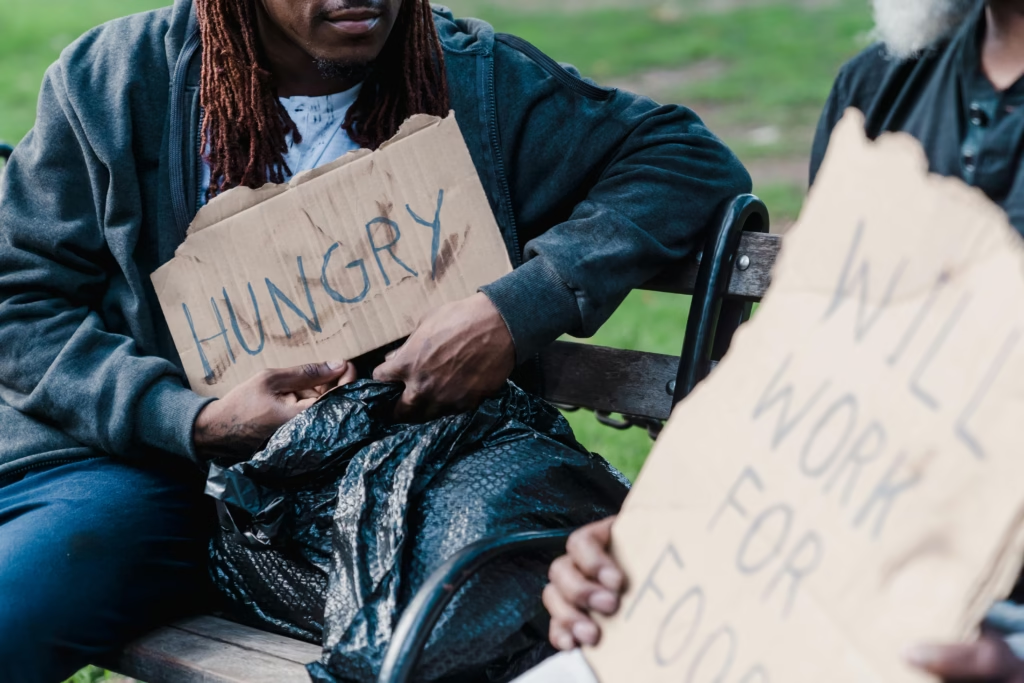
The sudden collapse of KOKO Networks has become one of the most consequential corporate failures in Kenya’s recent history. Once celebrated as a revolutionary clean energy company serving over a million households, KOKO’s downfall has left a trail of financial distress. Employees have been rendered jobless with limited financial protection, while creditors, including suppliers, partners, and investors, face potentially devastating losses.
This unfolding crisis is not merely about one company’s failure. It exposes structural weaknesses in corporate governance, insolvency frameworks, and the protection of workers in emerging markets. It also raises serious concerns about Kenya’s attractiveness to investors in innovative sectors like clean energy.
The Rise and Fall of KOKO Networks
To understand the magnitude of the collapse, it is essential to revisit the meteoric rise of KOKO Networks. Founded in 2014, the company pioneered a technology-driven clean cooking solution using bioethanol fuel, positioning itself as an alternative to charcoal and kerosene. By 2023, it had reached over one million households and was seen as a flagship model for sustainable energy innovation.
KOKO’s business model was unique. It sold subsidized cooking fuel and stoves, relying heavily on revenue from carbon credit markets to offset costs. However, this model proved fragile. When the Kenyan government declined to authorize the sale of carbon credits internationally, a crucial revenue stream disappeared.
Without access to carbon financing, the company could no longer sustain its operations. The result was an abrupt shutdown in early 2026, followed by entry into administration under PricewaterhouseCoopers.
KOKO Networks’ Collapse Impact on Employees
One of the most immediate and painful consequences of the KOKO Networks collapse has been the impact on employees. More than 700 workers lost their jobs almost overnight, with little clarity on severance or compensation.
Unlike large corporations with structured redundancy packages, startups often lack robust employee protection mechanisms. In KOKO’s case, the sudden nature of the shutdown meant that many employees were left without financial cushioning. Reports indicate that workers must now file claims alongside other creditors in the insolvency process, placing them in direct competition with larger, more legally equipped entities.
This situation highlights a critical issue: employees, despite being among the most vulnerable stakeholders, often rank lower in priority during insolvency proceedings. While labor laws provide some safeguards, enforcement becomes complex once a company enters administration.
The result is a harsh reality; many former employees may receive only a fraction of what they are owed, if anything at all.
Creditor Losses in KOKO Networks Collapse
While employees face hardship, creditors are confronting even larger financial risks. The KOKO Networks collapse has triggered a scramble among suppliers, partners, and financial backers to recover their funds.
Administrators have instructed all creditors to submit claims within a strict timeline, with failure to comply risking total loss. This process underscores the severity of the situation: there are likely insufficient assets to cover all liabilities.
Creditors fall into several categories, each facing different levels of exposure:
- Trade suppliers who provided goods and services
- Small business agents who operated KOKO distribution points
- Institutional investors and lenders
- Government-linked entities tied to carbon credit agreements
In insolvency hierarchies, secured creditors typically recover first, leaving unsecured creditors, many of whom are small businesses, at the greatest risk of substantial losses.
The scale of potential losses is amplified by KOKO’s capital-intensive model. The company had invested heavily in infrastructure, subsidies, and expansion, meaning that liquidation values may fall far short of total obligations.
Insolvency Proceedings Kenya: Why Employees Lose Out
The KOKO case provides a real-world example of how insolvency proceedings in Kenya operate under the Insolvency Act. Once a company enters administration, control shifts from directors to appointed administrators whose primary duty is to maximize returns for creditors.
This legal framework, while necessary for orderly resolution, often disadvantages employees. Their claims are categorized differently and may not receive immediate priority unless specifically protected under labor provisions.
Moreover, the administrative process itself is a bit complex and inaccessible. Employees and small creditors must submit detailed documentation within tight deadlines, a requirement that many may struggle to meet.
The imbalance becomes clear: well-resourced creditors with legal expertise are better positioned to recover funds, while ordinary workers face procedural and informational barriers.
KOKO Networks Financial Crisis and Business Model Failure
At the heart of the collapse lies a deeper issue, the fragility of KOKO’s financial model. The company’s reliance on carbon credit revenue created a structural vulnerability. When regulatory approval was denied, the entire system unraveled.
This dependency highlights a broader risk in emerging market startups: over-reliance on external or uncertain revenue streams. In KOKO’s case, the inability to monetize carbon credits eliminated the financial backbone that supported its subsidized pricing strategy.
The crisis also raises questions about policy consistency and regulatory risk in Kenya. Investors depend on predictable frameworks, especially in sectors like climate finance. The breakdown of agreements or delays in approvals can have cascading effects, as seen in this case.
Clean Energy Startup Collapse in Kenya: Wider Economic Implications
The collapse of KOKO Networks extends beyond employees and creditors. It has broader implications for Kenya’s economy and its position as a hub for innovation.
First, the shutdown has cut off access to affordable clean cooking solutions for more than 1.5 million households. Many of these households may revert to charcoal or kerosene, negating environmental and health benefits.
Second, the failure sends the wrong signal to investors. Kenya has been positioning itself as a green energy and climate innovation leader. But high-profile failures, particularly those involving regulatory disputes, can undermine confidence.
Third, the case illustrates the dangers of public-private partnerships in nascent industries. When expectations diverge between governments and companies, the consequences can be dire.
The Human Cost: Beyond Numbers
While financial losses dominate headlines, the human cost of the KOKO Networks collapse is equally significant. Employees have lost livelihoods, small business agents have seen their income streams disappear, and households have lost access to affordable energy.

For many workers, the collapse represents more than just unemployment. It disrupts financial stability, family welfare, and future career prospects. In a country where formal employment opportunities are limited, such shocks will definitely have long-lasting effects.
Similarly, small-scale creditors, often operating with thin margins, will face business closure if they fail to recover their dues.
Lessons for Investors and Policymakers
The KOKO case offers critical lessons for multiple stakeholders.
For investors, it underscores the importance of assessing regulatory risk alongside business fundamentals. Even innovative and well-funded companies can fail if their operating environment becomes unstable.
For policymakers, the collapse highlights the need for clearer frameworks and stronger protections for workers. Ensuring that employees are not left vulnerable in corporate failures should be a priority.
For entrepreneurs, the lesson is equally stark: sustainable business models must be resilient to policy shifts and external shocks.
What Happens Next?
The future of KOKO Networks now depends on the outcome of the administration process. Administrators will evaluate whether the company can be restructured, sold, or liquidated.
However, regardless of the outcome, one reality is clear: employees are unlikely to receive substantial financial assistance, while creditors face significant losses.
The claims process will determine how remaining assets are distributed, but given the scale of liabilities, recoveries may be limited.
A Stark Warning for Kenya’s Business Landscape
The collapse of KOKO Networks is a powerful reminder of the risks inherent in high-growth, innovation-driven sectors. While the company once symbolized progress in clean energy, its downfall reveals deep vulnerabilities in business models, regulatory environments, and worker protections.
Employees, often the backbone of such enterprises, have been left exposed with minimal financial support. Meanwhile, creditors, ranging from small businesses to institutional investors, face enormous losses that may never be fully recovered.
The broader implication is clear: without stronger safeguards, similar collapses could continue to disproportionately affect the most vulnerable stakeholders. For Kenya to sustain its growth as an innovation hub, it must address these structural challenges and ensure that the costs of failure are not borne unfairly.
The KOKO Networks collapse is ultimately not just a corporate story but a cautionary tale on the intersection of innovation, policy, and human impact.
About The Author