Explosive Support: Western Kenya Residents Shower Sifuna’s Linda Mwananchi with Cash Donations
Explosive grassroots energy is transforming Kenyan politics as Western Kenya residents shower Sifuna’s Linda Mwananchi with cash donations, funding a citizen-driven challenge to elite-backed campaigns ahead of 2027.
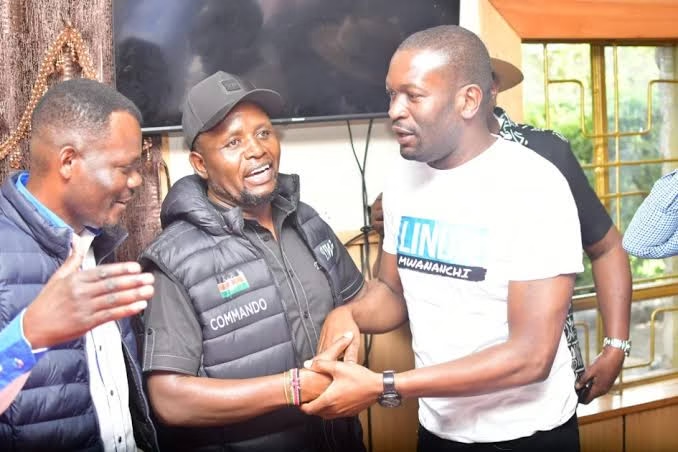
In the dusty trading centres and packed grounds of Trans Nzoia and Bungoma, ordinary Kenyans have begun rewriting the unwritten rules of political financing. During the Linda Mwananchi movement’s recent Western Kenya tour, residents did not merely cheer or wave placards. They stepped forward with notes in hand, pressing cash into the hands of organisers and leaders, turning public rallies into spontaneous collection points.
This is not the familiar theatre of big-money politics where a handful of tycoons underwrite an entire campaign in exchange for future tenders and influence. It is something rarer and more disruptive: the open, visible transfer of small amounts of money from the pockets of wananchi to a movement that claims to answer only to them. Nairobi Senator Edwin Sifuna has repeatedly framed these Linda Mwananchi cash donations as proof that a different model is possible, one in which the people themselves bankroll the politics that claims to serve them.
The scenes in places such as Kiminini, Chwele, Kimilili and Bungoma town were striking precisely because they inverted the usual power dynamic. Supporters approached Sifuna and other leaders mid-speech, handing over money while the cameras rolled. Sifuna paused on more than one occasion to acknowledge the gifts, using the moments to underline a central message: the movement does not need the patronage of a few wealthy financiers. “I would rather have KSh 10 from wananchi than accept millions from a handful of rich people who will later come to collect political favours,” he told one gathering.
The statement is more than rhetoric. It is an explicit rejection of the patronage system that has long defined Kenyan electoral politics, where campaigns are treated as investments by the rich and the returns are extracted from the public purse once power is secured.
Edwin Sifuna Western Kenya Rallies and the Birth of Visible Ownership
The Western Kenya leg of the tour, which included stops across Trans Nzoia before culminating in Bungoma, was designed as both mobilisation and demonstration. Accompanied by Trans Nzoia Governor George Natembeya, Embakasi East MP Babu Owino, Kakamega Senator Boni Khalwale and other allies, Sifuna moved through trading centres and larger grounds, drawing crowds that local organisers described as energetic and self-organised.
What distinguished these Edwin Sifuna Western Kenya rallies was the unscripted nature of the financial support. In Kiminini, residents gifted cash on the spot. In Chwele, contributions arrived during the address itself. These were not pre-arranged cheque presentations or discreet bank transfers; they were public acts performed in full view of neighbours and media.
Sifuna used the moments to draw a sharp contrast with conventional campaign economics. He argued that when ten rich people fund a presidential bid, those ten become the only true beneficiaries of government. By contrast, when thousands of small donors contribute, the resulting administration remains accountable to a much broader constituency.
The logic is straightforward and politically potent. A candidate who owes his platform to ordinary citizens can more credibly promise policies that hurt elite interests—lower fuel prices, the scrap of certain levies, or a genuine attack on state capture—because the financial base does not depend on those same elites. Whether that logic survives contact with the realities of governing is another question, but the immediate effect is to create a sense of shared ownership that traditional campaigns rarely achieve.
The timing matters. The Western Kenya tour followed the formal launch of a public M-Pesa paybill for the movement. Within the first day, organisers reported more than 9,000 individual contributions totalling over Sh519,000. Within 36 hours the figure had climbed past Sh2.2 million. The dominant denomination was the symbolic Sh10. Sifuna repeatedly thanked supporters for those small amounts, insisting that the daily inflows proved the paybill was working and that the movement could sustain itself without wealthy backers or government-linked money. The physical cash handed over during the rallies functioned as a public confirmation of the digital numbers. People who had already sent Sh10 via phone were now adding notes in person, turning abstract support into tangible commitment.
Grassroots Political Funding in Kenya Challenges the Old Order
Kenya’s political financing has long operated in the shadows. Large donations are rarely disclosed in real time, and the formal legal framework under the Election Campaign Financing Act remains weakly enforced. Caps, disclosure rules and independent oversight exist more on paper than in practice.
Against that backdrop, the decision to invite micro-donations through a publicly advertised paybill and to celebrate physical cash gifts at rallies represents a deliberate break. Grassroots political funding in Kenya has existed before—church collections, community harambees, occasional party appeals—but rarely has it been positioned as the primary engine of a national political project with presidential ambitions.
The comparison often drawn is with Barack Obama’s 2008 campaign, which raised hundreds of millions of dollars from small online donors and used that base to claim independence from special interests. The parallel is imperfect. Kenya’s economy is far smaller, disposable incomes are tighter, and the regulatory environment around digital payments is more politicised. Yet the psychological effect is similar.
When a supporter sends Sh10 or hands over a few hundred shillings at a rally, the act becomes a declaration of belonging. The donor is no longer a spectator; he or she is a stakeholder. Sifuna has leaned into this language, speaking of a politics “funded and driven by wananchi themselves.”
Critics are not silent. Some question whether the volume of small donations can ever match the logistical demands of a nationwide campaign. Fuel for convoys, sound systems, advertising, security and sustained mobilisation across 47 counties cost real money measured in tens or hundreds of millions of shillings.
The Sh2.2 million raised in the first day and a half is impressive as a proof of concept, but it is modest against the scale of what lies ahead. Others point to the temporary disruption of the paybill shortly after its launch, which Sifuna attributed to “orders from above”. The episode, whether caused by a technical glitch, an internal Safaricom process or external pressure, illustrated the vulnerability of any fundraising channel that relies on a single corporate platform operating under the shadow of the state.
There is also the persistent claim, repeated by opponents, that the movement is secretly bankrolled by larger political figures, most commonly former President Uhuru Kenyatta. Sifuna has repeatedly denied the allegation and challenged critics to produce evidence, noting that the paybill statements and M-Pesa records are available for scrutiny. In the absence of public proof, the charge functions more as political messaging than established fact. Still, the suspicion itself reveals how thoroughly Kenyan political culture equates serious ambition with elite sponsorship. A genuinely citizen-funded effort is so unusual that many observers struggle to believe it exists.
Sifuna 2027 Presidential Bid Gains Momentum from Public Money
The cash and the crowds have accelerated speculation around a Sifuna 2027 presidential bid. The senator has been careful not to make a formal declaration, stating that he intends to take the Linda Mwananchi movement through all 47 counties before deciding. Yet the movement’s own leaders have already positioned him as their preferred candidate, and recent opinion polls have ranked him among the leading opposition figures.
The Western Kenya reception matters because the region remains a critical electoral battleground. Strong local support, visible financial contributions and the endorsement of figures such as Governor Natembeya strengthen the argument that Sifuna can assemble a credible national coalition.
Whether that coalition can expand beyond current strongholds is the harder test. Kenya’s politics remains heavily ethnic and regional. A movement that draws enthusiastic cash donations in Bungoma and Trans Nzoia must still persuade voters in Central, Rift Valley, Coast and North Eastern that its agenda is not merely another vehicle for one community’s ambitions. The emphasis on cost-of-living issues—fuel prices, housing levies, agricultural support—offers a potential bridge, but translating economic grievance into durable multi-ethnic organisation has defeated many previous opposition projects.
The brutal honesty required here is that enthusiasm is not the same as institutional strength.
Movements that begin with volunteer energy and small donations often struggle once the initial wave recedes. Sustaining a professional campaign apparatus for more than a year demands consistent income, professional management of funds, transparent accounting and the ability to withstand both external attacks and internal mismanagement. Sifuna has promised public accountability for every contribution. Delivering on that promise will be essential if the moral advantage of citizen funding is not to evaporate in allegations of misuse.
Citizen-Driven Political Campaigns and the Risks They Carry
What is unfolding is an experiment in citizen-driven political campaigns. If it succeeds, it could loosen the grip of wealthy financiers on the country’s political destiny and force future candidates to court the public rather than a handful of kingmakers. If it fails, it will be remembered as another brief flare of popular energy that could not overcome the structural advantages of money and incumbency. The difference will turn on several practical questions that the movement has only begun to answer.
First is transparency. Publishing regular, independently audited statements of income and expenditure would convert the current goodwill into lasting trust. Second is institutionalisation. A movement that remains centred on one charismatic senator risks collapsing if that individual’s fortunes change.
Registering as a political party, building durable local structures and creating clear succession and decision-making processes are necessary if the project is to outlast any single election cycle. Third is coalition politics. Even a well-funded citizen movement will struggle to win a presidential election alone. Negotiations with other opposition forces will eventually test whether the pure grassroots model can accommodate the compromises of broader alliance-building.
The cash that Western Kenya residents have pressed into Sifuna’s hands is more than symbolic. It is a demand for a different relationship between citizen and politician. For decades, Kenyans have been asked to vote and then wait while the real decisions were made in private rooms by people who paid for the campaign.
The Linda Mwananchi cash donations reverse that sequence. The people are paying first and expecting to be owed something in return. Whether that expectation can be institutionalised into accountable government is the central question this moment poses. The answer will not be found in the size of the next donation or the volume of the next crowd. It will be found in the quieter, harder work of building systems that make the money and the power it purchases answerable to the many rather than the few.
The scenes from Kiminini, Chwele and Bungoma are real. The numbers from the paybill are real. The political challenge they represent is also real. Kenya has seen many populist surges. Few have been financed so visibly by the people they claim to represent. The coming months will reveal whether this one has the depth to endure.
About The Author