Manchester United vs AC Milan: Furious Pre-Season Warning as Carrick Faces Amorim in a Defining Final Test
Manchester United vs AC Milan brings Michael Carrick face to face with former United boss Ruben Amorim in a tense final pre-season test. With Amorim under pressure after Milan’s difficult preparations and Carrick still searching for proof that his revived United side is truly ready, this friendly could expose uncomfortable weaknesses before the Premier League season begins.
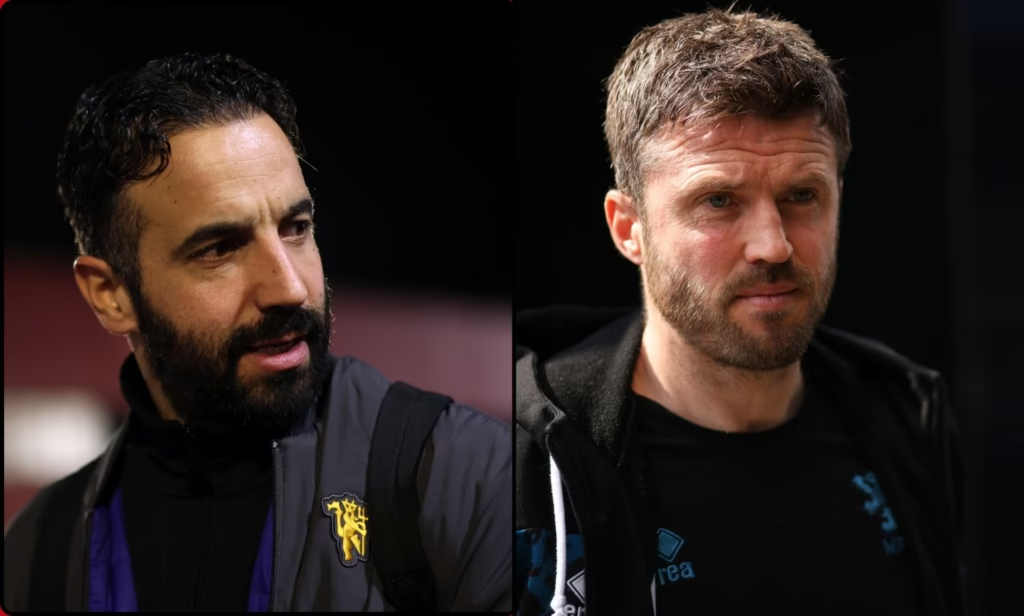
Manchester United vs AC Milan Is More Than a Friendly
The final score may not count towards the Premier League table, but pretending that Manchester United vs AC Milan is just another meaningless pre-season exercise would be a serious misunderstanding of the circumstances surrounding this match. Manchester United are approaching the final stages of their preparation for the 2026/27 campaign, while AC Milan arrive with their own questions, their own tactical problems and, most significantly, a manager with an unusually personal connection to the opposition.
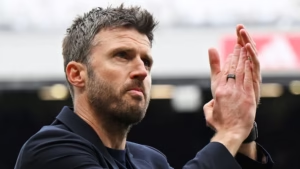
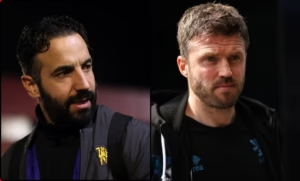
Ruben Amorim will stand in the AC Milan technical area against the club that dismissed him in January. Michael Carrick, the man who arrived after Amorim’s departure and transformed himself from caretaker into permanent head coach, will be in the opposite dugout. The symbolism is impossible to ignore, even if both managers attempt to reduce the occasion to another stage of preparation.
The facts surrounding their respective journeys are stark. Amorim left Manchester United on January 5 after 14 months in charge, with the club sitting sixth in the Premier League. United described the decision as reluctant but concluded that a change was necessary to give the team the best possible opportunity to achieve a stronger league finish. His departure ended a turbulent period in which his overall record and league performances had generated serious questions about whether his tactical project could ever function consistently at Old Trafford.
Carrick’s arrival changed the trajectory of the season dramatically. Initially appointed until the end of the campaign, he won 11 of his 16 matches and lifted United from seventh to third, securing Champions League qualification and ultimately earning a permanent two-year contract.
The difference between where United were under Amorim and where they finished under Carrick is the reason this meeting carries more emotional and analytical weight than an ordinary summer friendly.
AC Milan officially appointed Amorim as their head coach in June, presenting him as a modern coach with a strong tactical identity built around pressing, possession, transitions, and player development. Yet a promising philosophy on paper does not automatically guarantee immediate results. Milan’s preparations have already attracted scrutiny, particularly after disappointing pre-season performances, and their meeting with United comes at an inconvenient time for a manager who cannot afford to begin another major job with questions multiplying around him.
That is what makes Manchester United vs AC Milan genuinely interesting. This is not simply a match between two famous European institutions. It is a confrontation between the manager Manchester United abandoned and the manager who benefited from the collapse of his predecessor’s project.
Ruben Amorim Has a Point to Prove, but Emotion Will Not Solve Milan’s Problems
There is no need to invent a dramatic revenge narrative to understand why this match matters to Amorim. Any ambitious manager would want to perform well against a former employer, particularly when his departure was followed by a dramatic improvement in results. Amorim does not need to publicly declare that he has a point to prove. The circumstances do that for him.
His time at Manchester United ended badly. The Portuguese coach had arrived with an impressive reputation after his success at Sporting CP, where he built a clearly identifiable footballing project and won major honors. The attraction of his appointment was understandable. Manchester United wanted structure, modern tactical thinking, and a coach capable of establishing a long-term identity.
The problem was that the theory never consistently became reality at Old Trafford.
Amorim’s system became a subject of continuous debate. His preferred tactical structure demanded specific profiles and collective understanding, but Manchester United frequently looked uncomfortable within it. Results fluctuated, performances lacked consistency, and the relationship between tactical ideology and the available squad often appeared strained. By the time he departed, the club’s leadership had concluded that waiting for the project to improve carried too much risk.
The uncomfortable part for Amorim is what happened next. Carrick inherited the same club in the middle of the season and produced an immediate improvement. United defeated major opponents, climbed the table, and eventually finished third. Carrick’s success does not prove that every problem under Amorim was exclusively Amorim’s fault. Football is never that simple. A change of manager can alter confidence, selection, communication, and momentum at the same time.
However, the contrast is still impossible to escape.
Carrick demonstrated that the Manchester United squad was capable of substantially better results than it had produced during Amorim’s final months. That does not erase Amorim’s achievements before arriving in England, but it damages the argument that his difficulties were entirely caused by an impossible squad or an unmanageable club environment.
Now Amorim has AC Milan, another enormous institution with an impatient fanbase and a history that creates immediate expectations. Milan themselves announced that their new coach was selected partly because of his modern tactical approach and his ability to build a clear playing identity.
Yet the early signs have not been entirely convincing. Reports from Milan’s pre-season have described growing scrutiny after disappointing performances, including a heavy defeat to Chelsea, with concerns surrounding the team’s adaptation to Amorim’s tactical ideas.
That makes the Manchester United match dangerous for him. A defeat would not destroy his Milan project, because pre-season results should never be treated as definitive evidence of what will happen over nine months. But another poor performance, particularly against the club that replaced him and immediately improved, would create an unwanted narrative before Serie A has properly begun.
Amorim therefore has a point to prove, but proving it requires more than motivation. He needs evidence that Milan are beginning to understand what he wants from them.
Michael Carrick Must Show That Manchester United’s Revival Was Not Just a Rescue Operation
Carrick deserves enormous credit for what he achieved after returning to Manchester United. His initial appointment was not supposed to become a permanent revolution. He was brought in to stabilize a club that had removed its manager midway through the season, and his job was initially limited to the remainder of the campaign.
Instead, he turned an emergency appointment into a permanent position.
According to the Premier League’s official profile, Carrick won 11 of his 16 matches in charge after taking over and lifted United from seventh to third. Manchester United subsequently confirmed his permanent appointment after a run that restored Champions League football and dramatically improved the mood around the club.
But rescuing a season and building a successful era are entirely different tasks.
That is the central issue facing Carrick now.
The honeymoon period is over. Supporters will remain grateful for the recovery, but gratitude does not protect managers forever. Once the new Premier League season begins, every tactical decision, poor result, and weak performance will be judged against the expectations created by last season’s remarkable turnaround.
About The Author