Manchester United Transfer News: Carrick’s Brutal Summer Demand Could Expose INEOS and the Glazers
The latest Manchester United transfer news suggests Michael Carrick believes his squad still needs reinforcements before the summer window closes. The real question is whether INEOS and the Glazers will provide the backing required—or gamble on another incomplete rebuild.
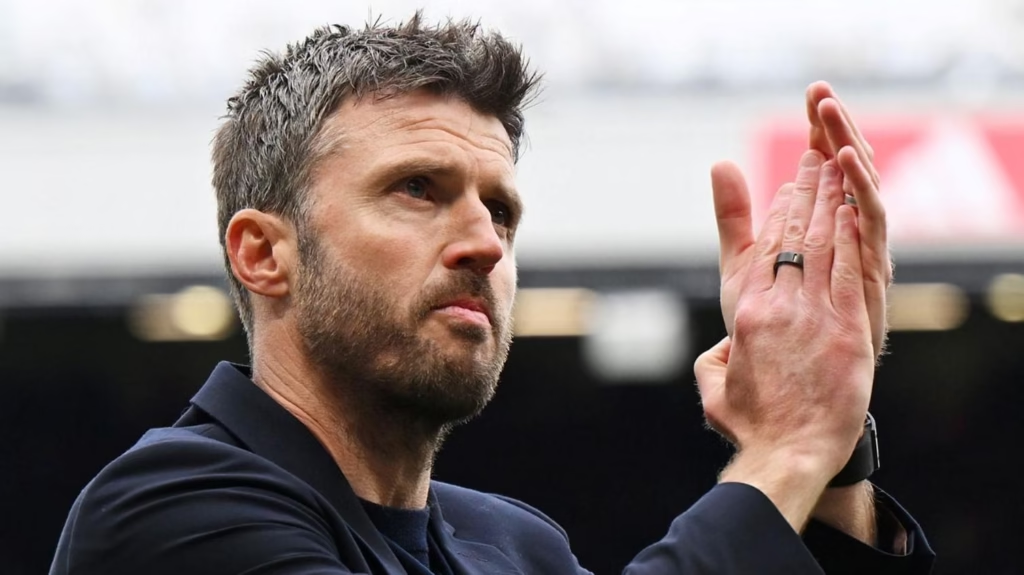
Manchester United transfer news is once again being shaped by a familiar and deeply uncomfortable question: when the manager identifies weaknesses in his squad, will the people above him actually give him the tools required to fix them? Reports and discussion surrounding the closing stages of the summer window suggest that Michael Carrick believes Manchester United still needs additional players before business officially ends. If that assessment is accurate, it should not be dismissed as the routine appetite of a manager who simply wants more options. It would instead represent a far more serious warning about the state of a squad that has already consumed enormous sums of money and yet still appears vulnerable in crucial areas.
The central issue is not whether Manchester United can find players. A club of United’s financial scale, global profile, and commercial power can identify targets in almost every major market. The harder question is whether INEOS, working within the club’s ownership structure alongside the Glazer family, is prepared to sanction the final pieces of business required to give Carrick a genuinely competitive squad. That distinction matters because there is a significant difference between declaring a transfer window successful and actually entering a season with a balanced team capable of surviving injuries, tactical problems, and the relentless demands of elite football.
Why Michael Carrick’s Transfer Demands Matter More Than Another Summer Rumour
The latest Manchester United transfer news has to be examined in the context of what Carrick has already achieved and what awaits him next. He was not handed the permanent job after a full season of gradual development. He inherited a difficult situation in January 2026 and produced an immediate turnaround, winning 11 of his 16 Premier League matches and lifting United from seventh to third to secure Champions League qualification. The club subsequently confirmed him as permanent head coach on a contract running to 2028.
That success creates an obligation for the football structure above him. Carrick has earned the right to have his assessment of the squad taken seriously. It does not mean every player he wants should be bought regardless of price, age, or tactical suitability. Manchester United cannot afford to return to the reckless era in which managers could identify a famous name and the club would simply pursue him at almost any cost. But there is an equally dangerous opposite extreme: using financial discipline as an excuse for failing to solve obvious football problems.
The window remains open until 1 September at 23:00 BST, which means there is still time for United to act. Yet time itself can become a problem. Clubs become more reluctant to sell as the deadline approaches, prices can rise, and late recruitment often leaves a manager trying to integrate players after the competitive season has already begun. A serious club should not need the final days of August to discover weaknesses that were visible months earlier.
Michael Carrick Transfers: Improvement Is Not the Same as Completion
United has not stood still. Official club material confirms the arrival of Youri Tielemans, while Andrey Santos has also been added to the squad, meaning the midfield has received attention rather than being ignored completely. The problem, however, is that recruitment cannot be judged solely by the number of names arriving or by the excitement surrounding individual announcements.
The real question is whether the collective squad is stronger, deeper, and tactically more balanced.
This is where the brutal reality becomes uncomfortable. A team can sign two midfielders and still lack the midfielder it actually needs. Tielemans offers experience, technical quality, and the ability to control possession, while Santos represents a different profile and potentially greater energy. Those qualities may improve unity. But if Carrick believes the team still lacks defensive security, athleticism, or a specialist capable of protecting the defense consistently, then the arrival of midfielders does not automatically mean the underlying problem has been solved.
That distinction should be central to the remaining Manchester United summer transfer window. Recruitment should not become an exercise in counting bodies. Carrick’s tactical system will be tested far more severely this season because Champions League football has returned to the calendar. A squad that appears sufficient when playing one match per week can suddenly look dangerously thin when injuries, European travel, and domestic cup competitions begin to accumulate.
The early concerns surrounding availability only reinforce that point. Reports ahead of the opening Premier League fixture have indicated injury problems involving several important players, including Matthijs De Ligt, Manuel Ugarte, Lisandro Martínez, Kobbie Mainoo, and Benjamin Šeško. While individual availability can change quickly, the broader lesson is obvious: depth is not a luxury when the squad is already carrying physical uncertainty.
The Manchester United Midfield Signing Problem Has Not Disappeared
If there is one area where United cannot afford to deceive themselves, it is midfield.
For years, the club’s recruitment has repeatedly oscillated between extremes. At different moments, United has relied too heavily on aging experience, creative players being asked to perform defensive work, or technically gifted midfielders without enough protection around them. The result has frequently been a side capable of looking excellent when the match follows its preferred rhythm and completely exposed when the opposition turns the game into a physical, transitional contest.
Carrick understands this position better than almost anyone in modern Manchester United history. As a player, he was never merely a passer occupying the middle of the pitch. His greatest value was positional intelligence. He understood when to slow a game, when to accelerate it, where to stand to receive the ball, and how to reduce danger before it became visible to everyone else.
That experience should matter when evaluating his recruitment priorities. If Carrick believes United still require another Manchester United midfield signing, INEOS should not simply assume that the existing additions have closed the case. The manager is now responsible for turning a promising short-term revival into a sustainable project.
The danger is that United could enter the season with a midfield that looks impressive on paper but remains structurally vulnerable. Football is full of talented midfielders. What is rare is a combination of physical durability, positional discipline, defensive awareness, athleticism, and technical quality. If United are missing a player who can consistently anchor the center of the pitch, then adding another technically elegant midfielder may not solve the most important tactical problem.
The preseason criticism surrounding United’s midfield points in that direction, although preseason alone should never be treated as definitive evidence of what will happen during a competitive campaign. The more important issue is whether the recruitment team and the coaching staff agree on the diagnosis. If Carrick wants another profile and the hierarchy believes the window is already complete, then United risk beginning a new era with a disagreement at its foundation.
INEOS Manchester United: Financial Discipline Must Not Become Paralysis
The arrival of INEOS changed the language surrounding Manchester United. The club has attempted to establish a more structured football operation, with recruitment, sporting leadership, and financial discipline expected to play a greater role than the chaotic decision-making that often defined the later years of the previous regime.
That change was necessary.
Manchester United spent extraordinary amounts of money and frequently received poor value in return. The answer to that failure was never simply to spend even more. It was to spend better.
However, INEOS now faces a difficult test. Financial discipline is easy to praise when a squad is weak but expectations are low. It becomes much harder when the manager has qualified for the Champions League, supporters expect progress, and the squad still contains obvious weaknesses. The leadership must decide whether its commitment to a controlled transfer strategy can coexist with the immediate needs of a manager who has earned his position.
Recent reporting indicates that Carrick has ruled out the possibility of a £100 million signing, while also making clear that United are still looking for ways to improve the team. That is an important indication of the financial parameters within which the club is operating.
There is nothing inherently wrong with refusing to spend £100 million on a single player. In fact, given Manchester United’s history of paying inflated fees, there is a strong argument that restraint is sensible. But refusing one extravagant deal is not the same as refusing to strengthen the squad at all.
The intelligent approach would be to ask a more difficult question: is there a player available at a reasonable price who solves a genuine problem? If the answer is yes, then allowing a transfer window to close simply because the club has reached an internally preferred spending level would be difficult to justify.
The financial strategy must serve the football strategy. It cannot replace it.
Glazers Manchester United: The Old Question Has Not Gone Away
The ownership structure makes this story more complicated. INEOS controls football operations, but the Glazer family remains part of Manchester United’s ownership. For supporters, that means every major decision still exists within a structure that has generated years of distrust.
The Glazers’ problem is not merely historical anger. It is credibility.
Manchester United supporters have repeatedly seen managers inherit flawed squads, receive partial solutions, and then face criticism when the limitations of those squads become obvious. Different managers, different systems, and different executives have come and gone, yet the underlying pattern has often remained familiar: expensive rebuilding followed by another period of reconstruction.
Carrick’s situation is an opportunity to break that cycle.
He has not demanded the impossible. There is no evidence that he is insisting on a series of record-breaking transfers or demanding that the club abandon financial controls. But a manager who has taken United into the Champions League and been trusted with a permanent contract should not be left to begin the season with a squad that the coaching staff themselves believe remains incomplete.
If United refuses to act and weaknesses subsequently damage the season, responsibility cannot be placed entirely on Carrick. That would be the easiest narrative, but not necessarily the honest one. Managers are judged on results, yet those results are produced within the limitations of the squad they are given.
The Marcus Rashford Situation Could Influence Everything
Another major complication is Marcus Rashford.
According to recent reporting, Rashford has returned to the Manchester United squad, and his future remains unresolved, even though Carrick has expressed confidence in his attitude and ability to contribute. That situation has consequences beyond the future of one player.
If Rashford remains, United possess another established attacking option and may feel less pressure to recruit in certain areas. If he leaves, the club could face an immediate question over whether the existing squad contains sufficient attacking depth. His contract situation and wages also make the issue financially significant.
This is precisely why United should avoid prematurely declaring the transfer window finished. Squad planning is interconnected. One departure can create a tactical weakness. One injury can turn a position that appeared adequately covered into an emergency. A club competing in the Premier League and Champions League cannot operate on the assumption that every important player will remain fit and every uncertain situation will resolve itself favorably.
Will the Glazers and INEOS Actually Back Carrick?
The honest answer is that the coming weeks will provide the clearest evidence.
There are reasons to believe United could still act. Carrick has openly indicated that the club remains interested in improving the squad, while the window remains open. United have also already demonstrated that they are willing to recruit during the summer, meaning this is not a case of complete inactivity.
But the concern is whether the hierarchy believes it has done enough.
That is where the risk lies.
Manchester United can convince themselves that the squad is stronger than last season and still be correct. But being stronger than last season is not the same as being strong enough for the season ahead. Champions League qualification raises the standard. United are no longer merely trying to climb back into the top four. They must now prove they belong among the teams capable of staying there.
If Carrick identifies another priority—particularly a specialist defensive or physically dominant midfielder—INEOS should evaluate the request through the lens of long-term squad building rather than treating it as a short-term indulgence. The right signing could remain valuable beyond Carrick’s tenure. Good recruitment is not about buying a manager’s favorite player. It is about identifying players who improve the club regardless of who occupies the dugout in three years.
The Cost of Getting This Wrong Could Be Another Rebuild
The most damaging outcome would be neither a failed signing nor an expensive deadline-day mistake.
It would be complacency.
Manchester United have often made the mistake of interpreting a positive run of form as proof that deeper structural problems have disappeared. Carrick’s excellent work last season should be celebrated, but it should not be used as an excuse to believe that he has magically repaired every weakness in the squad.
Coaching can improve players. Confidence can transform performances. Tactical clarity can make an average squad look significantly better. But eventually the limitations of personnel return.
That is why the final weeks of the Manchester United summer transfer window are so important. United needs to distinguish between progress and completion. They have made progress. Carrick has made progress. The recruitment operation appears more structured than in some previous eras. Yet none of that automatically means the rebuild is complete.
The Premier League will not wait for United to finish the job next summer. The competition is too intense, the margins are too small, and the demands of European football are too severe.
Back Carrick Properly or Accept the Consequences
Manchester United transfer news should not be reduced to a countdown of rumors and speculative names. The bigger story is whether the club’s leadership has learned from its own recent history.
Michael Carrick earned the permanent job by producing results when United desperately needed them. He transformed the team’s league position, secured Champions League football, and convinced the club that he deserved a contract through 2028. If he now believes additional recruitment is necessary, his view should carry significant weight.
That does not mean INEOS should abandon discipline or hand him unlimited funds. Manchester United’s previous mistakes prove why that would be reckless. But there is a substantial difference between being financially responsible and being strategically passive.
If a sensible, affordable, and tactically appropriate player can address a genuine weakness, then the club should act. If INEOS and the Glazers allow the window to close while knowing that Carrick believes the squad remains short, they will be making a calculated gamble.
And it is Carrick who may ultimately be judged for losing it.
The coming days before the 1 September deadline will therefore reveal far more than Manchester United’s final list of summer signings. They will reveal whether the club genuinely believes in its new manager, whether INEOS can balance financial control with football ambition, and whether the Glazer-era habit of leaving managers with incomplete squads has truly disappeared.
For all the talk of a new Manchester United, this is where the words must finally be matched by action.
About The Author