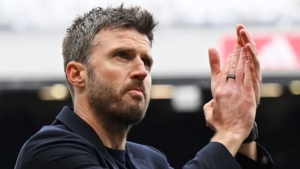
Manchester United’s Dangerous Adam Wharton Gamble: Are Carrick and the Board Ignoring the Real Priorities?
Adam Wharton to Manchester United would be a major statement, while Louis Page could represent another investment in youth. Yet Manchester United’s transfer strategy raises an uncomfortable question: are the club strengthening where they need help most, or simply buying opportunities while leaving Carrick exposed to the consequences?
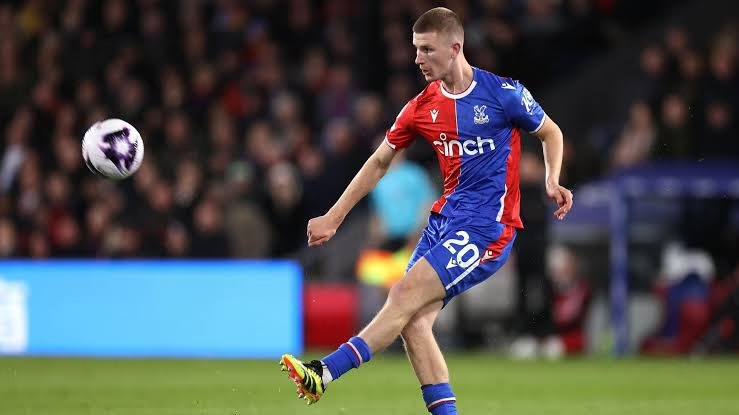
Manchester United have spent far too many years creating the same illusion in different forms. A new manager arrives, optimism returns, a handful of promising performances convince supporters that the worst is over, and the transfer window is then treated as an opportunity to add exciting names rather than solve the structural weaknesses that caused the previous problems. The players change. The managers change. Even the people responsible for recruitment have changed. Yet the central danger remains remarkably familiar: Manchester United can still confuse activity with strategy.
That is why the growing discussion around Adam Wharton to Manchester United, alongside reports that the club are close to completing a deal for Leicester City teenager Louis Page, deserves considerably more scrutiny than the usual excitement surrounding transfer speculation. On the surface, there is an obvious argument in favour of both moves. Wharton is one of the most technically gifted young midfielders in English football, while Page is reportedly viewed as an exciting long-term prospect capable of developing within the United system. There is nothing inherently wrong with signing either player. In fact, both could eventually prove to be intelligent acquisitions.
The problem is not necessarily the quality of the targets. The problem is timing, priority, and responsibility.
Manchester United cannot afford another transfer window in which the club spends heavily on players who may improve the squad in theory while failing to adequately address the positions that could determine whether Michael Carrick succeeds or fails. A manager does not survive on the quality of a recruitment presentation. He survives on results. If Carrick is handed a squad that remains fundamentally unbalanced, vulnerable in key areas, and short of the specialist profiles required to compete consistently, then the eventual consequences will not be distributed equally between the manager and the board. History suggests that the man standing on the touchline will be the easiest person to blame.
That is the uncomfortable question hanging over United’s summer business. If the club is genuinely pursuing Adam Wharton for Manchester United and simultaneously moving toward a reported £10 million-plus-add-ons agreement for Louis Page, are they building the squad Carrick actually needs? Or are they once again pursuing attractive opportunities in the market while leaving more urgent weaknesses unresolved?
Adam Wharton to Manchester United: A Brilliant Signing or a Dangerous Distraction?
There is a reason Wharton has attracted attention from elite clubs. He possesses qualities that are increasingly difficult to find in modern midfielders, particularly among English players of his age. He is comfortable receiving the ball under pressure, capable of progressing possession through intelligent passing and able to influence the rhythm of a match without needing to dominate it through constant physical intensity. His appeal is not based simply on spectacular statistics or highlight-reel moments. It lies in his ability to make the difficult parts of midfield football appear controlled.
For Manchester United, that profile is unquestionably attractive.
A side that has repeatedly struggled to establish control in central areas would naturally benefit from a player capable of improving its technical security. Wharton could help United retain possession more effectively, progress the ball through deeper zones, and reduce the chaotic transitions that have too often defined the team’s football. He is the kind of midfielder who could potentially become a tactical reference point for a manager who wants his team to play with greater intelligence rather than simply greater energy.
But this is where admiration for the player must be separated from blind acceptance of the transfer strategy.
Signing a good footballer is not automatically the same as solving a football problem. Manchester United’s recruitment failures over the years have frequently emerged from precisely that confusion. The club have repeatedly identified talented players without sufficiently asking whether those players represented the most urgent solution to the weaknesses already present within the squad.
Wharton could be excellent at Old Trafford and still fail to address Manchester United’s most immediate requirements.
The crucial question is what Carrick needs his midfield to do. If United lack a true defensive midfielder capable of protecting the defence, winning physical duels, controlling dangerous transitions and providing tactical discipline when others attack, then signing another technically outstanding midfielder does not automatically eliminate that weakness. Wharton can contribute defensively, but expecting him to become a one-man solution to every midfield problem would be unfair to both the player and the manager.
Manchester United have suffered repeatedly when attempting to force players into roles they were not specifically recruited to perform. A midfielder with exceptional passing ability is suddenly expected to become an elite ball-winner. A progressive player is asked to provide permanent defensive protection. A technically gifted number eight is turned into a holding midfielder because the squad lacks alternatives. When the system inevitably becomes unstable, the individual is criticised for failing to become something he was never supposed to be.
If Adam Wharton to Manchester United becomes reality, Carrick and the recruitment department must avoid repeating that mistake. Wharton should be signed because the club understands precisely how he fits into a coherent midfield structure, not because United have identified another talented English midfielder and concluded that talent alone is sufficient justification.
Manchester United Midfield Still Needs More Than Another Good Footballer
The brutal reality is that Manchester United’s midfield questions cannot be solved by simply adding names.
For years, the club have lacked consistency in the balance between technical quality, defensive security and physical control. At different moments, United have possessed midfielders capable of progressing the ball, creating chances or producing individual moments of brilliance. What they have often lacked is a unit capable of functioning as a reliable collective across an entire season.
That distinction matters enormously.
A successful midfield is not simply the sum of three talented players. The roles must complement each other. One player’s attacking freedom must be supported by another player’s discipline. A deep midfielder must have sufficient protection when advancing the ball. The team must know who controls transitions when possession is lost. Without those relationships, even technically excellent players can become part of an unstable structure.
This is why the Manchester United midfield debate should not be reduced to whether Wharton is good enough. He clearly has the potential to operate at the highest level. The more important issue is whether United can afford to spend substantial resources on him while leaving other weaknesses untouched.
If Carrick believes his squad urgently requires a specialist defensive midfielder, then that requirement should not disappear because a different midfielder becomes available. If the team needs greater defensive reliability elsewhere, recruitment cannot simply ignore that need because a promising young player represents an attractive market opportunity.
This is where Manchester United have sometimes appeared reactive rather than ruthless. Elite clubs do not merely ask, “Is this player talented?” They ask, “Is this the player we need now, and how does he fit into the next three years of the project?”
Those questions must define Michael Carrick’s transfers if United are serious about breaking the cycle of managerial failure.
The danger is obvious. Carrick could begin the season with a midfield containing more technical talent than before while still discovering that his side is too easy to play through when matches become stretched. If that happens, supporters will not spend months analysing whether the recruitment committee prioritised the wrong profile. They will ask why the manager cannot organise the team.
That is the nature of football management, and it is exactly why Carrick must not be left carrying responsibility for decisions he did not control.
Louis Page to Manchester United: Smart Investment or Another Example of Misplaced Priority?
The reported pursuit of Louis Page requires a different analysis because the circumstances are different. An 18-year-old arriving from Leicester City for a reported initial fee of around £10 million, with additional payments potentially attached, should not be judged by the same immediate expectations as an established Premier League midfielder.
Young players are investments in the future. They can develop into first-team contributors, increase in value and provide the club with greater flexibility in the long term. Manchester United have historically built some of their strongest teams by successfully developing young talent, and there is no sensible argument against continuing to recruit high-potential players.
However, even intelligent investment can become questionable when examined within the context of limited resources and urgent first-team requirements.
If the reported Louis Page to Manchester United deal is completed, United must have a clear development pathway for him. Signing a teenager simply because another club believes he has potential is not enough. The club must know where he fits, how he will be coached, whether he is expected to play immediately and what environment will maximise his development.
The concern arises when youth recruitment is presented as evidence that a transfer window is progressing successfully while the senior squad remains incomplete.
Manchester United cannot solve a shortage of established first-team quality by accumulating talented teenagers. Nor should they expect an 18-year-old to carry responsibility that should belong to experienced professionals. Page may become an excellent player, but that possibility cannot be used to disguise the difference between signing for the future and strengthening for the present.

The reported fee also makes the situation worthy of scrutiny. Around £10 million is not an insignificant amount for an academy-age or development-stage signing, particularly for a club that must still make decisions about senior positions. If United believe Page is genuinely capable of becoming an important first-team player, the investment may eventually look cheap. But the board must ensure that long-term recruitment does not cannibalise the resources or attention required to build a balanced team for the coming campaign.
The real test of the Manchester United summer transfer window will therefore not be whether Wharton and Page are individually exciting names. It will be whether their arrivals form part of a coherent plan.
Are Manchester United Missing the Priority Positions?
This is the question the club cannot afford to avoid.
Every squad has weaknesses, but not every weakness carries the same level of urgency. Recruitment must distinguish between positions that could improve the team and positions that must improve if the team is to function properly.
Manchester United’s history is filled with transfer windows in which the club appeared to recognise problems but addressed them only partially. A position was strengthened without being truly solved. A player was signed as a compromise because the preferred target was unavailable. Another position was postponed until the following window. Then injuries, poor form or tactical changes exposed the unfinished work.
The result was predictable: the manager inherited an incomplete squad and was judged as though it had been built precisely to his specifications.
Carrick now faces the possibility of encountering the same trap.
A move for Wharton could make enormous footballing sense. The reported acquisition of Page could also be a smart long-term decision. But neither transaction should be allowed to become a substitute for addressing the areas Carrick and his coaching staff identify as fundamental.
If the manager needs a specialist defensive midfielder, then the board should understand the difference between that requirement and signing a technically gifted central midfielder. If the defence requires a particular profile, that requirement should not be ignored because the midfield market suddenly produces an exciting opportunity. If the squad lacks depth in a position where injuries could destroy the season, that problem should not be postponed simply because another signing generates more excitement online.
The most successful recruitment strategies are often less glamorous than supporters expect. They involve signing the player who completes the structure rather than the player who produces the most impressive social media announcement.
That discipline has often been missing at Manchester United.
The club’s recruitment must now demonstrate that it understands the difference between collecting talent and constructing a team.
Michael Carrick Transfers and the Problem of Shared Responsibility
The most worrying aspect of this situation is not that Manchester United may make a questionable signing. Every major club occasionally gets recruitment wrong. The deeper concern is whether responsibility will be distributed honestly if the squad proves inadequate.
Carrick may have earned the permanent position after stabilising Manchester United and convincing the hierarchy that he deserved the opportunity to lead the project. If that is the case, then he deserves more than symbolic authority.
There is a major difference between being consulted about transfers and genuinely having a football structure built around a manager’s tactical requirements. The board and recruitment department have every right to contribute expertise. Modern football should not depend entirely on a manager personally selecting every signing. But collaboration only works when everyone is accountable for the final outcome.
If Carrick says that the squad requires a particular profile and the board instead decides to pursue a different opportunity, that decision must eventually be recognised as a recruitment choice rather than rewritten as a managerial failure.
This is especially important at Manchester United because the club’s recent history has demonstrated how easily structural problems become personalised. When results deteriorate, the manager becomes the central subject of criticism. His tactics are analysed. His selections are questioned. His authority is challenged. Meanwhile, the people responsible for constructing the squad often remain comparatively protected from the immediate consequences.
Carrick must not become the latest manager placed in that position.
If United finish the transfer window with obvious gaps and those weaknesses later damage performances, it would be intellectually dishonest to place the entire burden on the manager. A football team is shaped by recruitment, ownership, executive decisions, coaching and player performance. When one part of that chain fails, blaming only the person at the end of it does not solve anything.
That does not mean Carrick should be immune from criticism. A permanent Manchester United manager must be judged on tactics, development, results and decision-making. But accountability must be proportionate.
If the board creates the problem, the board must share responsibility for the consequences.
The Board Cannot Keep Building Half-Finished Teams
Manchester United’s greatest challenge is not identifying talented footballers. The club has resources, global appeal and enough institutional weight to compete for many elite targets. The greater challenge is resisting the temptation to believe that another exciting signing automatically represents progress.
A transfer strategy should begin with an honest audit of the squad.
What positions are genuinely weak? Which players can be relied upon physically and tactically? Where does the manager’s system repeatedly break down? Which profiles are missing entirely? How much can realistically be spent? And, perhaps most importantly, which problems cannot be postponed for another year?
Only after answering those questions should the club begin to decide whether a player such as Wharton represents the correct use of resources.
The board must also avoid another damaging habit: treating short-term and long-term recruitment as competing projects without establishing priorities. There is room for both. United can sign a teenager such as Page while also strengthening the first team. They can pursue Wharton while addressing another midfield need. But that requires planning, financial discipline and a willingness to make difficult decisions.
The worst possible outcome would be a transfer window that looks impressive in isolation but leaves the first team structurally exposed.
Supporters may initially celebrate the arrival of a highly rated midfielder and an exciting teenager. Transfer windows are often judged emotionally because new signings represent hope. The more difficult assessment comes months later, when the fixtures become demanding and the weaknesses that were ignored begin to reappear.
That is when recruitment strategy is exposed.
Adam Wharton Could Transform Manchester United — But Only in the Right Structure
It would be wrong to turn this argument into an attack on Wharton himself. In fact, the reason this debate matters is precisely because he could be an outstanding addition.
A player of his technical quality could help Manchester United become calmer and more controlled in possession. He could improve progression from deeper areas and give Carrick greater flexibility in how the midfield is structured. His age also means that, if developed correctly, he could become an important part of United’s long-term project rather than merely a short-term solution.
But potential should not be used to exaggerate certainty.
Moving to Manchester United is a different challenge from excelling elsewhere. The pressure is greater, the scrutiny is relentless and the tactical environment may be completely different. Wharton would need time to adapt, and supporters should resist the temptation to expect him to immediately repair every weakness in the team.
More importantly, United should resist creating that expectation themselves.
The Adam Wharton to Manchester United story should therefore be judged through a strategic lens. If Carrick sees Wharton as a central component of a midfield structure that also contains sufficient defensive security, then the transfer could be excellent. If United are signing him because they have once again fallen in love with a talented player without resolving the larger tactical puzzle, then the risk is obvious.
The difference between those two approaches may ultimately determine whether the transfer becomes a foundation stone or another expensive complication.
Manchester United Transfer News Must Be Judged Beyond the Excitement
The modern transfer cycle encourages superficial analysis. A player’s age, reputation, fee and social media highlights can quickly create a narrative that a club has “won the window”. But serious football analysis requires a more uncomfortable question: what problem has actually been solved?
Manchester United supporters have every reason to be excited by elite young talent. Wharton is an attractive potential signing. Page appears, based on the reports surrounding him, to be another example of United looking toward the future.
Yet excitement is not the same as evidence.
The club’s supporters should judge the entire window according to whether Carrick has been given the tools to implement his football. Does he have the midfield balance he requires? Does the defensive unit have the necessary protection? Is there sufficient depth? Have the departures and arrivals improved the collective rather than merely changing the names on the squad list?
Those questions matter more than how many players have been announced.
The real danger for United is that another incomplete transfer window could create a false narrative around Carrick. If the team struggles, the argument may quickly become that the manager failed to maximise an expensive squad. But the value of a squad is not determined solely by the amount spent assembling it. It is determined by whether the pieces fit together.
A £100 million collection of the wrong profiles can be less effective than a significantly cheaper group recruited with absolute clarity.
That lesson should already be obvious to Manchester United.
Will Carrick Pay for a Boardroom Mistake?
This is ultimately the central issue.
Carrick can influence tactics, improve players, establish standards and make decisions on matchdays. He cannot personally correct every structural weakness created above him. If Manchester United’s board and recruitment department fail to address the positions that the football operation considers essential, then they cannot reasonably expect the manager to produce a perfect season regardless.
The fear is that football rarely works that rationally.
Managers are visible. Boards are not. A poor result immediately places the manager under pressure, while the decisions that shaped the squad can remain hidden behind internal processes and vague statements about long-term strategy.
Carrick therefore needs clarity now, before the transfer window closes.
He needs to know which players are genuinely part of his plans, which positions the club will strengthen and what tactical compromises he will be expected to make. The board must also decide whether they are building around the manager they appointed or merely providing him with a collection of players selected according to broader market opportunities.
If it is the latter, then the club are already creating the conditions for future conflict.
No manager can demand every player he wants. That is neither realistic nor desirable. But a manager must have enough influence to ensure that the squad reflects the basic requirements of his football. Otherwise, the appointment itself becomes contradictory. United would be asking Carrick to deliver a project without allowing him access to the essential tools required to execute it.
The Verdict: Manchester United Must Stop Confusing Opportunity With Priority
Manchester United’s reported interest in Adam Wharton and Louis Page is not, by itself, evidence of another disastrous transfer strategy. Wharton could become one of the most important midfield signings the club makes for years. Page could develop into a valuable first-team player and potentially justify every pound of his reported fee.
The danger lies elsewhere.
United must not allow attractive opportunities to distract them from urgent needs. The club have spent too long operating as though every talented player represents a solution. Sometimes a talented player is simply a talented player, and the squad still requires someone else.
That distinction could be crucial for Carrick.
If Wharton arrives as part of a complete and carefully balanced midfield plan, Manchester United could be making a genuinely intelligent move. If Page joins through a clear development pathway without compromising investment in the senior squad, the deal could also be justified.
But if these moves become the headline acts of a transfer window that leaves essential positions unresolved, then the consequences could be severe. Carrick may eventually find himself trying to compensate for problems that were not created on the training ground but in the boardroom.
And if results deteriorate, Manchester United must not repeat their oldest mistake: pretending that the man on the touchline was solely responsible for a squad he did not fully get to build.
The club have an opportunity to prove that their recruitment has finally evolved beyond opportunism. They can sign Wharton if he genuinely fits the plan. They can invest in Page if they believe in his development. But they must also finish the harder work: identifying the positions that cannot be ignored and solving them before the season exposes the consequences.
Because Manchester United do not need another transfer window that looks exciting.
They need one that actually works.
About The Author