Manchester United’s Abrasive Hull City Humiliation Exposes a Deteriorating Midfield and Defence Crisis
Manchester United began the 2026/27 Premier League season with a humiliating 2-0 defeat to promoted Hull City. The performance exposed familiar weaknesses in midfield protection, defensive organisation, set-piece defending and attacking efficiency, raising serious questions about what Michael Carrick must fix before the problems deepen.
Manchester United’s Hull City Humiliation Was More Than Just a Bad Start
Manchester United were supposed to begin the 2026/27 Premier League season with momentum. Michael Carrick’s side had finished the previous campaign in third place, optimism had returned to Old Trafford, and a summer of squad changes was supposed to strengthen the foundations of the club’s revival. Instead, the first competitive match of the new season produced a humiliating and deeply worrying reality check.
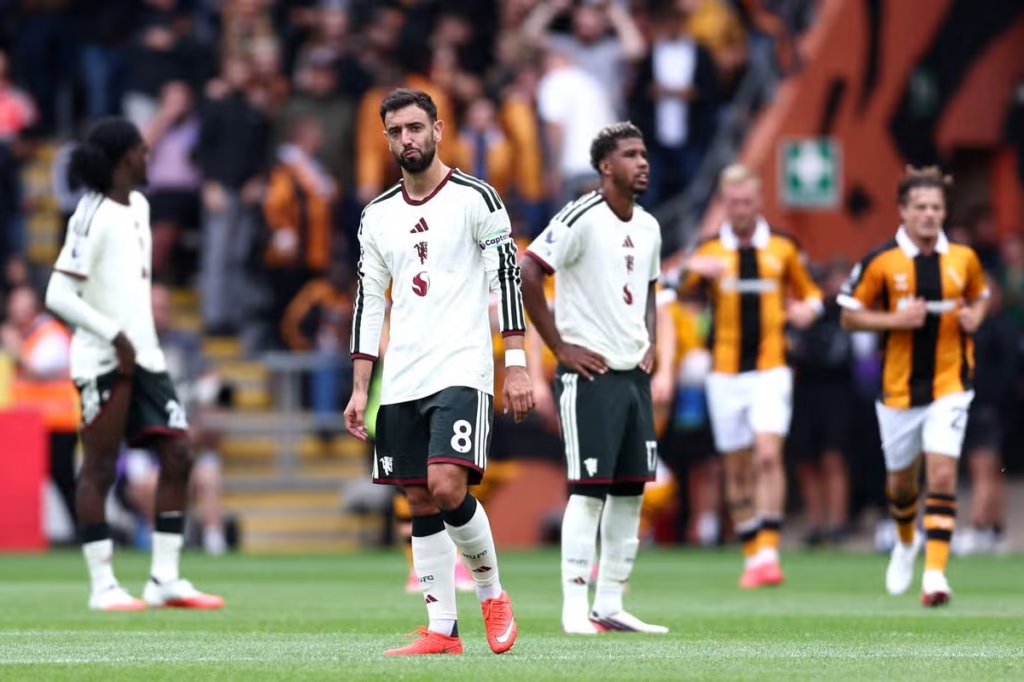
The Manchester United-Hull City humiliation ended in a 2-0 defeat at the MKM Stadium, with Semi Ajayi scoring in the 17th minute and Nobel Mendy adding a second before half-time. Both goals came from situations in which United’s defensive organisation was found badly wanting. Hull had only 28.4% possession and produced 1.26 expected goals compared with United’s 1.81, yet the newly promoted side were sharper, more aggressive, more disciplined and ultimately far more effective in the areas that decided the game.
That is what makes this defeat particularly uncomfortable. Manchester United were not simply beaten because Hull produced an extraordinary attacking masterclass. They were beaten because Hull understood exactly how to exploit weaknesses that should have been addressed long before the opening weekend.
United controlled 71.6% of possession, attempted 21 shots and completed 574 passes, but those numbers cannot disguise the quality of the performance. Possession without control is one of football’s most misleading statistics. United had plenty of the ball, but they lacked authority over the match. Hull were comfortable allowing them possession in areas that caused little damage before becoming dangerous whenever the game became physical, transitional or dependent on defensive concentration.
The result therefore deserves more than the usual opening-day excuse. One match does not define an entire season, but one match can expose structural weaknesses. And this performance exposed several.
Hull City vs Manchester United Analysis: How the Game Was Lost Before Half-Time
The basic story of the match is devastatingly simple. Hull City scored twice in the first half, Manchester United failed to recover, and the visitors spent the remainder of the afternoon trying to turn territorial dominance into meaningful pressure.
Carrick selected a midfield featuring Youri Tielemans and Andrey Santos, with Bruno Fernandes operating further forward, while Harry Maguire and Ayden Heaven were part of the defensive structure in front of goalkeeper Senne Lammens. Marcus Rashford and Benjamin Sesko began on the bench, with Rashford introduced at half-time and Sesko entering in the 67th minute.
The problem was not simply that individual players performed below their level. The deeper issue was that the collective structure looked unbalanced.
Hull recognised that they could make the match uncomfortable by attacking United physically and directly. They did not need to dominate possession. They needed to compete, win important duels and make United defend situations in which concentration mattered more than technical superiority.
The first goal was a warning that United failed to understand. Defensive problems allowed Hull to create danger, and Ajayi eventually finished from close range. The second was even more damaging because it reinforced the same theme: another set-piece situation, another failure to defend decisively, and Mendy punished United with a header.
Conceding twice from situations involving dead-ball defending against a promoted side is not merely bad luck. It points toward poor organisation, weak execution or both.
By half-time, United were two goals behind and psychologically chasing the game. Hull no longer needed to be adventurous. They could defend deeper, compress space and wait for United to become increasingly predictable.
That is exactly what happened.
Manchester United Defensive Crisis Was Impossible to Ignore
Calling it a Manchester United defensive crisis after one league match would normally sound exaggerated. Yet the concern here is not based exclusively on the scoreline.
It is based on the nature of the goals and the wider pattern of vulnerability.
Manchester United’s defending deteriorated at precisely the moments when the match demanded composure. The team struggled to deal with physical pressure, lost important positions around the penalty area and failed to impose authority at set pieces. A team hoping to challenge at the top of the Premier League cannot repeatedly treat these situations as secondary details.
Set pieces are among the most controllable aspects of football. They can be rehearsed. Roles can be clearly assigned. Zones can be protected. Opponents can be analysed. When a team concedes two goals from situations where defensive organisation should be clear, questions must be asked about preparation as well as execution.
The concern becomes greater when considering that Hull were not expected to dominate the match. They had returned to the Premier League after nine years away and entered the fixture as the promoted side. Yet they played with greater intensity and conviction, and their first top-flight victory over Manchester United in decades was built on winning the decisive moments.
Manchester United cannot afford to build a season around the assumption that possession will protect them. It will not.
If the defensive structure remains vulnerable whenever opponents attack directly, press aggressively or deliver quality set pieces, stronger teams will create even more problems.
The defensive unit also needs greater consistency. Carrick must determine which players form his strongest partnership and defensive structure rather than constantly relying on reactive changes. Harry Maguire, Ayden Heaven, Lisandro Martínez and Leny Yoro offer different qualities, but a successful defence requires more than talented individuals. It requires communication, familiarity and a clearly understood collective system.
Against Hull, those elements did not look secure.
Manchester United Need a Defensive Midfielder, and Hull Proved Why
Perhaps the most important lesson from the defeat concerns the centre of the pitch.
The argument that Manchester United need a defensive midfielder has existed for some time, but the Hull defeat gave that argument fresh evidence. Tielemans and Santos are talented footballers, yet neither performance demonstrated that United currently possess a completely reliable specialist shield capable of controlling dangerous transitions and protecting the defence over an entire Premier League season.
This is where recruitment philosophy becomes important.
A central midfielder does not automatically solve the defensive midfield problem simply because he can tackle or cover ground. United need someone capable of reading danger before it develops, controlling space when full-backs advance, breaking up transitions and providing a dependable passing outlet under pressure.
The best defensive midfielders often make the game look easier because they prevent chaos rather than simply reacting to it.
That is exactly what Manchester United lacked too often against Hull.
When possession changed hands, the midfield did not always provide an immediate barrier between Hull’s attack and United’s defence. The back line was therefore exposed to situations where it had to react quickly, while the team’s attacking players were unable to establish sustained pressure after losing the ball.
Bruno Fernandes remains an exceptional creator, but asking him to compensate for structural defensive problems is an inefficient use of his strengths. He should be influencing the final third, not repeatedly becoming part of emergency defensive repairs because the midfield behind him lacks balance.
Santos may develop into an important player, while Tielemans brings quality and experience, but Carrick must be brutally honest about the profile of the team. A midfield can contain technically gifted players and still be structurally weak.
That is the distinction Manchester United’s recruitment department must understand.
Manchester United Midfield Problems Are About Balance, Not Just Individual Quality
The Manchester United midfield problems against Hull were not caused by one player. Blaming Santos, Tielemans or Fernandes individually would be too simplistic.
The real problem was the relationship between them.
Tielemans can dictate possession and progress the ball. Santos has athleticism and potential. Fernandes is capable of unlocking any defence. On paper, those qualities are attractive. In practice, however, the midfield lacked a clear defensive anchor.
A balanced midfield needs complementary responsibilities. One player may advance, another may create, but someone must remain responsible for protecting central spaces.
Without that discipline, the entire team can become stretched.
That was one of the most worrying aspects of the Hull performance. United’s possession did not always translate into control because the team could not consistently establish the right distances between midfield and defence. Once Hull disrupted United’s rhythm, the visitors became vulnerable to exactly the type of direct football that promoted teams often use effectively.
This is not an argument against attacking football. It is an argument for balance.
The best possession teams do not merely keep the ball. They organise themselves to deal with what happens when they lose it.
Manchester United did not do that convincingly enough.
Carrick therefore has a tactical decision to make. He can either alter the responsibilities within the existing midfield or demand a specialist defensive signing before the transfer window closes. The second option appears increasingly necessary if the United States wants to compete on multiple fronts.
Michael Carrick Tactics Must Be Examined Honestly
The defeat also places Michael Carrick’s tactics under scrutiny.
That is not because Carrick should suddenly be treated as a failed manager after one match. He earned his permanent position through the work that helped United recover and finish third last season. But permanent managers are judged differently from caretakers.
The standard has changed.
Carrick cannot simply rely on the emotional momentum of last season. He now has to prove that his ideas can evolve when opponents identify weaknesses.
Against Hull, United appeared too slow to adapt. Once the promoted side established a two-goal advantage, the match increasingly required creativity, movement and unpredictability. United introduced Rashford at half-time and later brought on Sesko and Kobbie Mainoo, but the substitutions did not fundamentally transform the rhythm of the game.
That raises an important question: was the starting structure capable of breaking down a compact and physical opponent?
The answer, based on this performance, was no.
United’s 21 shots suggest attacking activity, but only five were on target, while two big chances were missed. Hull, meanwhile, were ruthlessly efficient in the moments that mattered most.
Carrick must therefore examine not just how much attacking football his side produces, but what kind of chances it produces. Shooting frequently is not the same as creating high-quality opportunities. A team can dominate the shot count while rarely making the goalkeeper genuinely uncomfortable.
United’s attacking patterns became increasingly easy to anticipate.
The manager must also accept responsibility for defensive preparation. Players are responsible for winning duels, but the coaching staff are responsible for ensuring that players understand their roles.
Two first-half goals from defensive situations should make that analysis unavoidable.
The Areas That Deteriorated From Pre-Season
The most alarming aspect of the defeat is that some of these warning signs were visible before the Premier League season began.
Manchester United’s final pre-season fixture ended in a 4-2 defeat to AC Milan. That result alone did not matter much, because pre-season is about preparation rather than points, but defensive vulnerability was already visible. The Hull result made it much harder to dismiss those issues as harmless summer experimentation.
The deterioration was particularly noticeable in three areas.
First, defensive reliability worsened when United faced direct and physical football. The team did not establish the authority expected from a side with ambitions of competing near the top of the table.
Second, midfield protection deteriorated because possession was not consistently supported by effective rest defence. Too much responsibility appeared to fall on the defensive line once Hull broke through midfield.
Third, attacking efficiency deteriorated because United had plenty of possession but lacked the precision required to turn pressure into goals.
These are connected problems.
A weak defensive midfield structure makes defenders uncomfortable. Uncomfortable defenders become more cautious. Cautious defenders can reduce the team’s ability to sustain attacking pressure. If the attack then fails to score, every opposition transition becomes more dangerous.
Football teams do not deteriorate in isolated departments. Problems spread through the structure.
That is why Manchester United should resist the temptation to blame this defeat on a poor afternoon from one or two players.
The Manchester United Attack Also Failed Its Test
Defensive weaknesses will dominate the headlines, but United cannot escape criticism for their attacking performance.
A team with Bryan Mbeumo, Bruno Fernandes, Matheus Cunha, Patrick Dorgu, Marcus Rashford and Benjamin Sesko should have enough quality to score against almost any opponent.
Yet quality on paper does not guarantee chemistry on the pitch.
Mbeumo, Fernandes and Cunha were unable to consistently dismantle Hull’s defensive block, while Dorgu missed an opportunity that could have changed the momentum of the match. The late introduction of Rashford, Sesko and Mainoo also failed to produce the necessary breakthrough.
United’s problem was not a complete absence of chances. The problem was that they failed to take control of decisive moments.
The statistics underline the frustration. United produced a higher expected-goals figure than Hull, but football is decided by actual goals. Hull scored twice; Manchester United scored none.
That is why xG must always be interpreted carefully.
Expected goals can explain whether a team created chances, but they cannot excuse poor finishing or defensive mistakes. United lost because they failed at both ends.
What Manchester United Must Improve Immediately
The response to this defeat must be practical rather than emotional.
First, Manchester United need to solve the defensive midfield question. If Carrick and the recruitment department believe the current squad does not contain a natural, reliable holding midfielder capable of protecting the defence, they should stop pretending that the problem will disappear through tactical optimism.
A proper defensive midfielder would not magically solve every weakness, but the right profile could improve United’s transition defence, protect the centre-backs and give the more creative players greater freedom.
Second, the team must improve its defensive organisation at set pieces. Conceding twice from such situations in the opening game is an immediate red flag. United need clearer assignments, stronger communication and a greater willingness to attack the ball.
Third, Carrick needs greater tactical flexibility. Not every Premier League opponent will play the same way. Some will press high, others will defend deep, while promoted teams often bring enormous physical intensity and emotional energy to matches against elite clubs.
Manchester United need different solutions for different problems.
Fourth, the defence needs a stable identity. Constant uncertainty over personnel can undermine communication. Carrick must establish his preferred defensive combinations while ensuring the players understand exactly how to respond when the midfield is bypassed.
Finally, United’s attackers must become more ruthless. Dominating possession and producing 21 shots means little when the match ends 2-0. The best teams turn periods of dominance into goals. United allowed Hull to survive their pressure, and once the promoted side believed they could win, the psychological balance of the match changed completely.
The Manchester United-Hull City Humiliation Must Become a Warning, Not a Pattern
It would be foolish to declare Manchester United’s season finished after one match.
But it would be equally foolish to dismiss this defeat as simply an opening-day accident.
Hull City deserved credit for their intensity, defensive discipline and ability to exploit United’s weaknesses. The Tigers returned to the Premier League and immediately produced one of the shocks of the opening weekend, recording a 2-0 victory through goals from Semi Ajayi and Nobel Mendy.
Manchester United, however, have to look inward.
This was a performance that exposed a lack of balance in midfield, alarming defensive frailty, poor set-piece defending and insufficient attacking ruthlessness. The numbers show that United had more of the ball and generated more expected goals, but the match itself demonstrated why statistics without context can be deceptive.
Hull controlled the moments that mattered.
For Michael Carrick, the challenge is now clear. His side cannot simply return to the training ground and work harder. They must identify exactly why their structure failed. They need to decide whether the current midfield can provide the defensive protection required for an entire season. They need to fix their set-piece defending. And they need an attacking system capable of turning territorial dominance into clear, repeatable scoring opportunities.
The Manchester United-Hull City humiliation should therefore be treated as a warning siren.
The defeat itself is damaging, but the greater danger lies in what happens next. If United learn from it, strengthen intelligently and correct the structural weaknesses that Hull exposed, the opening-day embarrassment could eventually become an important turning point.
If they ignore the evidence and hide behind possession statistics, preseason excuses or the belief that it was “only one game”, then Hull City may simply have been the first opponent to expose a problem that many others will soon exploit.
For a club that finished third last season and entered the new campaign with renewed ambition, that is the brutally honest reality.
Manchester United did not lose to Hull because they were unlucky.
They lost because, on the day, the promoted side were better organised, more aggressive in decisive situations and more ruthless when opportunities arrived. Until United fix the midfield protection and defensive fragility that this performance exposed, the optimism surrounding Carrick’s new era will remain vulnerable to collapse at the first sign of pressure.
And after the humiliation at the MKM Stadium, the pressure has already begun.
About The Author