Marcus Rashford Future: The Alarming Questions Hanging Over Manchester United’s Risky 2026/27 Season
Manchester United are approaching the 2026/27 season with enough positive developments to create optimism, but also enough unresolved questions to make that optimism dangerously premature. Michael Carrick has earned the opportunity to lead the club after restoring competitive momentum, Marcus Rashford appears to have a route back into the first-team picture, Bruno Fernandes has committed his future until 2032, and Senne Lammens has been entrusted with the No. 1 shirt. Yet none of those developments answers the fundamental question facing Manchester United: are they genuinely stronger and more balanced, or are they simply entering another season with familiar weaknesses hidden behind a new atmosphere?
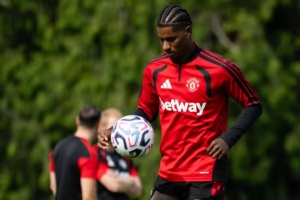
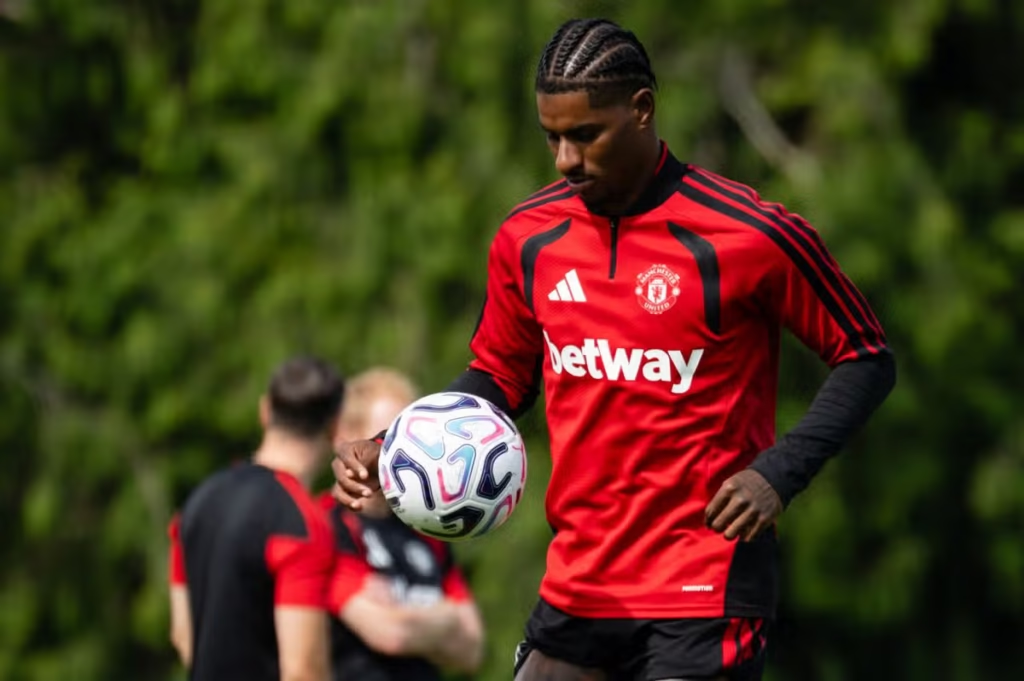
Marcus Rashford’s future is at the center of that uncertainty. Carrick’s confidence in the forward has opened a door that appeared firmly closed not long ago, but a managerial change cannot automatically repair a damaged relationship between a player, a club, and sections of its support. Rashford’s potential reintegration is one of the most fascinating stories of the season because it could become either a genuine redemption or another exhausting cycle of expectation followed by disappointment.
Recent reporting has indicated that Carrick is open to working with Rashford and that the forward was expected to return to the Manchester United environment after his World Cup involvement. The relationship between player and coach is not understood to be the problem. The bigger issue is whether Rashford’s return makes footballing sense for both sides and whether he can produce the consistency that has too often been missing during the difficult periods of his career.
That uncertainty exists alongside a broader concern about Manchester United’s midfield. United have not ignored the department entirely. Recent reporting shows significant investment and recruitment, including Youri Tielemans and Andrey Santos. However, strengthening midfield is not necessarily the same thing as solving the specific problem of defensive balance. The real debate is whether Carrick now possesses a midfielder capable of consistently protecting the defense, controlling transitions, and giving the more creative players freedom to attack without leaving the team exposed.
That distinction could define Manchester United’s season.
Marcus Rashford’s Future Depends on More Than Michael Carrick’s Confidence
Marcus Rashford’s future has become complicated because the argument is no longer about whether he possesses the ability to play for Manchester United. That was established long ago. Rashford has already demonstrated that, at his best, he can be one of the most destructive attacking players in English football. His pace, ability to attack space, and capacity to produce decisive moments remain genuine assets.
The more difficult question is whether Manchester United can consistently get the best version of him.
Rashford’s career has become a story of dramatic highs followed by periods in which his performances, confidence, and influence have declined sharply. That inconsistency is why the current situation demands more than sentimental optimism. The fact that he came through the academy will always matter to supporters, and it gives any potential comeback an emotional dimension that would not exist with an ordinary signing. But Manchester United cannot build their sporting decisions around nostalgia.
Carrick’s confidence is important because players returning from a difficult situation require clarity. A manager must know exactly why he wants the player and how he intends to use him. Rashford should not simply be welcomed back because he is available, because he has history with the club or because replacing him would be expensive.
If Carrick believes Rashford can play an important role, the manager must define that role.
Rashford is most dangerous when he can attack space and receive the ball in situations that allow him to run directly at defenders. He is not a player who should be expected to solve every attacking problem through individual brilliance. Manchester United must create an environment in which his strengths are maximized and his weaknesses are not constantly exposed.
But Rashford also has responsibilities of his own. Another fresh start cannot become another excuse. The forward is at an age where Manchester United need dependable production, not permanent promises about what might happen if everything finally comes together.
The coming season therefore represents a genuine test. Carrick can provide trust, tactical structure, and an opportunity. Rashford must provide the response.
How Will Manchester United Fans Receive Rashford?
The answer is likely to be brutally simple: the fans will respond to what they see.
There will undoubtedly be supporters who are immediately prepared to welcome him back. Rashford is one of their own, and his connection to the academy gives him an emotional advantage that few players possess. Community discussion surrounding his possible return has also shown that opinion remains divided rather than uniformly hostile. Some supporters believe he deserves another opportunity under Carrick, while others believe a clean break would have been better for both the player and the club.
That division will disappear quickly if Rashford starts producing.
Manchester United supporters have never required perfection. What they demand is commitment, improvement, and evidence that a player understands the responsibility of representing the club. If Rashford begins the season with energy, contributes goals and assists, and fits naturally into Carrick’s system, the atmosphere could change rapidly.
Football supporters can be unforgiving, but they are also willing to forgive when a player provides convincing reasons to do so.
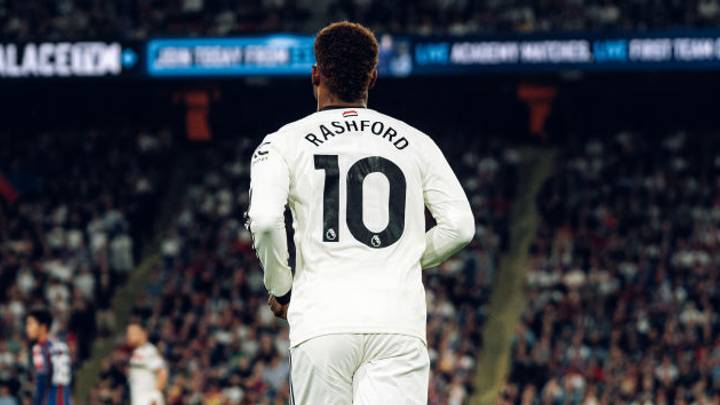
The danger lies in the opposite scenario. If Rashford returns but produces another sequence of frustrating performances, every missed chance and every poor decision will reopen the debate. His history with the club will not protect him indefinitely. In fact, it may increase the scrutiny because expectations for an academy graduate who has already experienced success at Old Trafford are naturally higher.
This is why Manchester United fans should not be asked to simply trust the process. They have heard enough promises. They have watched enough rebuilds begin with optimism and end in frustration.
Rashford has a chance to change the narrative, but he must do it through performance.
The Defensive Midfield Problem Manchester United Cannot Ignore
The criticism of Manchester United’s summer business must be precise. It would be inaccurate to claim that the club has ignored midfield. Reporting in recent days has focused on the arrivals and integration of Youri Tielemans and Andrey Santos, with Carrick attempting to build a midfield capable of combining possession, pressing, and attacking freedom.
The problem is that Manchester United’s need may be more specific than simply adding midfielders.
A proper defensive midfielder does not merely add another body to the center of the pitch. The specialist role involves reading danger before it develops, controlling the space in front of the defense, interrupting transitions, and providing the positional discipline that allows more creative players to take risks.
That is where the concern remains.
Tielemans brings technical quality and experience, while Santos adds another significant midfield option. But neither signing automatically guarantees that Manchester United will have the defensive structure required across a long season. The question is not whether the players are talented. The question is whether the collective midfield balance is sufficiently strong against the best opponents.
This matters enormously because Carrick’s preferred approach cannot succeed if Manchester United repeatedly lose control of transitions. A team can dominate possession and still be structurally vulnerable. It can create chances and still concede dangerous counter-attacks. The modern game punishes midfield imbalance quickly.
Community reaction during the summer has reflected similar anxiety, with supporters expressing concern that the midfield could remain too lightweight despite optimism about Carrick and the squad’s attacking potential. Such reactions are opinions rather than evidence of how the season will unfold, but they demonstrate that the concern is not limited to tactical analysts.
If the club genuinely believes its summer business is complete, it is taking a calculated risk.
That risk could work if Carrick has identified a tactical solution within the current squad. But if the first difficult run of the season reveals that Manchester United still lack a reliable shield in front of their defense, the club will face an uncomfortable question: why was a visible problem allowed to survive another transfer window?
Bruno Fernandes Until 2032: Still the Heartbeat of Manchester United?
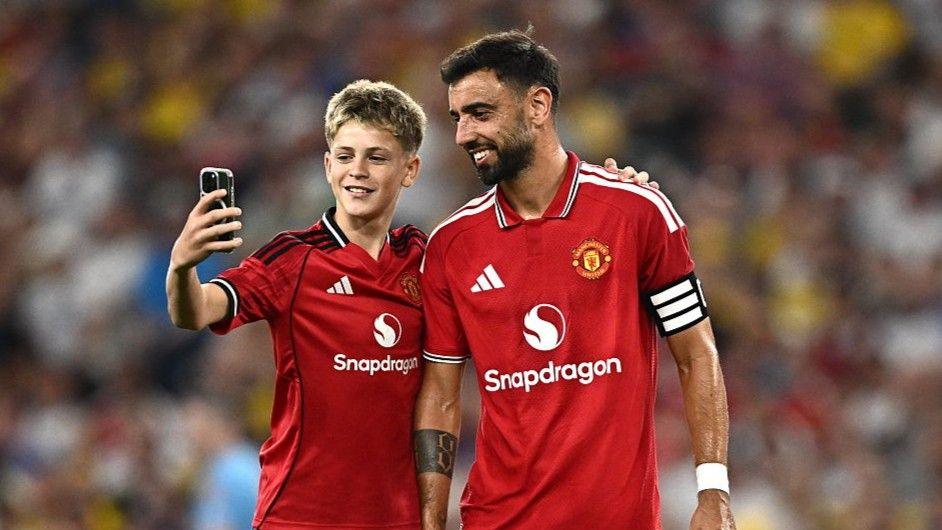
Bruno Fernandes’s contract commitment until 2032 provides Manchester United with something they have frequently lacked: long-term continuity around their most influential creative figure.
Fernandes has spent years carrying an extraordinary amount of responsibility. In difficult matches, Manchester United have repeatedly looked to him for invention, urgency, and leadership. When the team needs a decisive pass, the expectation is that Bruno will find it. When the tempo is too slow, he is often the player expected to change it.
The question is not whether he remains important.
He clearly does.
The more worrying question is whether Manchester United will again become excessively dependent on him.
Fernandes should remain the heartbeat of the club, but no player should be expected to become the entire operating system. A stronger Manchester United would allow Bruno to be decisive because the team around him is functioning properly, not because he is constantly required to compensate for structural weaknesses.
This is where midfield recruitment becomes even more significant. A stable defensive platform would allow Fernandes greater freedom. Better control behind him would reduce the need for him to drop deep in search of possession. More reliable attacking options would also prevent opponents from concentrating entirely on limiting his influence.
If Carrick can build that structure, Fernandes’ commitment until 2032 could become one of the most important foundations of the next Manchester United project.
If he cannot, the club risks repeating an old mistake: possessing an exceptional individual but failing to build a sufficiently coherent team around him.
The heartbeat may still be strong, but even the strongest heartbeat cannot carry a body that remains structurally unbalanced.
Senne Lammens and the Enormous Responsibility of the No. 1 Shirt
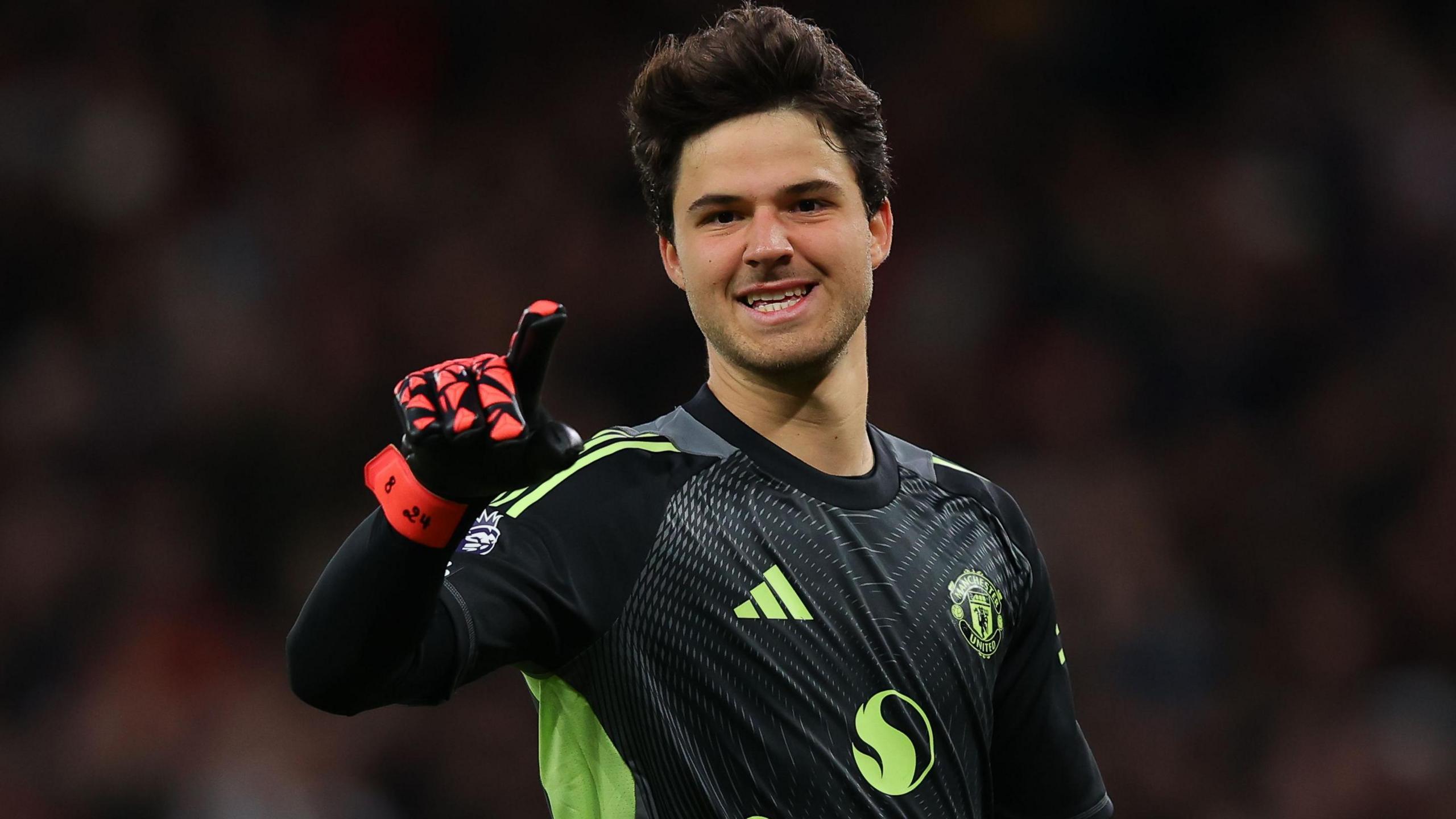
The decision to give Senne Lammens the No. 1 jersey is significant because shirt numbers at Manchester United carry history and expectation.
For a goalkeeper, the No. 1 is a declaration of status. It tells the player, the dressing room, and the supporters that the club sees him as more than a temporary solution.
Recent discussion around the club has confirmed that Lammens is set to wear the number during the 2026/27 season, and the symbolism should not be underestimated.
However, symbolism will not protect him.
Goalkeeping at Manchester United is one of the most heavily scrutinized jobs in football. Every error is replayed repeatedly. Every difficult performance creates immediate debate about confidence and selection. A goalkeeper can go from hero to problem within a matter of weeks.
Lammens’ success will depend not only on his individual ability but also on the protection provided by the players in front of him.
If Manchester United’s midfield repeatedly allows opponents to attack the defensive line without resistance, the goalkeeper will be exposed. If the team becomes vulnerable during transitions, he will face situations that no goalkeeper should be expected to solve consistently.
That is why judging Lammens fairly will require judging Manchester United collectively.
A new No. 1 can represent a new era, but the era will be defined by results, not the number on the back of his shirt.
Why Preseason Concerns Cannot Simply Be Dismissed
Preseason should never be treated as a perfect predictor of competitive football. Teams experiment, players return at different stages of fitness, and managers test tactical ideas that may never appear in the final version of the side.
But neither should preseason concerns be dismissed simply because the matches are technically friendlies.
The purpose of preseason is to reveal where a team is strong and where it is vulnerable. If Manchester United repeatedly struggle with midfield control, defensive organization, or transitions, Carrick and the recruitment department must decide whether those weaknesses are temporary or structural.
That is the key difference.
A temporary problem can be solved through coaching and fitness.
A structural problem usually requires either tactical compromise or recruitment.
Recent analysis of Carrick’s first period in charge has also raised an important point: results improved, but improved results do not automatically mean every aspect of the team’s underlying football was convincing. The full 2026/27 campaign, with Champions League football and a significantly heavier schedule, will be a much more demanding examination of Carrick’s management.
That is why the new season should not be viewed as a continuation of the previous rescue mission.
It is the real test.
Carrick will now be judged over months rather than weeks, across multiple competitions rather than a relatively narrow fixture list. Squad depth, tactical flexibility, and the ability to control difficult matches will become increasingly important.
Is Another Season of Frustration Loading?
It would be unfair to predict failure before a competitive ball has been kicked.
Manchester United have talented players. Carrick has created renewed belief. Rashford could rediscover his best form. Fernandes remains capable of deciding major matches. Lammens could establish himself as a reliable long-term goalkeeper. Tielemans and Santos could improve the midfield considerably.
But acknowledging those possibilities does not mean ignoring the risks.
The biggest danger is complacency.
Manchester United have spent too many years treating positive developments as evidence that deeper problems have disappeared. A promising signing is celebrated as a solution before he has played. A strong run of results is described as proof of a complete transformation. A new manager brings optimism that is sometimes mistaken for structural progress.
The 2026/27 season will expose whether the current optimism is different.
If Rashford succeeds, it could become one of the most compelling redemption stories in the club’s recent history. If he struggles again, Marcus Rashford’s future may finally require a definitive resolution.
If Fernandes continues to dominate, his long-term commitment will look like a masterstroke. But Manchester United must ensure that he is supported rather than overburdened.
If Lammens thrives as No. 1, United may have found stability in a position that demands it. But if the team in front of him remains disorganized, he could become another player judged for collective failure.
And if the midfield proves capable of controlling matches, the concerns about a specialist defensive midfielder will look overstated. If it does not, Manchester United will have to explain why they entered another demanding campaign without making a clearer attempt to eliminate such an obvious risk.
Manchester United Have Hope, but Hope Is Not a Plan
Marcus Rashford’s future remains uncertain despite Michael Carrick’s confidence because this season will ultimately be decided by evidence. The manager has opened the door, but Rashford must walk through it with performances. The supporters may be divided now, but goals, consistency, and commitment would change the conversation faster than any interview or public statement.
Bruno Fernandes’ commitment until 2032 offers stability, yet Manchester United must finally stop depending on him to solve every problem. Senne Lammens receiving the No. 1 jersey represents belief in the future, but the goalkeeper will need a functioning structure in front of him.
The midfield is the area that deserves the closest scrutiny. United have added talent, and that must be acknowledged. But talent and balance are not identical. The real question is whether Carrick now has the defensive control necessary to support an aggressive and creative team across an entire season.
That question will become increasingly difficult to ignore once the campaign begins.
Manchester United may be better than last season. They may be more stable. They may even surprise those who expect another collapse.
But they are not entering 2026/27 without risk.
The club has chosen to place considerable faith in Carrick’s coaching, Rashford’s potential redemption, Fernandes’ leadership, Lammens’ development, and the ability of the reconstructed midfield to find the right balance. It is an ambitious gamble.
By the end of the season, it may be remembered as the moment Manchester United finally built a coherent foundation.
Or it may be remembered as another summer when the club saw its weaknesses, believed it could live with them, and discovered, once again, that hope is not the same thing as preparation.
About The Author