Devastating Tender Typo Costs Finnish Firm Kalmar Finland Oy Sh947m KPA Container Handling Contract
A single clerical mistake in a pricing schedule has proven catastrophically expensive. The devastating tender typo costs Finnish firm Kalmar Finland Oy a Sh947 million Kenya Ports Authority container handling contract, as the Court of Appeal firmly closes the door on its challenges and affirms the award to a higher bidder.
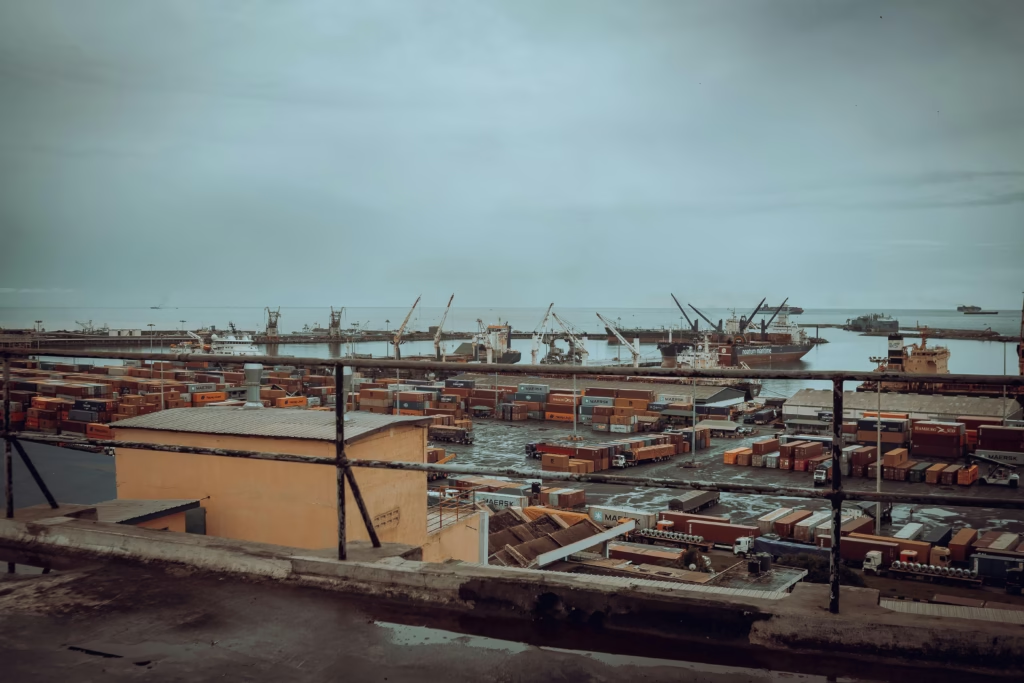
In the high-stakes world of public procurement for critical national infrastructure, precision is not just a virtue; it is an absolute prerequisite for survival. A recent Court of Appeal decision has delivered a stark reminder of this reality, confirming that a single alteration in a bid document can erase even the most competitively priced offer from contention. The case centres on Finnish equipment manufacturer Kalmar Finland Oy and its failed attempt to secure a major contract from the Kenya Ports Authority for container handling machinery at the Port of Mombasa.
What began as a restricted tender for fourteen new reachstackers ended with Kalmar locked out, its lower bid discarded, and the contract awarded to a competitor whose price was nearly two hundred million shillings higher. The root cause was not alleged corruption, technical inferiority, or failure to meet quality standards, but a typographical change in the quantity field of the price schedule—from the required fourteen units down to one. Courts at every level treated this as a material deviation rather than a forgivable slip, and the final appellate ruling has now extinguished any remaining hope of recovery.
This outcome carries implications that stretch far beyond one company’s balance sheet. It illuminates the unforgiving character of Kenya’s public procurement regime, the operational pressures facing East Africa’s premier maritime gateway, and the practical risks that even sophisticated international suppliers face when navigating local tender rules. For port operators, logistics stakeholders, and foreign investors watching Kenya’s infrastructure ambitions, the episode offers a brutally clear lesson: form can, and frequently does, triumph over substance when the letter of the law is engaged.
The Restricted Tender and the Fatal Price Schedule Alteration
The Kenya Ports Authority issued the tender in December 2025 as a restricted process limited to four original equipment manufacturers whose machinery was already operating at the Port of Mombasa: Kalmar, Sany, Hyster, and ZPMC (Shanghai Port Machinery Heavy Industries Company Limited).
Manufacturers could bid directly or through authorised agents, a structure intended to ensure both quality continuity and parts interchangeability while still allowing competitive pressure. The goods sought were fourteen new reachstackers—heavy-duty machines designed to lift, transport, and stack shipping containers within the terminal. These units form an essential layer of yard equipment that keeps containers moving between quay cranes, stacking areas, and landside transport. With the Port of Mombasa having recently surpassed two million TEUs in annual throughput and continuing to expand capacity, reliable reachstackers are not optional luxuries; they are operational necessities.
Kalmar Finland Oy, a longstanding supplier to KPA with equipment in use at the port since at least 2005, submitted a bid of approximately $5.83 million, equivalent to roughly Sh754.6 million. That figure undercut the eventual winner by a substantial margin. Amberton Holdings FZC, bidding as the authorised representative of ZPMC, quoted $7.31 million, or Sh947 million. On pure price, Kalmar appeared unassailable. Yet during the financial evaluation stage, KPA evaluators discovered that the Finnish firm had altered the pre-set quantity in a section of its price schedule from fourteen machines to one. The authority treated the modification as a material change to the scope of the tender and disqualified the bid as non-responsive.
Kalmar insisted the change was a typographical or clerical error—an inadvertent slip that did not alter its clear intention to supply all fourteen units at the quoted total price. It argued that Section 79(2) of the Public Procurement and Asset Disposal Act protects minor deviations and oversights that do not materially affect the substance, quality, or competitive balance of a bid.
The firm further contended that KPA should have sought clarification under the Act rather than proceeding straight to disqualification and that its overall tender sum remained unambiguous. These arguments failed at every stage. The Public Procurement Administrative Review Board upheld the disqualification. A subsequent High Court judicial review application was dismissed. Finally, in July 2026, a three-judge Court of Appeal bench comprising Justices Wanjiru Karanja, Hellen Omondi, and Lucy Njuguna dismissed the appeal with costs, characterising the quantity change as a major material deviation that went to the heart of the contractual scope.
The appellate judges were explicit: allowing post-opening correction of such a defect would confer an unfair competitive advantage and undermine the transparency and equity of the procurement system. They emphasised that value for money cannot be extracted from a non-responsive bid and that financial competitiveness is relevant only among tenders that have cleanly satisfied preliminary and technical responsiveness requirements.
To compel a public entity to award a contract solely on the basis of a lower price while sacrificing compliance, operational viability, and parts interchangeability would, in their view, undermine the integrity of national public economic interests. Section 82 of the Act, which declares the tender sum as submitted and read out at opening to be absolute and final and not subject to correction, provided additional statutory reinforcement for the rigid stance.
Kalmar Finland Oy Bid Error and the Limits of Substance Over Form
Kalmar is no novice in global port equipment markets. Headquartered in Helsinki and operating in more than 120 countries, the company traces its roots to the 1940s and specialises in terminal tractors, reachstackers, empty container handlers, and related automation solutions.
Its long association with KPA includes successful deployments of reachstackers and other machinery that port engineers have publicly praised for reliability and ease of maintenance. That history made the disqualification particularly painful. The firm had every reason to expect that its technical credentials and existing footprint at the port would carry weight. Instead, a single data-entry mistake in a spreadsheet-style schedule proved decisive.
The decision sits within a broader pattern of disputes between Kalmar and KPA over cargo-handling equipment tenders in 2025 and 2026. Parallel processes involving terminal tractors and forklifts have produced mixed outcomes, with the Public Procurement Administrative Review Board at times ordering re-evaluations when it found procedural flaws in KPA’s handling of Kalmar’s bids and at other times upholding exclusions.
The reachstackers case, however, turned purely on the price-schedule alteration and the courts’ refusal to recharacterise it as minor. This consistency in treating quantity as a core element of responsiveness rather than a correctable arithmetic detail reflects a deliberate judicial preference for predictability and equality of treatment over case-by-case equity.
Critics of the outcome can fairly ask whether such rigidity serves the public interest when the result is a significantly more expensive contract. The difference between Kalmar’s bid and Amberton’s award price approaches Sh200 million. In a country where fiscal pressures are constant and infrastructure budgets are finite, that differential is not trivial.
Yet the counter-argument is equally forceful: once evaluators begin selectively forgiving material deviations after bids are opened, the entire competitive process becomes vulnerable to manipulation, after-the-fact negotiation, and perceptions of favouritism. Kenya’s procurement framework, shaped by constitutional requirements of fairness, equity, transparency, and cost-effectiveness under Article 227, has been designed precisely to minimise such risks. The courts have repeatedly signalled that they will not dilute those safeguards merely because a particular non-compliant bid happens to be cheaper.
Reachstackers Procurement Dispute and the Operational Stakes at Mombasa
Reachstackers occupy a critical niche in container terminal operations. Unlike ship-to-shore cranes that load and unload vessels or rubber-tyred gantries that stack containers in dense blocks, reachstackers provide flexible mobility for moving containers around the yard, stacking them several stories high, and feeding them onto trucks or rail.
At a port handling more than two million TEUs annually and serving as the primary maritime gateway for Uganda, Rwanda, South Sudan, eastern Democratic Republic of Congo, and beyond, any shortfall in this equipment category quickly translates into congestion, longer truck turnaround times, and higher logistics costs for the entire region. KPA’s decision to procure fourteen new units through a restricted tender reflects both the urgency of fleet renewal and a desire to standardise around manufacturers already proven in the local operating environment.
The award to Amberton Holdings FZC, acting for ZPMC, keeps Chinese-manufactured equipment in the mix. ZPMC is a major global player in port machinery, particularly cranes, and its participation through an authorised agent complied with the tender rules once a valid manufacturer’s authorisation was produced.
Kalmar’s challenge to Amberton’s eligibility—portraying the UAE-based firm as a mere trading intermediary rather than a permitted participant—was rejected by the courts. The tender documents expressly contemplated bidding by authorised agents of the four named OEMs. That finding closed another potential avenue of attack and left the price-schedule error as the sole decisive ground for exclusion.
From an operational perspective, the prolonged litigation itself imposes costs. While the legal process unfolded through the Review Board, High Court, and Court of Appeal, the actual delivery and commissioning of the new reachstackers remained delayed. In a high-growth port environment, such delays compound.
Existing machines continue to age, maintenance burdens rise, and the risk of equipment-related bottlenecks increases. Whether the higher price paid for the compliant bid ultimately delivers superior long-term reliability or lower lifecycle costs remains an empirical question that only future performance data can answer. What is already clear is that the procurement system prioritised procedural integrity over immediate fiscal savings.
Kenyan Public Procurement Integrity and the Lessons for International Bidders
The Court of Appeal’s ruling reinforces a consistent message from Kenyan procurement jurisprudence: mandatory requirements and material elements of a tender cannot be waived after opening, and the lowest price does not confer an automatic right to award.
This approach protects the process against opportunistic corrections and preserves a level playing field for all bidders who invest the effort to submit fully compliant documents. It also places a heavy premium on internal quality control within bidding organisations. For a company of Kalmar’s size and experience, the failure to catch a quantity change from fourteen to one before submission is, on any honest assessment, a serious internal lapse. Sophisticated software tools, dual-review protocols, and checklist discipline exist precisely to prevent such errors. Their absence or breakdown in this instance proved extraordinarily costly.
International suppliers eyeing Kenyan infrastructure opportunities must absorb the lesson. Kenya’s ports, railways, energy, and transport projects continue to attract global interest because of the country’s strategic position and growing trade volumes.
Yet the procurement environment demands meticulous adherence to document requirements. Arguments that elevate “substance” or “obvious intention” over the written form of the bid face an uphill battle once the tender has been opened. Clarification mechanisms exist, but they are not designed to rescue material alterations that change the scope of what is being offered. Bidders who treat the price schedule as a flexible working document rather than a locked contractual statement do so at their peril.
At the same time, the episode should prompt reflection within procuring entities. Restricted tenders limited to a handful of OEMs already present at the facility can reduce technical risk and support parts commonality, but they also narrow competition and can produce outcomes in which the only fully responsive bid is substantially more expensive than a disqualified lower offer.
Balancing those considerations requires careful tender design, clear and proportionate evaluation criteria, and rigorous internal training so that evaluators apply rules consistently without creating unnecessary barriers. The fact that parallel Kalmar-related tenders have produced both reinstatements and upholding of exclusions suggests that the system is capable of, of course, correction when procedural flaws are identified, yet remains unyielding when the deviation is judged material.
Broader Consequences for Port Efficiency and Foreign Participation
The Port of Mombasa’s continued expansion and modernisation are central to Kenya’s ambition of serving as the logistics hub for a large swathe of Eastern and Central Africa. Equipment procurement is only one element of that strategy, alongside berth expansions, automation, hinterland connectivity, and institutional reforms. When a major tender becomes entangled in multi-level litigation lasting many months, the practical effect is to postpone the arrival of new capacity. In an environment of rising cargo volumes, that postponement is not costless. Truckers, shipping lines, cargo owners, and landlocked neighbours all feel the friction.
Foreign manufacturers, meanwhile, observe these outcomes closely. Kalmar’s long history of supplying KPA did not immunise it against disqualification for a documentary error. Other global players will note that even established relationships and demonstrably competitive pricing can be nullified by a failure of form.
The result may be greater caution, higher compliance costs built into future bids, or, in extreme cases, reduced willingness to participate in restricted processes where the margin for error is narrow. Kenya benefits when top-tier equipment suppliers compete vigorously; anything that systematically deters them carries a hidden price in the form of less innovation, slower technology transfer, and potentially higher long-term costs.
Yet the alternative—a regime in which material deviations are routinely forgiven in the name of obtaining the lowest price—would introduce its own distortions. Bidders might deliberately submit incomplete or ambiguous schedules in the hope of negotiating corrections later. Evaluators would face constant pressure to exercise discretionary leniency, opening the door to claims of uneven treatment. Public confidence in the fairness of large infrastructure awards would erode. The courts have chosen the stricter path, and that choice is now settled law for this particular tender.
The Sh947 million award to Amberton Holdings FZC therefore stands. The fourteen reachstackers will, in due course, arrive from the ZPMC line rather than from Kalmar’s factories. Whether that outcome ultimately serves the operational needs of the Port of Mombasa better than the alternative will be measured in uptime, maintenance costs, and container velocity over the coming years.
What is already measurable is the price of a single typographical alteration: the loss of a major contract, the expenditure of significant legal resources, and a public demonstration that, in Kenyan public procurement, the written document remains king. For every firm that tenders for government work in the country, the message is unambiguous and unforgiving. Check every cell, verify every quantity, and treat the submitted schedule as final—because the courts certainly will.
About The Author