Kenya’s new car industry is becoming alarmingly lopsided as Isuzu dominates the market
Isuzu market dominance in Kenya has hit a record 56% share of new vehicle sales, exposing deep weaknesses in the country’s automotive sector.
Kenya’s automotive industry has entered a deeply uncomfortable phase. What would normally be celebrated as a major corporate success story is increasingly exposing the fragile state of the country’s new vehicle market. Isuzu has now captured a record 56% share of Kenya’s new car market, cementing its position as the undisputed king of the industry. That sounds great on paper. In fact, it highlights a market that is dangerously becoming dependent on one dominant player.
The scale of Isuzu’s dominance is extraordinary. Industry data from the Kenya Motor Industry Association (KMIA) shows that Isuzu has consistently widened the gap between itself and competitors such as Toyota, Mitsubishi, Tata, and other vehicle brands operating in Kenya. Reports indicate the company sold thousands of units in 2025 while competitors struggled to keep pace.
But beneath the numbers lies a much bigger story. Kenya’s new vehicle industry is no longer behaving like a balanced, competitive market. Instead, it increasingly resembles a system where one company has become almost too powerful for rivals to challenge.
Isuzu Market Dominance Reflects Kenya’s Commercial Vehicle Reality
To understand why Isuzu has become so dominant, it is important to understand what drives Kenya’s automotive market. Unlike developed economies where passenger cars dominate sales, Kenya’s new vehicle sector is heavily dependent on commercial vehicles.
Trucks, pickups, buses, and fleet vehicles form the backbone of the industry. Construction companies, logistics firms, government agencies, NGOs, transport SACCOs, and agricultural businesses are the biggest buyers of brand-new vehicles. This naturally favors Isuzu because the company has built its reputation around durable commercial vehicles that can survive harsh road conditions and heavy usage.
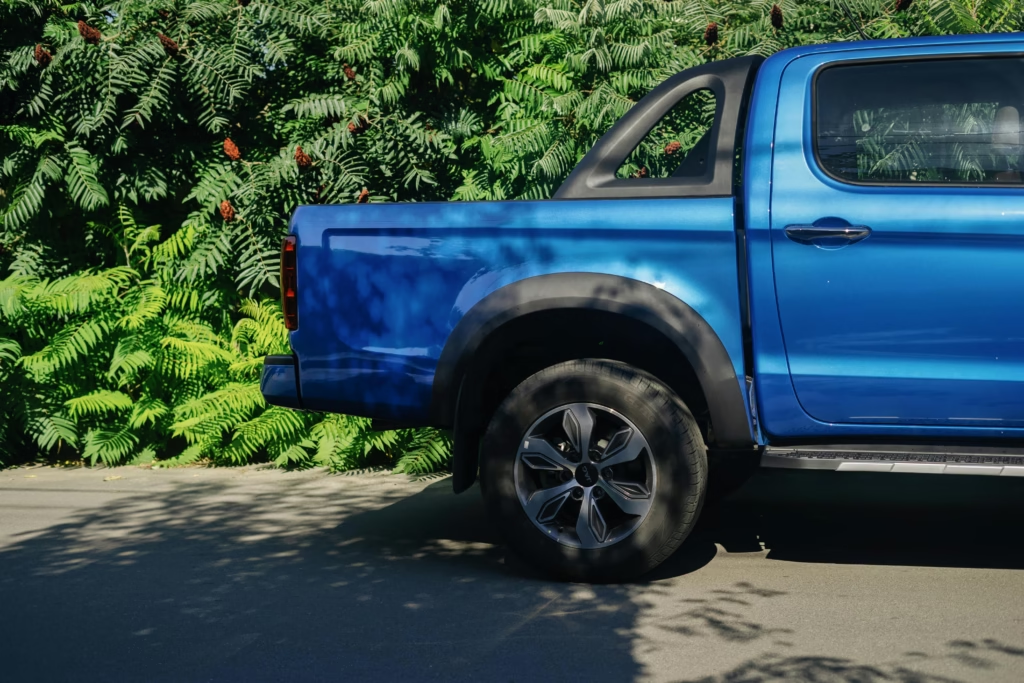
The Isuzu D-Max pickup, medium-duty trucks, buses, and transport vehicles have become deeply embedded in Kenya’s business ecosystem. Reports show that demand from transport, construction, and logistics sectors significantly boosted Isuzu’s growth.
However, this dependence also exposes a painful truth about Kenya’s economy. The ordinary Kenyan consumer is largely absent from the new car market.
Most middle-class Kenyans simply cannot afford brand-new vehicles anymore. High inflation, heavy taxation, expensive financing, and the rising cost of living have pushed new cars far beyond the reach of average households. As a result, the new vehicle market has become dominated by institutional buyers and businesses rather than individual consumers.
That environment heavily benefits Isuzu because commercial buyers prioritize durability, service networks, spare parts availability, and resale value over luxury or innovation.
Kenya’s New Car Market Is Becoming Less Competitive
A 56% market share is not merely strong performance. It is a warning sign.
Healthy industries depend on competition because competition drives innovation, better pricing, customer service, and technological advancement. When one company controls more than half the market, competitors begin losing the scale needed to remain aggressive.
This is already becoming visible in Kenya.
Toyota still maintains a strong presence, particularly through CFAO Mobility Kenya, but the gap between Toyota and Isuzu continues to widen. Mitsubishi, Tata, Scania, Hyundai, and smaller brands remain far behind in overall sales volumes.
The danger here is not that Isuzu is succeeding. The danger is that competitors are failing to seriously challenge Isuzu’s dominance.
When competition weakens, consumers ultimately suffer. Pricing power becomes concentrated. Innovation slows. Product diversity shrinks. Smaller dealers struggle to survive. Financing options narrow because lenders prioritize dominant brands. Even servicing ecosystems become overly dependent on one manufacturer.
Kenya risks creating an automotive market where one company becomes “too entrenched to disrupt.”
That is not healthy for long-term industry growth.
The Collapse of Rivals Has Helped Isuzu Grow Even Faster
Another uncomfortable reality is that Isuzu’s rise has partly been fueled by the decline of competitors.
Several automotive players in Kenya have faced severe operational and financial challenges in recent years. CMC Motors, once one of the country’s biggest vehicle distributors, announced plans to wind down operations after struggling with economic pressures, rising operational costs, and weakening market conditions.
Other brands have struggled with shrinking consumer purchasing power, currency depreciation, and unstable import costs. Some manufacturers have reduced local operations, while others have failed to aggressively adapt to Kenya’s changing economic conditions.
Meanwhile, Isuzu continued strengthening its dealer network, after-sales service infrastructure, spare parts availability, and financing partnerships.
This matters enormously in Kenya because vehicle ownership is not just about buying a car. Reliability of maintenance and spare parts often determines whether businesses can continue operating profitably.
A transport company cannot afford extended downtime. A logistics fleet cannot wait weeks for imported spare parts. NGOs and government agencies prioritize reliability over aesthetics. In that environment, Isuzu’s practical advantages become extremely difficult to compete against.
Economic Conditions Have Also Strengthened Isuzu’s Position
Ironically, Kenya’s economic hardships have strengthened Isuzu instead of weakening it. Reports indicate that easing interest rates and improving access to financing in 2025 contributed to increased new vehicle sales.
But these benefits primarily favored businesses and institutional buyers rather than ordinary households. When financing conditions improve, commercial operators are usually the first to borrow money for fleet expansion. Transport companies upgrade trucks. Construction firms buy pickups. Government contractors replace aging vehicles.
This naturally channels growth toward commercial vehicle manufacturers like Isuzu. At the same time, passenger vehicle growth remains weak because many households are still struggling with economic pressure. The cost of food, housing, fuel, school fees, electricity, and taxes continues squeezing disposable income.
For many Kenyans, buying a new private vehicle has become unrealistic. The used-car import market remains far more attractive because imported second-hand vehicles are dramatically cheaper.
This imbalance creates a structural problem. Kenya’s new car market is expanding, but not in a broad-based way. Growth is concentrated in commercial segments dominated by one company.
Isuzu’s Dominance Is Both a Strength and a Risk for Kenya
There is no denying that Isuzu has earned much of its success. The company has invested heavily in local assembly, distribution, servicing infrastructure, and market adaptation. Kenya’s harsh driving conditions demand rugged vehicles, and Isuzu built products specifically suited for those realities.

Its dominance also supports local employment, supply chains, tax revenues, and industrial activity. But excessive market concentration always carries risks.
If one company becomes overwhelmingly dominant, the broader industry becomes vulnerable to disruptions affecting that single player. Supply chain shocks, pricing changes, production slowdowns, or policy disputes could have outsized effects on the entire market.
Kenya also risks discouraging future investment from competing manufacturers if rivals believe the market has become too difficult to penetrate profitably.
That could slow technological progress, especially as the global automotive industry rapidly shifts toward electric vehicles, hybrid systems, connected mobility, and advanced safety technologies.
If Kenya’s market becomes too commercially concentrated around traditional utility vehicles, it may fall behind global automotive trends.
The Bigger Problem Is Kenya’s Weak Consumer Purchasing Power
The deeper issue here is not merely Isuzu’s success. It is the weakness of Kenya’s consumer economy. A truly healthy automotive industry would have strong participation from both commercial buyers and private households. Kenya currently lacks that balance.
New cars have become luxury products for most families. Even middle-income earners increasingly rely on imported second-hand vehicles because taxes, financing costs, and dealership prices make new vehicles inaccessible.
This is why Isuzu’s dominance should not simply be viewed as corporate brilliance. It should also be viewed as evidence of how narrow Kenya’s new car market has become.
The industry is increasingly dependent on a relatively small pool of institutional buyers, government contracts, fleet operators, and businesses.
That concentration creates vulnerability. If economic growth slows, infrastructure projects decline, or fleet financing tightens, the entire new vehicle market could face severe contraction.
What Happens Next for Kenya’s Automotive Industry?
The biggest question now is whether Kenya’s automotive industry can rebalance itself before market concentration becomes even more extreme.
Competitors must find ways to differentiate themselves instead of trying to fight Isuzu directly on its strongest battlefield. That could include electric mobility, affordable passenger vehicles, innovative financing models, or niche commercial solutions.
The government also faces difficult policy questions. Kenya has repeatedly spoken about strengthening local manufacturing and industrialization, but achieving that goal requires maintaining healthy competition.
A market overwhelmingly dominated by one player may discourage broader industrial diversification.
Consumers, meanwhile, should pay attention to what this dominance means long-term. While Isuzu’s reliability and commercial success are undeniable, no market benefits indefinitely from shrinking competition.
The real story behind Isuzu’s record 56% market share is not simply about one company winning. It is about the growing imbalance within Kenya’s automotive economy itself.
And unless that imbalance changes, Kenya’s new vehicle market may become increasingly less dynamic, less competitive, and ultimately less beneficial for consumers in the years ahead.
By the way, what do you think of this style of analysis-heavy writing? Is there anything about the tone, structure, or depth you’d want adjusted for future articles?
About The Author