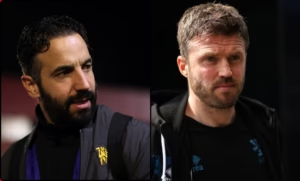
Brutal Truth: Michael Carrick’s Manchester United Deal Could Echo Club’s Biggest Post-Ferguson Failure
Michael Carrick has reportedly earned a permanent Manchester United contract after guiding the club back to the Champions League. Yet the biggest concern remains whether the club will finally support its manager with elite signings or repeat the same mistakes that ruined previous projects.
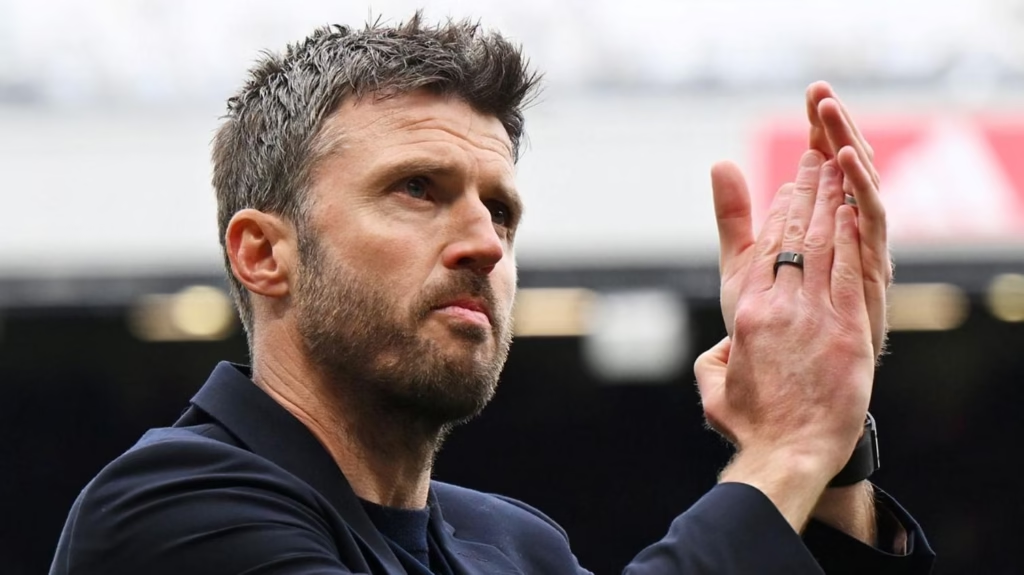
Manchester United are reportedly preparing to reward Michael Carrick with a permanent two-year contract, including the option of an additional season, after overseeing the club’s return to Champions League football. On paper, it sounds like a logical and emotionally satisfying decision. Carrick is a respected former player who understands the identity of the club, commands the respect of the dressing room, and has managed to restore competitiveness during a period where United looked directionless, tactically confused, and psychologically fragile.
But beneath the excitement surrounding Carrick’s rise lies a far more uncomfortable question that Manchester United supporters know all too well: can this club actually sustain a football project anymore?
That question matters more than the appointment itself because the post-Sir Alex Ferguson era has repeatedly shown that managerial talent alone is not enough to rescue Manchester United from structural dysfunction. The club has spent over a decade changing coaches, rebuilding squads, abandoning projects midway, and restarting cycles that never truly reach completion. Every manager arrives with optimism, ideas, and promises of transformation, only to eventually encounter the same institutional problems, inconsistent recruitment, poor squad planning, commercial priorities interfering with football logic, and an ownership structure that often reacts too late rather than planning proactively.
This is why Carrick’s appointment cannot simply be analyzed emotionally. It must be examined strategically.
The central issue is not whether Carrick deserves the job. The real issue is whether Manchester United are finally prepared to build a modern football structure capable of supporting him long-term.
Michael Carrick Has Earned Respect Through Results, Not Nostalgia
One of the most important distinctions in this situation is that Carrick is not merely benefiting from sentimental attachment as a former player. That would be dangerous. Manchester United has made emotional decisions before, often confusing nostalgia with competence. However, Carrick’s case appears to be grounded in tangible improvement rather than romanticism.
Under his leadership, United became more organized without the ball, more disciplined in midfield transitions, and more composed in possession during high-pressure moments. Perhaps most importantly, players who previously looked disconnected and uncertain suddenly began performing with clarity and confidence again. That kind of turnaround does not happen accidentally at elite-level football. It usually indicates that the manager has simplified responsibilities, restored belief inside the dressing room, and created a tactical environment where players understand exactly what is expected of them.
There is also another factor that should not be underestimated: Carrick appears to understand the emotional weight of Manchester United better than many external appointees. He knows the expectations surrounding the club. He understands the scrutiny. He understands how quickly pressure escalates after poor results. Most importantly, he understands what supporters actually want to see from the team beyond trophies: intensity, courage, attacking intent, and personality.
Yet despite these positives, Carrick’s success so far has also created a dangerous illusion that Manchester United may already be closer to competing at the highest level than they actually are.
That illusion could become catastrophic if the club misreads what Champions League qualification truly means.
Champions League Qualification Does Not Mean The Squad Is Complete
One of the biggest mistakes elite clubs make after overachieving seasons is assuming the squad requires only minor adjustments. That thinking destroys momentum because qualification for the Champions League often hides structural weaknesses that become brutally exposed once fixture intensity increases.
Manchester United may currently be benefiting from emotional momentum, tactical clarity, and improved confidence under Carrick. However, sustaining success across a full Premier League campaign while simultaneously competing in Europe requires far more than short-term stability. It requires elite squad depth, physical durability, tactical flexibility, and recruitment precision.
This is where serious concerns begin to emerge.
When analyzing the current Manchester United squad objectively, several unresolved issues remain obvious. The midfield still lacks consistent athletic dominance against elite opponents. Defensive transitions remain vulnerable against fast counterattacking sides. The attack still depends too heavily on individual moments rather than fully developed automatisms. Squad depth in several positions remains questionable, especially considering the physical demands of modern football.
These are not small details. They are the exact flaws that repeatedly separate teams capable of qualifying for the Champions League from teams capable of genuinely competing inside it.
And that distinction matters enormously because expectations will immediately change next season.
Once Manchester United return to Europe’s biggest competition, supporters will not simply demand participation. They will expect progression, consistency, and evidence that the club is moving toward genuine elite status again. That pressure will intensify every tactical weakness, every squad limitation, and every failed recruitment decision.
This is why Carrick’s appointment alone changes nothing unless it is accompanied by aggressive structural improvement.
Manchester United’s Real Crisis Has Been Recruitment, Not Managers
For years, Manchester United have operated as though replacing the manager automatically resets deeper football problems. In reality, the club’s greatest weakness has consistently been recruitment strategy and squad construction.
The evidence is impossible to ignore.
Different managers arrived with completely different football philosophies, yet the squad often remained a chaotic mixture of incompatible player profiles signed for previous systems. One manager wanted possession dominance. Another wanted pressing intensity. Another prioritized counterattack transitions. Instead of building a coherent long-term football identity, United repeatedly accumulated expensive players without establishing structural continuity.
That lack of continuity has been devastating.
Managers inherit squads partially designed for football they do not even want to play. Recruitment departments react to short-term pressure instead of following long-term planning. The result is constant tactical compromise. Instead of building teams specifically suited to a clear vision, United frequently attempt to force mismatched profiles into systems that expose weaknesses rather than maximizing strengths.
This is why many previous managerial projects collapsed after promising starts. The issue was rarely just coaching quality. The issue was that the football structure above the manager lacked clarity, patience, and consistency.
If Manchester United repeat that mistake with Carrick, then his current momentum may disappear faster than supporters expect.
INEOS Must Prove They Are Different From Previous Leadership
The coming transfer window will likely become the first true test of the new football leadership under INEOS. Public statements about modernization and long-term planning sound encouraging, but supporters will ultimately judge the project through actions rather than messaging.
Backing Carrick properly requires far more than signing famous names.
It requires recruitment discipline.
Manchester United must stop operating like a club obsessed with marketable solutions instead of football solutions. Too often in recent years, transfers appeared reactive, emotionally driven, or commercially influenced. Elite clubs do not build sustainably that way anymore. The best modern football institutions identify profiles years in advance, understand how every signing fits tactical structure, and prioritize system compatibility over reputation.
Carrick’s success depends heavily on whether United finally embraces that approach.
If he wants higher pressing intensity, the club must recruit players physically capable of sustaining it. If he wants quicker ball progression, midfield profiles must reflect that demand. If defensive transitions remain a weakness, athletic recovery speed becomes essential during recruitment.
These decisions sound obvious, but Manchester United has repeatedly failed to align transfer strategy with tactical identity. That disconnect is one of the biggest reasons the club continues to fluctuate between short-term recovery and long-term instability.
The danger now is that Champions League qualification could tempt the hierarchy into believing the rebuild is ahead of schedule. That would be a major mistake.
In reality, qualification should be viewed as the beginning of the rebuild rather than proof of completion.
Carrick Could Become the Next Victim of Structural Failure
The harshest reality surrounding this appointment is that Manchester United supporters have seen this story before.
Managers arrive and initially improve morale. Results stabilize. Fans reconnect emotionally with the team. Optimism returns. Then structural weaknesses gradually resurface once expectations rise and squad limitations become harder to hide.
At that point, pressure shifts entirely toward the manager.
Recruitment mistakes become tactical criticisms. Squad imbalance becomes “poor coaching.” Institutional instability becomes individual blame. Eventually, the manager absorbs the frustration generated by failures that were often created far above them.
That cycle has repeated so consistently at Manchester United that supporters now instinctively fear it happening again.
And honestly, those fears are justified.
Because if Carrick enters next season without major reinforcement in key positions, he may eventually face impossible expectations. Competing domestically while handling Champions League football demands enormous squad quality. Injuries become inevitable. Fatigue increases. Opponents adapt tactically. Momentum alone stops being enough.
At that point, structural depth matters more than emotional energy.
This is why the next few months could define whether Carrick’s appointment becomes the start of a genuine revival or merely another temporary phase before another reset.
Manchester United Risk Turning Michael Carrick Into Another Sacrificial Project
Michael Carrick may genuinely possess the intelligence, composure, and tactical understanding required to succeed as Manchester United manager. His early work suggests he can improve organization, restore dressing-room confidence, and reconnect the team with supporters emotionally. Those achievements should not be minimized.
However, modern elite football is no longer won through managerial charisma alone. Sustainable success now depends on institutional competence, recruitment efficiency, squad planning, and structural alignment between ownership, executives, analysts, and coaching staff.
That is where Manchester United still faces enormous questions.
If INEOS truly wants Carrick to succeed, they cannot repeat the cautious half-measures that undermined previous managers. They must build aggressively, intelligently, and decisively around a clearly defined football identity. Anything less risks dragging the club back into the same destructive cycle that has defined the post-Ferguson era.
The most dangerous thing Manchester United could do now is mistake progress for completion.
Because securing Champions League football is not proof that the rebuild is finished.
It is proof that the real pressure is only beginning.
About The Author