Bold Yet Painful: Understanding the 5% Mitumba Import Tax in Kenya
The proposed 5% mitumba import tax is a bold yet controversial move by the Kenyan government, with far-reaching consequences for traders, consumers, and the broader economy.
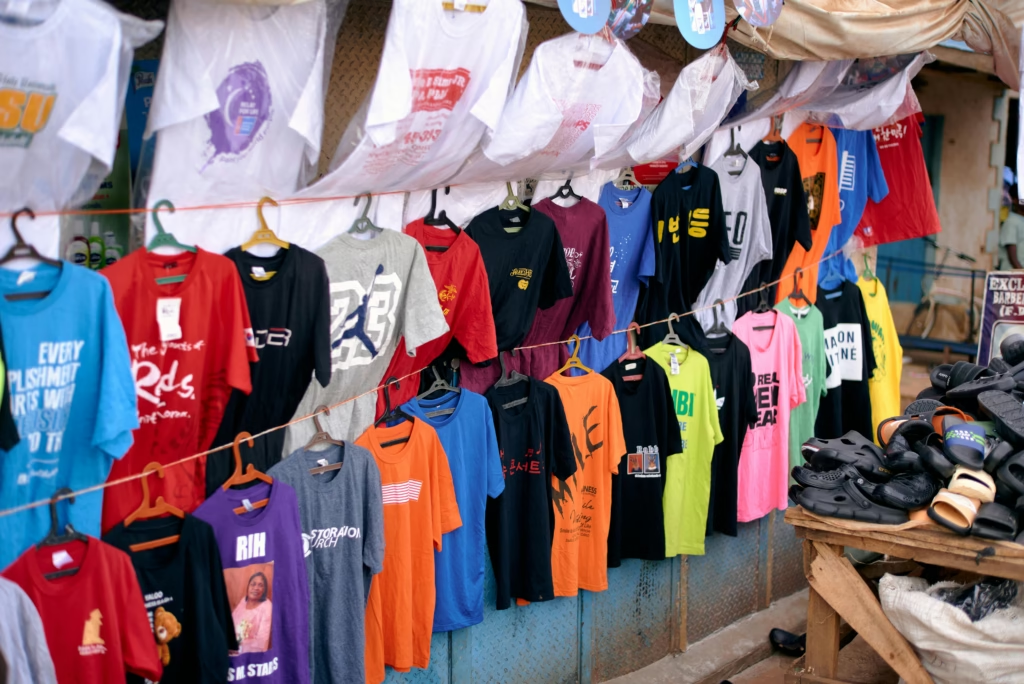
The proposal to introduce a 5% mitumba import tax under the Finance Bill 2026 will be one of the most contentious fiscal measures in Kenya’s recent economic history. At first glance, the policy appears to be a technical adjustment, simply treating 5% of the customs value of imported second-hand clothes as taxable income. But beneath this seemingly modest figure lies a far-reaching restructuring of how one of Kenya’s most critical informal sectors is taxed, regulated, and ultimately reshaped.
The mitumba industry is not a marginal economic activity. It is a lifeline for millions of Kenyans, traders, transporters, retailers, and consumers alike. Any disruption to this ecosystem sends ripples across employment, household consumption, and even social stability. The proposed tax, therefore, is not just a fiscal tool; it is a structural intervention with deep economic and political consequences.
Why the Government Is Proposing the 5% Mitumba Import Tax
The rationale behind the 5% mitumba import tax Kenya proposal is rooted in the government’s urgent need to expand its revenue base. Kenya has been grappling with rising public debt, fiscal deficits, and mounting pressure from international lenders to increase domestic revenue collection. The Finance Bill 2026 reflects this urgency by targeting sectors that have historically operated with limited tax oversight.
One of the key motivations is the formalization of the informal sector. The mitumba trade, despite its size, has largely remained outside structured taxation frameworks. By introducing a presumptive tax collected at the point of importation, the government aims to capture revenue efficiently without relying on complex compliance systems. The tax is designed as a final charge, meaning importers pay upfront and are not required to file additional income tax returns for those goods.
Another justification lies in the desire to create a more balanced competitive environment between imported second-hand clothes and locally manufactured textiles. The influx of cheap mitumba has long been blamed for the decline of Kenya’s textile industry. By increasing the cost of imports, policymakers hope to make locally produced garments more competitive.
Additionally, the government seeks to curb tax evasion. The new structure addresses a common issue where traders declare minimal or no profits despite handling large volumes of goods. By pegging taxable income at 5% of the customs value, the state ensures a predictable and enforceable tax base.
Yet, while these objectives may appear economically sound on paper, they overlook the complex realities of the mitumba ecosystem.
The Structure of the Finance Bill 2026 Mitumba Tax
Under the Finance Bill 2026 mitumba tax framework, the government introduces a “deemed profit” model. Instead of calculating actual profits, it assumes that 5% of the customs value of imported goods represents profit. This amount is then subjected to income tax, payable immediately upon importation before the goods are released into the market.
This approach simplifies tax administration but shifts significant financial pressure onto importers. Unlike traditional tax systems that consider actual earnings, this model imposes a fixed burden regardless of market conditions, demand fluctuations, or operational costs.
The tax also represents a shift from previous mechanisms. Historically, mitumba imports were already subject to duties such as a 35% customs value levy or a fixed rate per kilogram, whichever is higher. The new tax does not necessarily replace these costs but adds another layer, intensifying the cumulative tax burden.
The Economic Weight of the Mitumba Industry
To fully understand the impact of the proposed tax, one must appreciate the scale of the Kenya second-hand clothing industry. Studies show that over 90% of Kenyan households rely on mitumba for affordable clothing, with annual spending running into hundreds of billions of shillings.
Employment is equally significant. Hundreds of thousands of jobs, ranging from importers and wholesalers to market vendors and casual laborers, depend directly on trade. In major markets such as Gikomba, tens of thousands of traders operate daily, forming one of the largest informal economic clusters in the country.
This widespread dependence means that any increase in costs at the import level inevitably cascades down to the entire value chain.
The Dire Consequences of the 5% Mitumba Import Tax
The impact of mitumba tax is likely to be profound and, in many cases, destabilizing.
The most immediate effect will be an increase in prices. Importers, facing higher upfront costs, will pass these expenses down to wholesalers and retailers, who in turn will transfer them to consumers. For a population already grappling with a high cost of living, even small price increases will significantly reduce purchasing power.
Beyond pricing, the tax threatens the survival of small-scale traders. Many mitumba businesses operate on thin margins, relying on quick turnover rather than high profits. The requirement to pay tax upfront, before goods are even sold, creates cash flow constraints that could push many traders out of business.
There is also a risk of reduced imports. Higher costs may discourage importers from bringing in large consignments, leading to supply shortages. This, paradoxically, could drive prices even higher and create opportunities for illegal or unregulated trade.
Employment losses are another major concern. If traders scale down operations or exit the market altogether, the ripple effect on jobs will be immediate. Casual workers, who depend on daily wages in markets and logistics chains, are particularly vulnerable.
The broader economy will not be spared. Reduced activity in the mitumba sector translates to lower economic circulation, affecting everything from transport services to small-scale food vendors who rely on market traffic.
How Increased Taxation Is Frustrating Business Owners
The taxation on mitumba traders reflects a broader pattern of fiscal pressure that many Kenyan entrepreneurs are increasingly struggling to cope with. Business owners are not just facing one tax; they are navigating a complex web of levies, duties, and compliance requirements.
For mitumba traders, the frustration is amplified by the perception that the government is targeting a sector that already operates under significant constraints. Currency fluctuations, particularly the weakening of the Kenyan shilling against the US dollar, have already increased the cost of imports. Adding another tax layer compounds these challenges.
Moreover, the shift to upfront taxation disrupts traditional business models. Traders who previously relied on selling goods before settling tax obligations must now secure additional capital to cover import costs. For many small-scale operators, this is simply not feasible.
The psychological impact cannot be ignored. Persistent tax increases create an environment of uncertainty, discouraging investment and long-term planning. Entrepreneurs become more focused on survival than growth, limiting innovation and economic expansion.
Impact on Consumers and the General Population
The consequences of the 5% mitumba import tax proposal extend far beyond traders. For ordinary Kenyans, mitumba is not a luxury; it is a necessity. The affordability of second-hand clothing allows households to allocate limited income to other essential needs such as food, education, and healthcare.
As prices rise, consumers will be forced to make difficult trade-offs. Some may reduce clothing purchases altogether, while others may turn to lower-quality alternatives. The social implications are significant, particularly for low-income households that rely heavily on affordable clothing options.
There is also a cultural dimension. Mitumba markets are not just economic spaces; they are social hubs that support community interactions and livelihoods. Disrupting these ecosystems has intangible costs that are often overlooked in policy discussions.
Short-Term and Long-Term Economic Effects
In the short term, the introduction of the tax is likely to generate additional revenue for the government. However, this gain may be offset by reduced economic activity within the sector. Lower import volumes, declining sales, and business closures could ultimately shrink the tax base.

Inflationary pressures are another immediate concern. As the cost of clothing rises, it contributes to the overall increase in the cost of living, further straining households.
In the long term, the policy could have mixed outcomes. If successful, it may encourage the growth of local textile industries by reducing competition from imports. However, this assumes that domestic production can scale up efficiently and offer competitive pricing, an outcome that is far from guaranteed.
There is also the risk of unintended consequences, such as the expansion of informal or illegal trade networks. When formal systems become too costly, economic activity often shifts underground, undermining both regulation and revenue collection.
What Investors and Business Owners Should Do
For investors and business owners in the mitumba sector, the proposed tax signals the need for strategic adaptation. The first priority should be financial resilience. Businesses must reassess their cost structures, ensuring they can absorb or mitigate the impact of higher taxes without compromising operations.
Diversification is another critical strategy. Traders who rely solely on mitumba imports may need to explore complementary business lines, such as local clothing production or value-added services like customization and branding.
Efficiency will become increasingly important. Streamlining supply chains, reducing waste, and optimizing inventory management can help offset rising costs.
Collaboration is equally vital. Industry players will benefit from forming associations or cooperatives to advocate for favorable policies, share resources, and strengthen bargaining power.
Finally, there is a need for long-term thinking. While the current policy environment is challenging, it also presents opportunities for innovation. Entrepreneurs who can adapt to changing conditions, whether through technology, new business models, or market diversification, will be better positioned to survive and thrive.
A Defining Moment for Kenya’s Informal Economy
The 5% mitumba import tax proposal is more than a fiscal measure; it is a test of the country’s economic priorities and policy coherence. It highlights the tension between revenue generation and economic inclusivity, between formalization and survival.
The government’s objectives, expanding the tax base, supporting local industries, and improving compliance, are legitimate and necessary. On the contrary, the implementation of these objectives must account for the realities of a sector that sustains millions of livelihoods.
The danger lies in pursuing short-term revenue gains at the expense of long-term economic stability. If the mitumba industry is weakened without viable alternatives for traders and consumers, the social and economic costs could outweigh the benefits.
Ultimately, the success of this policy will depend on balance. A balanced approach would involve not just taxation, but also support for local manufacturing, access to financing for small businesses, and policies that protect the most vulnerable populations.
The debate over the impact of mitumba tax is therefore not just about numbers; it is about people, livelihoods, and the future direction of Kenya’s economy.
About The Author