Stunning Surge: SBM Bank Kenya Profits Jump 88.2% to KSh 380.2 Million in H1 2026
SBM Bank Kenya profits leapt 88.2% to KSh 380.2 million in H1 2026, powered by deposit growth, cleaner asset quality, and non-interest income. This deep analysis cuts through the headlines to examine sustainability, remaining risks, and the bank’s place in Kenya’s competitive banking landscape.
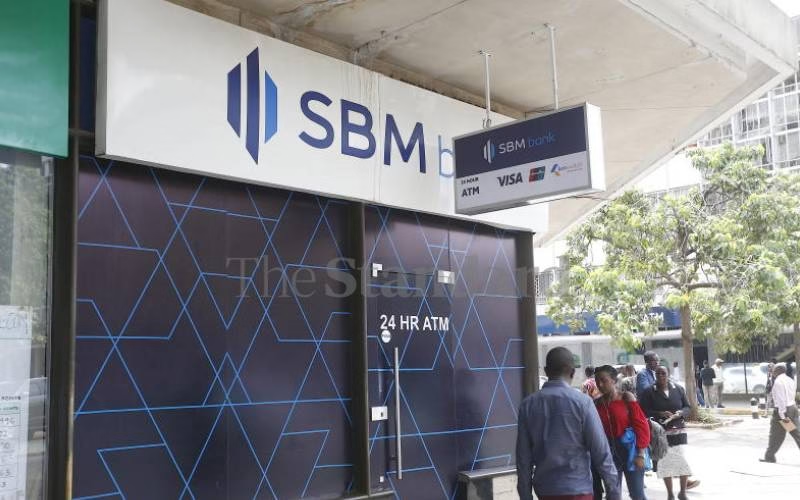
SBM Bank Kenya reported an 88.2% jump in half-year net profit to KSh 380.2 million for the six months ended 30 June 2026. Profit before tax rose even more sharply, climbing 171% to KSh 548 million, while operating profit nearly quadrupled to KSh 852 million. The announcement hit with the quiet force of a bank that has clawed its way out of inherited trouble for years. These are not cosmetic improvements.
They reflect measurable progress in a mid-tier institution that once carried the heavy scars of the Chase Bank acquisition and years of elevated non-performing loans. Yet the numbers also invite hard questions about durability, absolute scale relative to Kenya’s dominant lenders, and whether the current rate environment and provisioning discipline can sustain the momentum into the second half of the year and beyond.
What follows is a detailed examination of the results, the operational shifts that produced them, the structural constraints that still bind the bank, and the realistic outlook for customers, depositors, and the broader market.
Unpacking the SBM Bank Kenya Half-Year Results
The headline profit after tax of KSh 380.2 million compares with KSh 202 million in the corresponding period of 2025. That 88.2% increase sits atop a broader expansion in operating performance. Total operating income grew approximately 35%, while operating expenses rose only 12%. The resulting operating leverage is genuine rather than accounting artifice. Net interest income advanced 18.5% to KSh 2.18 billion. Non-interest income climbed 43.7% to KSh 1.40 billion. These two streams together explain the bulk of the earnings lift.
Interest expenses paid to depositors fell from roughly KSh 3.5 billion to KSh 3.2 billion, a direct benefit of the declining Central Bank Rate environment. The CBR has moved lower from levels above 10% in earlier periods toward 8.75% territory, reducing the cost of funds even as the bank expanded its deposit base. Loan interest income itself was relatively flat to slightly lower, reflecting the same rate compression that cut deposit costs. The net result was still a healthy expansion in the interest margin contribution.
Non-interest income growth proved more robust. Transaction volumes, fees, and digital activity expanded meaningfully. Management pointed to higher customer activity across payments channels, supported by free PesaLink transfers up to KSh 1 million on the Mfukoni platforms, enhanced Mastercard capabilities, the Busara Kids Banking App, and the SBM Loyalty Programme.
These are not isolated product launches; they form part of a deliberate shift toward a payments-led model that generates fee income less dependent on pure lending spreads. In a market where interest margins face secular pressure, the ability to grow non-interest revenue faster than the loan book is a strategic necessity rather than a temporary windfall.
Loan loss provisions rose 69.3%, a notable increase that the bank absorbed while still delivering sharp profit growth. The higher charge reflects continued caution on residual problem assets even as the overall book quality improved. This willingness to provision more aggressively while reporting higher earnings is one of the more credible signals in the results. It suggests management is not simply growing around problems or releasing prior provisions to manufacture profit.
SBM Bank Kenya Customer Deposits as the Clearest Vote of Confidence
Customer deposits grew 23.5% year-on-year to KSh 94.03 billion. Over a two-year horizon the expansion approaches 66%. For a bank that only recently emerged from multi-year losses, this deposit trajectory is the single most important external validation of the turnaround.
Depositors do not move money on the basis of press releases; they respond to perceived safety, service reliability, and competitive pricing. The fact that SBM has consistently attracted sticky retail and business balances while cleaning its balance sheet indicates that the brand is recovering trust faster than many observers expected.
Net loans and advances rose 18.3% to KSh 54.09 billion. The growth was described as broad-based across households and businesses. Total assets expanded more modestly, by about 4% to KSh 109.88 billion, reflecting a measured approach rather than aggressive balance-sheet inflation. Shareholders’ equity strengthened to approximately KSh 11.1 billion, and both capital and liquidity ratios remained comfortably above Central Bank of Kenya minima.
The deposit growth also lowers the bank’s overall cost of funds over time and provides a more stable funding base for future lending. In Kenya’s banking system, where wholesale funding can be expensive and flighty, a retail-heavy deposit franchise is a durable competitive advantage. SBM’s progress on this front is therefore more significant than the absolute size of its loan book.
Sharp Progress on the SBM Bank Kenya NPL Ratio
Perhaps the most striking single metric is the improvement in asset quality. Gross non-performing loans fell 42.4% to KSh 9.69 billion. The gross NPL ratio nearly halved, declining from 32.4% a year earlier to 17.3%. This is not a statistical illusion created by rapid loan growth diluting the ratio. Absolute problem loans declined substantially while the performing book expanded.
A 17.3% NPL ratio remains elevated by the standards of Kenya’s strongest banks and still sits above the broader system average, which has hovered in the mid-teens in recent periods. The improvement, however, is material and directionally correct. It reflects deliberate credit discipline, recoveries, write-offs, and tighter underwriting under the leadership of Chief Executive Officer Bhartesh Shah, who assumed the role in May 2024.
The bank is no longer simply managing a legacy of poor assets inherited from the 2018 acquisition of Chase Bank’s carved-out business; it is actively shrinking the problem.
The residual NPL stock still requires careful monitoring. Concentrations in particular sectors or residual legal recoveries from the Chase era could produce volatility. Higher provisioning in the current period provides a buffer, yet any sharp economic slowdown or rise in interest rates could reverse some of the gains. Asset quality remains the single largest risk factor that could interrupt the profit trajectory.
SBM Bank Kenya Non-Interest Income and the Quest for Operating Leverage
The 43.7% rise in non-interest income to KSh 1.40 billion is central to the quality of the earnings story. Fee and transaction revenue is generally more stable and less capital-intensive than pure interest income. By expanding digital channels and making certain transfers free, SBM is trading short-term fee sacrifice for higher volume and stickier customer relationships. Management has also invested in core technology, becoming the first bank globally to go live on Oracle FLEXCUBE version 14.8. Such upgrades are expensive and operationally risky, yet they are prerequisites for competing with larger digital-native or digitally aggressive peers.
Operating expenses rose only 12% against 35% income growth. This positive operating leverage is the mathematical engine behind the near-quadrupling of operating profit. It demonstrates that the bank is beginning to scale revenue without a proportional increase in the cost base. For a mid-tier institution still investing in systems, branches, and talent, maintaining this discipline will be critical. Cost inflation in Kenya’s banking sector—salaries, technology, compliance, and security—rarely pauses. The current gap between income and expense growth cannot be taken for granted.
The Longer Arc of Recovery and Remaining Structural Constraints
SBM Bank Kenya’s journey cannot be understood without reference to its origins. In 2018 the Mauritian parent, SBM Holdings, acquired the majority of assets and liabilities of Chase Bank, which had been under receivership since 2016. The deal also involved elements of Fidelity Commercial Bank. The inheritance brought branches, customers, and staff, but also a toxic loan book, operational complexity, and years of losses. By 2024 the bank was still reporting heavy deficits. The appointment of Bhartesh Shah and the subsequent focus on credit discipline, digital payments, and deposit mobilisation marked the inflection point.
The H1 2026 results represent the strongest consecutive profitability streak in recent memory—six profitable quarters after a full year of losses in 2024. Absolute profit of KSh 380 million after tax remains modest when set against the multi-billion-shilling earnings of Equity, KCB, Co-operative Bank, or Absa. SBM is still a mid-tier player with roughly KSh 110 billion in assets. Market share gains will be incremental and hard-won against institutions that enjoy superior scale, brand recognition, and distribution.
Rate sensitivity cuts both ways. Lower funding costs have supported the current results, yet further declines in the CBR could compress asset yields faster than liability costs if the bank cannot maintain pricing power. Conversely, any reversal toward tighter monetary policy would raise deposit costs and potentially pressure asset quality. The bank’s relatively high remaining NPL ratio leaves less room for error than cleaner peers.
Capital adequacy is currently comfortable, but continued loan growth and any unexpected credit losses would require careful management or further support from the parent. The new higher minimum capital requirements being phased in across the sector will continue to pressure smaller and mid-tier banks, potentially accelerating consolidation. SBM’s improving trajectory improves its strategic options, whether organic growth or partnership, but does not eliminate the structural disadvantage of scale.
Critical Questions the Numbers Do Not Fully Answer
Is the profit growth sustainable at this pace? The combination of deposit expansion, NPL reduction, and fee income growth is powerful, yet the 88% jump partly reflects a low base. Maintaining double-digit profit growth from a higher platform will demand continued volume expansion and further efficiency gains.
How much of the improvement is cyclical versus structural? Falling interest rates helped net interest income. A durable payments franchise and cleaner underwriting are structural. Distinguishing the two will become clearer only in a different-rate environment.
What does this mean for customers and the market? Stronger profitability and capital support greater capacity to lend and invest in service. Free transfers and digital tools already benefit users. Yet competition remains intense, and customers will ultimately judge the bank on reliability, pricing, and problem resolution rather than reported earnings.
For investors and the parent, the results validate the two-year rebuild. They also highlight that SBM Kenya is still a recovery story rather than a mature growth franchise. Absolute returns on equity and assets, while improving, have further distance to travel before matching the sector leaders.
The H1 2026 performance of SBM Bank Kenya is real, hard-earned, and directionally encouraging. The bank has reduced its NPL burden, attracted deposits at scale, expanded non-interest revenue, and generated genuine operating leverage. These are the ingredients of a credible turnaround. At the same time, the residual asset-quality overhang, modest absolute size, and exposure to Kenya’s interest-rate and credit cycles mean the work is incomplete. The next two reporting periods will reveal whether the current momentum can be converted into a sustained, higher-quality earnings trajectory or whether the bank will face the familiar mid-tier constraints of scale and residual risk. For now, the numbers justify cautious optimism grounded in measurable progress rather than narrative alone.
About The Author